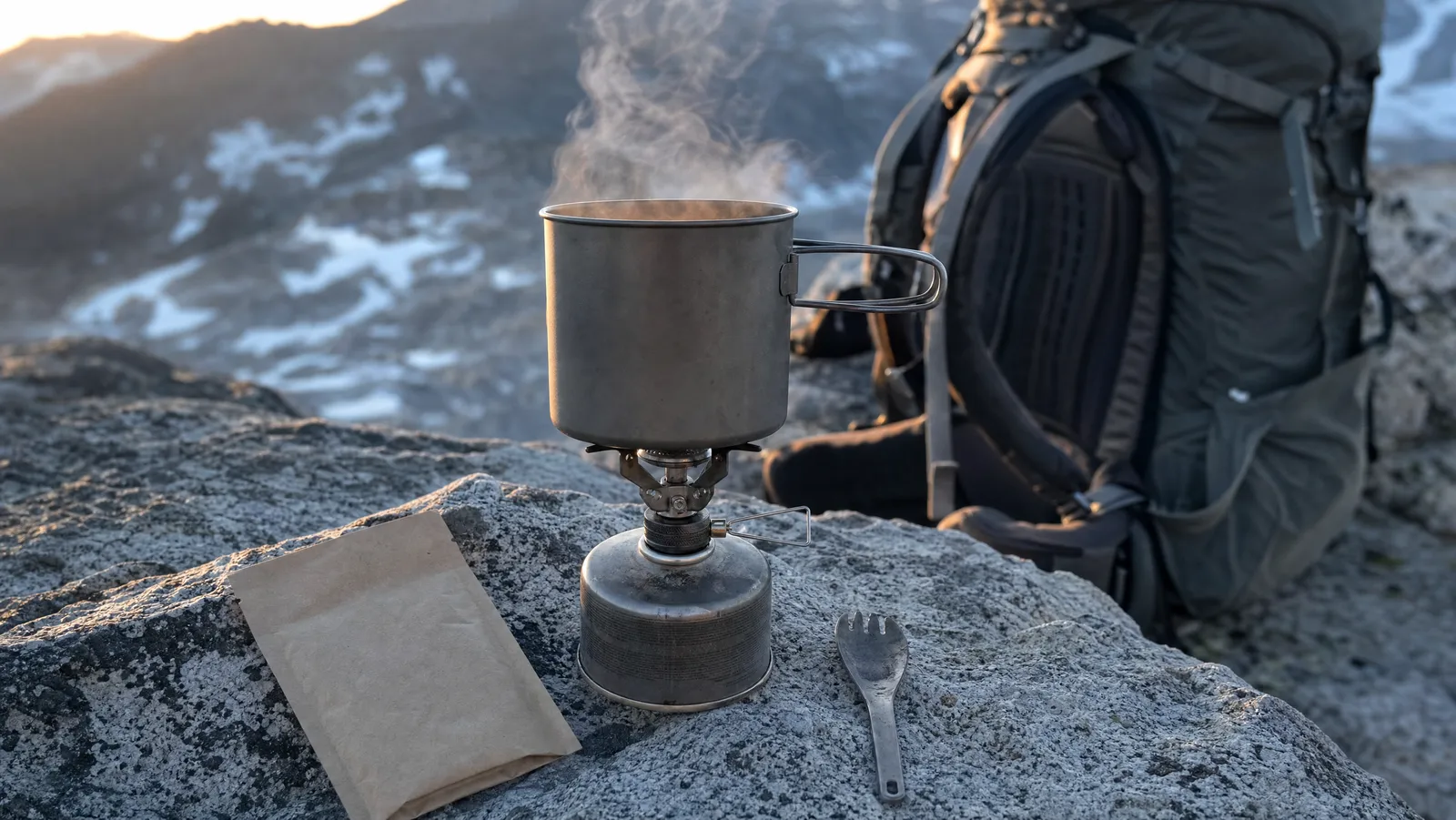
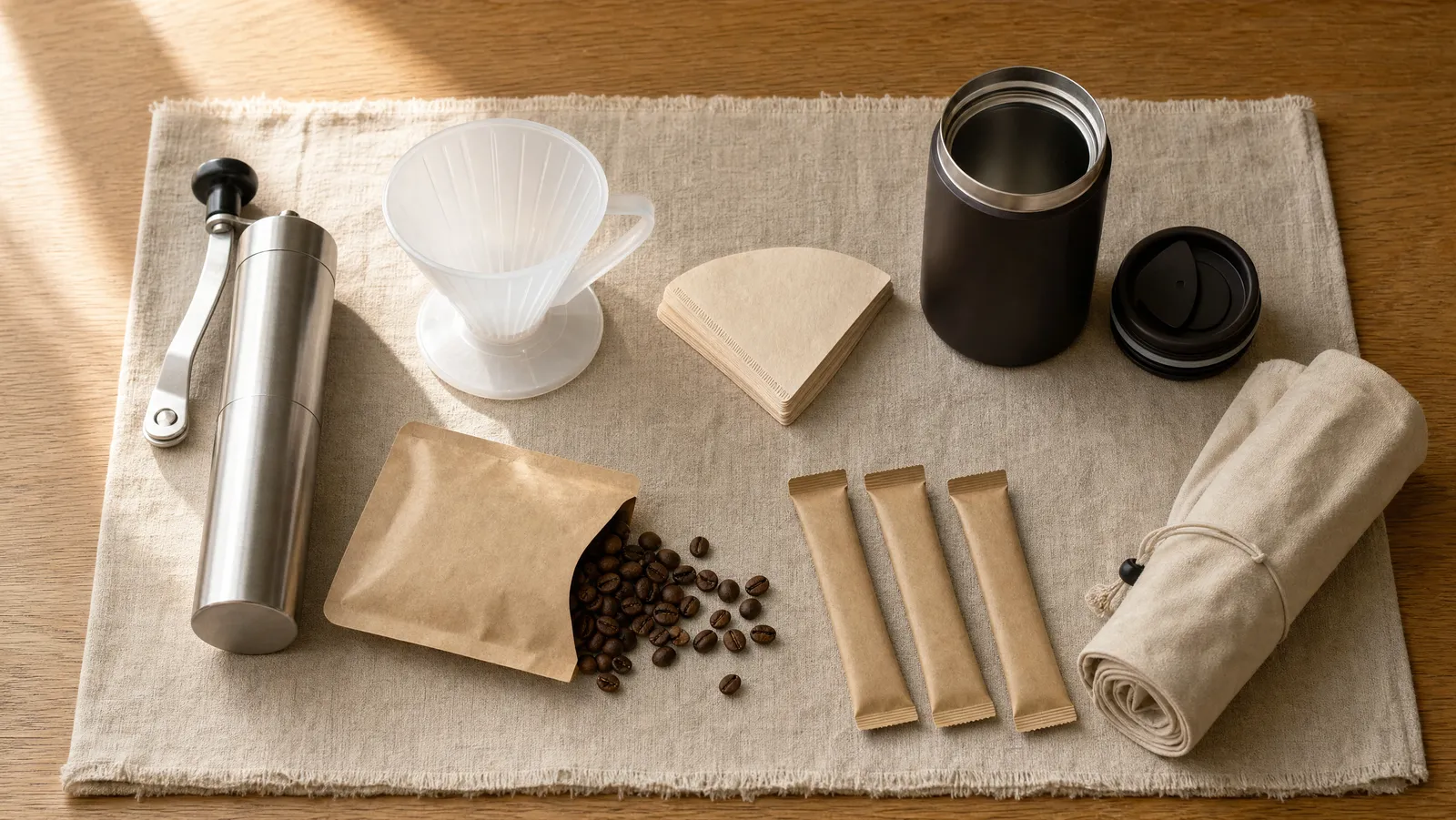
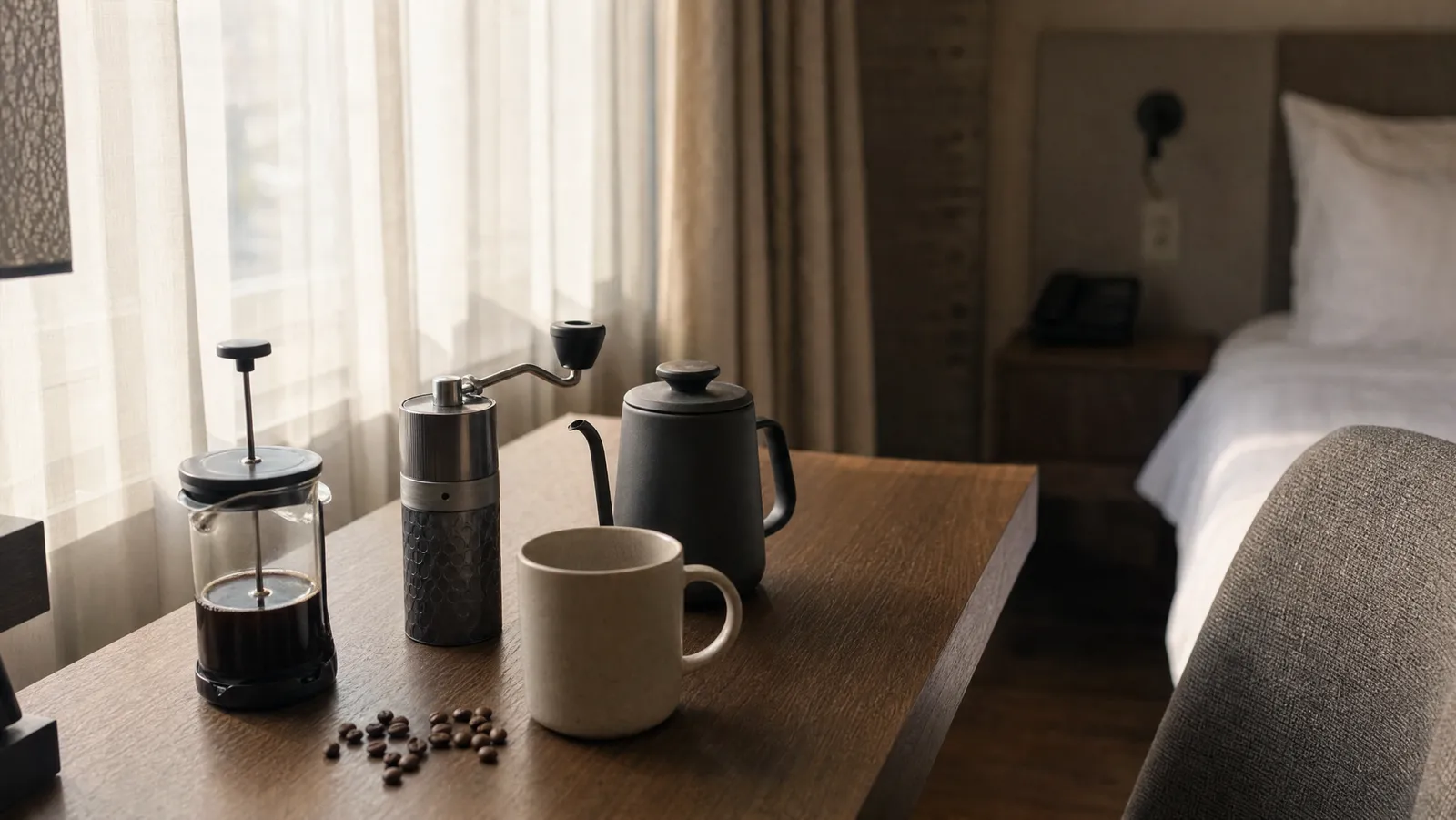
Camping and Travel Coffee: The Complete Guide
 Tommie Chaney··Updated
Affiliate disclosure: Sweeter Grind is a participant in the Amazon Services LLC Associates Program. We may earn commissions on qualifying purchases at no extra cost to you.
Camping coffee is the one place careful people cheerfully accept bad coffee. The same person who weighs their dose to a tenth of a gram at home will happily boil grounds in a dented pot at 6 a.m. and call it charming.
It doesn't have to be that way, and the fix costs almost nothing. Good camping coffee comes down to three variables — grind, water temperature, and cleanup — and all three have simple field answers. Nothing in this guide requires electricity, a scale, or a gooseneck kettle.
This is the hub for our camping and travel coffee series. Below: the methods compared side by side, what changes when you brew at 8,000 feet, which brewers survive a pack, how to grind without a countertop, when instant genuinely wins, and how to build a kit you'll actually carry. If you're new to brewing generally, start with the Complete Guide to Coffee Brewing Methods — this guide assumes you know roughly what immersion and percolation mean and focuses on what changes outdoors.
Why Camping Coffee Goes Wrong
Three things break outdoors, and they break in a predictable order.
Water temperature is the first. Home brewing targets a narrow band. According to the Specialty Coffee Association's Golden Cup standard, brew water should contact the grounds at roughly 195–205°F (93°C, plus or minus 3°C). At camp, most people have exactly two temperatures available: "boiling" and "whatever it cooled to." Boiling water dumped straight onto grounds runs hot and pulls harsh, bitter compounds; water that sat in a mug for four minutes in cold air runs sour and thin.
Altitude quietly moves the target. Water boils cooler as you climb, so "boiling" at elevation isn't the same water you brew with at home. According to the USDA's Food Safety and Inspection Service, water boils at 203°F at 5,000 feet and 194°F at 10,000 feet, and the boiling point drops by just under 1°F for every 500-foot gain in elevation. That's genuinely useful news: at a typical Rocky Mountain campsite, boiling water is already sitting close to the top of the Golden Cup range instead of 7 degrees above it. Above roughly 9,000 feet, though, your boiling water is at or below the bottom of that range, and under-extraction becomes the risk. Pour straight off the boil, don't let it rest, and grind a notch finer or steep a little longer to compensate.
Grind is the second failure. Pre-ground supermarket coffee is ground for automatic drip, which is the wrong size for nearly every camp method. Percolators and camp presses want coarse. Portable espresso wants very fine. Using drip-grind for both is why so much camp coffee tastes simultaneously muddy and weak.
Cleanup is the third, and it's the one that quietly decides what you actually use. A brewer that requires a sink and a scrub brush gets left in the car. A brewer whose spent puck ejects in one motion gets used every morning.
Everything below is organized around those three. Our Ultimate Coffee Equipment Guide 2026 covers the home versions of this gear; the outdoor versions trade precision for durability, and outdoors that trade is worth making.
The Methods, Compared
There are, broadly, the seven ways to make coffee while camping — plus portable espresso as a specialist branch we'll treat separately. Here's the honest comparison before we go deeper on each.
| Method | Packability | Cleanup | Cup quality ceiling | Best for |
|---|---|---|---|---|
| Instant | Pocketable | None | Good, and rising fast | Backpacking, emergencies, groups |
| Steeped coffee bags | Pocketable | Pack out one bag | Modest but clean | Ultralight, hotel rooms |
| Cowboy coffee | No gear at all | Grounds in the pot | Low but drinkable | Minimalists, one pot per group |
| Percolator | Bulky, indestructible | Rinse basket and pot | Moderate | Car camping, groups, campfire |
| French press / camp press | Bulky to medium | Messy without a plan | High | Car camping, van life |
| Collapsible pour-over | Flat and light | Fold filter, pack out | Highest | Solo car camping, road trips |
| AeroPress | Compact, near-indestructible | One-motion puck ejection | High | Everything, honestly |
A few patterns fall out of that table immediately.
Cup quality and packability are not opposed. The lightest options (instant, coffee bags) and one of the best options (AeroPress) are both small. What actually correlates with weight is batch size. Percolators and presses are heavy because they make coffee for four people; AeroPress and pour-over are light because they make one cup at a time.
Cleanup is the real tiebreaker. French press coffee at camp is excellent right up until you have to deal with a cylinder of wet grounds and no drain. If you love the method, our guide to how to make French press coffee applies outdoors with one change: bring a dedicated grounds bag and scrape the plunger into it before rinsing.
Immersion methods are more forgiving than percolation. Anything where the coffee simply sits in water — press, AeroPress, cowboy, cold brew — tolerates imprecise temperature far better than anything that recirculates or drips. If you don't want to think about brewing before your first cup, choose immersion.
What to Buy
Skip the "best of" paralysis. Start with your trip type, because that determines the answer more than any feature comparison does.
Car camping, two to four people. A stainless percolator or a full-size press. Weight is irrelevant when it rides in a bin, and both make enough coffee that nobody waits.
Car camping, solo or a pair. An AeroPress or a collapsible pour-over dripper. Faster than a percolator, better coffee, and cleanup is a single motion.
Backpacking. Specialty instant or coffee bags, with a hand grinder and a folding dripper only if coffee is a genuine priority for you and you're willing to carry it.
Road trips and van life. An AeroPress plus a hand grinder. It survives being tossed in a footwell, works with any hot water source, and produces the same cup in a parking lot that it does at home.
Air travel and hotels. Whatever fits in a packing cube and doesn't need a stove. See the last section.
When we rank the best camping coffee makers in a dedicated article, the criteria will be exactly these four: does it survive a pack, does it work with imprecise water temperature, does it clean up without a sink, and does it match your group size. Features beyond that are noise. To sanity-check your coffee-to-water numbers before you leave, our brew ratio calculator gives you a starting point you can write on a piece of tape and stick to the pot.
Percolators: The Camp Classic
The percolator is the coffee maker your grandfather had, and it deserves both its reputation and its criticism.
Here's how it works: water in the base boils, pressure pushes it up a central tube, it sprays over a basket of grounds, drips back down, and does the whole thing again. And again. That recirculation is the percolator's defining trait — it's the only common method that runs already-brewed coffee back through the bed.
That's also why percolator coffee has a reputation for bitterness. The water isn't at the Golden Cup range described above; it's at or near a boil, and it keeps passing through. Left unattended, a percolator will happily over-extract a perfectly good coffee into something tannic and flat.
The good news is that all of that is controllable, and the technique is simple enough to teach at a campsite:
- Grind coarse. Coarser than you think — closer to French press than drip. Fine grounds also slip through the basket holes and end up in your cup. Our grind size guide has the visual reference.
- Pull it off the heat sooner than feels right. Once you hear the steady perk and the sight glass runs medium brown, it's done. Most bad percolator coffee is coffee that perked for another five minutes because nobody was watching.
- Move it to the edge of the fire, not the middle. Percolators want a gentle, steady boil, not a roaring one. A raging fire perks so violently that extraction runs away from you.
- Remove the basket immediately. If the grounds stay in the pot, extraction continues while the coffee sits.
That's most of what a full walkthrough of how to use a camping percolator will cover, and it's genuinely most of the battle. A percolator that comes off the heat at the right moment makes a warm, sweet, campfire-appropriate cup. One that doesn't makes the coffee everyone remembers and nobody wants.
The percolator's real advantage is that it's indestructible, it holds heat, it makes a lot of coffee at once, and it can sit near a fire. No AeroPress does any of those things.
Espresso Away From Home
Portable espresso is real, it works, and it is the highest-effort category in this guide.
The devices are hand-powered lever or pump brewers that you fill with hot water and fine grounds and squeeze — no electricity, no plug, no boiler. They genuinely produce pressurized extraction with crema, not just strong coffee.
But they carry two hard requirements that the marketing photos leave out.
You need a grinder that goes truly fine and adjusts precisely. Espresso grind is at the extreme end of any grinder's range, and hand grinders vary enormously in whether they can get there and hold the setting. This is the single most common reason a portable espresso maker ends up unused in a drawer.
You need to manage water temperature by hand. There's no thermostat. You boil water, you wait, you pour. At sea level you're waiting for boiling water to fall into range; at 9,000 feet, per the FSIS figures above, boiling water is already near the bottom of the range and you shouldn't wait at all.
If both of those sound like a fun problem rather than a chore, portable espresso is deeply rewarding — a real shot on a tailgate is a genuine pleasure. If they sound like work, the AeroPress makes a concentrated, espresso-adjacent cup with a fraction of the fuss.
When we cover the best portable espresso makers in detail, expect the split to fall along exactly this line: hand-lever devices for people who will dial in a grind, and pressurized-basket devices for people who want forgiveness. Neither is wrong; they're answering different questions.
The AeroPress Question
If you buy one thing in this entire guide, buy an AeroPress. It's compact, effectively unbreakable in normal use, tolerant of imprecise water temperature, and it ejects its spent puck as a single dry disc you can flick straight into a grounds bag. That last point matters more outdoors than any flavor argument.
The real decision is the AeroPress Go versus the original. The short version:
The Go is the travel-oriented version. It nests into its own mug, which doubles as a carrying case, and the whole assembly is a single self-contained unit. Its brew chamber is smaller than the original's, so your maximum single-brew volume is lower — which for most people means brewing a concentrate and diluting, exactly as you would with any small brewer.
The original has the larger chamber, takes the widest range of third-party accessories and filters, and sits more stably on a wider range of mugs. It doesn't self-contain, so it needs a stuff sack or a corner of a bin.
Our honest read: if the brewer lives in a backpack or a carry-on, the Go's self-containment wins. If it lives in a car bin or does double duty at home, the original wins. Neither makes better coffee — the brewing mechanism is the same.
Either way, the recipes are the recipes. Our guide to the best AeroPress recipes and techniques works unchanged at a campsite, with one adjustment: at elevation, don't rest your boiled water before pouring.
Grinding on the Road
Here's the uncomfortable truth about camp coffee: grinding fresh matters more outdoors than it does at home, because everything else about your setup is already compromised. Fresh grounds are the cheapest quality you can buy back.
You have three options.
Grind at home and seal it. Perfectly reasonable for a weekend. Grind the morning you leave, seal it in a bag with the air pressed out, and accept that day three won't taste like day one. Our guide to storing coffee beans for freshness covers why the decline happens and how to slow it.
Bring a hand grinder. The right answer for trips longer than a couple of days, and the only answer if you want portable espresso. There is now a real category of hand grinders that pack small — narrow-bodied models with folding or removable cranks that slot alongside a water bottle rather than eating a whole pocket. Look for burrs seated in metal bearings rather than plastic bushings; that's what keeps the grind consistent when the thing gets knocked around.
Bring an electric grinder. Only if you have a real power source. Our comparison of manual versus electric coffee grinders lays out the trade honestly: electric wins on speed and effort, manual wins on everything that matters in a tent.
If you're buying your first hand grinder for travel, our roundup of coffee grinders under $50 is the right starting point — several of the picks there are travel-appropriate, and a modest burr grinder beats the best blade grinder made.
One field note: adjust your grinder before the trip, mark the setting, and check it after every travel day. Vibration in a vehicle walks the adjustment ring. It's the least obvious reason camp coffee tastes different from home coffee with identical beans.
When Instant Is the Right Call
Instant coffee has changed, and coffee people are slow to update.
According to Coffee Review, the ten single-origin specialty instants in their evaluation of the category averaged 83 points on their 100-point scale, with the highest — an Ethiopian natural from Augie's — hitting 89. That average sits in specialty territory, from a publication that has never been generous, though Coffee Review estimates the same coffees brewed fresh from whole bean would average around 87.
The reason is the process. Coffee Review describes the specialty approach as freeze-drying: concentrated coffee is frozen, pulverized, sifted, and then dried under gentle heat and vacuum. That's a different animal from the spray-drying used for most commodity instant, where concentrate is misted down a tower of hot air. The freeze-dried route preserves aromatics that heat destroys, which is why a good specialty instant tastes like a coffee with an origin and a bad one tastes like brown.
Instant wins outright in four situations:
- When you're carrying everything on your back. No brewer, no grounds, no cleanup, no waiting.
- When you're brewing for a group with one pot. Boil once, everyone doses their own mug at their own strength.
- When it's cold. Nothing is worse than fumbling a pour-over with numb hands while your water cools.
- As a backup. Two sachets in a pack pocket have saved more mornings than any brewer.
The honest limitation is cost per cup and a narrower ceiling than fresh-brewed. When we get to ranking the best instant coffee for camping, the criteria will be dissolve time in sub-boiling water, packaging that survives a pack, and whether the roaster names the origin — that last one is the fastest proxy for whether anybody cared.
Ultralight and Backpacking
Ultralight changes the question. It's no longer "what makes the best cup" but "what is coffee worth in grams."
The genuinely ultralight backpacking coffee methods share one trait: no dedicated brewing device. Instant and steeped coffee bags carry no hardware penalty at all — your pot and your mug were already coming. Everything else adds an object, and objects are what ultralight is a war against.
Water treatment is part of this calculation, because on trail you're usually brewing with water you sourced yourself. According to the CDC, boiling is the most effective way to kill germs in water: bring it to a full rolling boil for one minute, or three minutes at elevations above 6,500 feet. If you're filtering instead, the CDC notes that most portable filters remove parasites but not viruses, and that a filter with an absolute pore size of 0.3 micron or smaller will remove bacteria and parasites but still not viruses.
There's a happy overlap here: if you're already boiling to treat your water, you've done the hard part of making coffee. Boil, treat, brew. One fuel expenditure, two jobs.
Grounds disposal is the other backcountry-specific problem. Coffee grounds are biodegradable, which leads a lot of people to scatter them without thinking. According to Advnture's guide to disposing of coffee grounds at camp, the Leave No Trace approach is to pack them out — sealed in a bag and composted at home — because scattered grounds attract wildlife and, as that guide puts it, it's not your job to go fertilizing the land. This is the single strongest argument for the AeroPress in the backcountry: its puck comes out dry, in one piece, and drops into a bag without a mess.
If you want the highest cup quality your pack will tolerate, the combination is a hand grinder, a folding dripper, and beans in a sealed bag. If you want the highest cup quality per gram, it's specialty instant, and it isn't close.
Packable Pour-Over
Pour-over gives you the best coffee of any camp method, and it's the fussiest. Both of those are true because it's the method with the least margin for error.
What makes it work outdoors is collapsible pour-over drippers: silicone cones that flatten to a disc, wire frames that fold to a plate, stamped-metal drippers that pack against the side of a pot. All of them solve the same problem, which is that a rigid ceramic V60 is a bad thing to put in a duffel.
Three adjustments make camp pour-over work:
Accept that you don't have a gooseneck. Pouring from a wide-mouth pot means less control, which means channeling. Compensate by pouring slower and lower, keeping the stream close to the bed, and stirring gently once after the bloom to even things out. The technique in our guide to making perfect pour-over coffee still applies; you're just running it with cruder tools.
Grind slightly coarser than you would at home. Less pour control means more agitation, and more agitation extracts faster. Going a notch coarser buys back the margin.
Bring more filters than you think. They weigh nothing, they get crushed, and a trip without filters is a trip without pour-over. Metal mesh filters are the alternative if you'd rather not carry paper, at the cost of a heavier, more sediment-forward cup.
Single-serve pour-over sachets — pre-ground coffee in a disposable hanging filter — are the lazy middle ground. Less good than fresh, better than most instant, zero equipment. Ideal for a one-night trip where a whole kit isn't worth packing.
Building Your Kit
Once you've picked a method, the kit fills itself in. What's easy to get wrong is bringing three brewers and no grounds bag.
Here's the checklist we'd build to, in priority order:
- A brewer that matches your group size. One cup at a time for solo, a pot for groups. This decision drives everything else.
- A heat source and something to boil in. For most people this is the camp stove and pot they already own. A dedicated kettle only earns its place if you're brewing pour-over and want a pouring spout.
- Coffee, sealed. Whole bean plus a hand grinder for trips of three-plus days, ground and sealed for a weekend.
- A grounds bag. A zip bag or a small dry bag dedicated to spent grounds. This is the cheapest item in the kit and the one that determines whether you'll actually pack out what you should.
- A mug that doesn't dump heat. Insulated, ideally lidded. At 40°F ambient, an uninsulated mug turns a good brew into lukewarm coffee before you finish it.
- Filters, if your method needs them. Doubled up.
- One cloth. For wiping a brewer that can't be properly washed.
That's it. That's the whole kit. When we write up building a travel coffee kit under $100, the shopping list will look almost exactly like that list, because there is nothing expensive on it — the money in coffee gear goes to grinders and machines, and camp coffee needs neither.
Two things worth deliberately not bringing: a scale, and a thermometer. Both are precision instruments for an imprecise environment. Learn what your dose looks like in your scoop at home, write your ratio on a piece of tape, and free up the space.
Hotels, Offices, and Everywhere Else
Everything above transfers to travel that has nothing to do with tents — and the constraints are surprisingly similar. No grinder, no scale, unreliable heat, nowhere good to dump grounds.
Making good coffee in a hotel room comes down to one decision: do not use the in-room drip machine. It is almost certainly not brewing in the Golden Cup range noted earlier, and the more relevant problem is that it hasn't been descaled since it was installed. Use it as a hot water source at most, and even then, run a cycle with plain water first.
What actually works, in order:
The in-room kettle plus an AeroPress Go or instant. Kettles are increasingly common outside the US and are the single best amenity for a traveling coffee drinker. Boil, brew in a mug, done.
Steeped coffee bags. Zero equipment, works with any hot water including a hotel lobby dispenser. The floor here is higher than the in-room drip machine's ceiling.
Specialty instant. Same argument as backpacking, plus it clears airport security without a conversation.
The office version is identical, with one bonus: you probably have a sink, which puts French press and pour-over back on the table.
One universal note for hotel and office brewing — the water is whatever the building gives you, and that has more effect on your cup than most people credit. Our piece on why water quality matters for coffee explains the mechanism. In practice: if the tap water tastes like chlorine, use bottled or filtered water for the coffee. It's the highest-leverage fix available in a room where you control nothing else.
Water and Cleanup at Camp
Two housekeeping items that determine whether your camp coffee habit is a good one.
Treat your water before you brew it, not after. Coffee brewing does not reliably sanitize water — you'll pour water that's below a rolling boil onto grounds and then let it cool in a mug. Per the CDC guidance cited above, a full rolling boil for one minute (three minutes above 6,500 feet) is the reliable method, and boiling for coffee and boiling for safety can be the same action if you sequence it that way.
Deal with grounds and rinse water deliberately. According to Leave No Trace, you should wash dishes and dump dishwater at least 200 feet — about 70 big steps — from any water source, strain out food scraps, and dispose of the strained water by broadcasting it widely or depositing it in a cathole. Coffee rinse water counts as dishwater. Your grounds get strained out and packed out, not scattered.
Practically, this means the sequence at camp is: eject or scrape the grounds into your grounds bag first, then rinse. Straining coffee sludge out of a pot of gray water 200 feet from a lake in the dark is a bad way to learn this lesson.
Check local regulations too. Some heavily-used areas and most alpine zones have stricter rules than the general guidance, and a few prohibit scattering anything at all.
Frequently Asked Questions
Does coffee really taste different at high altitude?
Yes, and the main reason is water temperature rather than anything about your palate. According to the USDA's Food Safety and Inspection Service, water boils at 203°F at 5,000 feet and 194°F at 10,000 feet, dropping just under 1°F per 500 feet of elevation. Since the Specialty Coffee Association's Golden Cup standard targets roughly 195–205°F at contact with the grounds, high-elevation boiling water can land at or below the bottom of that range. The result reads as sour and thin — under-extraction. Grind a little finer, steep a little longer, and pour immediately off the boil rather than resting the water.
What grind size should I use for camping coffee?
It depends entirely on the method, and this is the most common camp coffee mistake. Percolators and camp presses want coarse. AeroPress and pour-over want medium to medium-fine. Portable espresso wants very fine. Bringing one bag of drip-ground coffee and using it for everything guarantees at least one bad cup. Our grind size guide has the reference chart, and a hand grinder solves the problem entirely.
Can I make decent coffee with just a camp stove and a pot?
Yes. Cowboy coffee — coarse grounds directly in the pot, off the heat once it boils, settled for a few minutes, then poured carefully — makes a genuinely fine cup when the grind is coarse and you're patient about settling. A splash of cold water on top after settling helps drive the floating grounds down. The result is closer to French press than to drip: full-bodied, a little sediment, and much better than its reputation.
How do I keep beans fresh on a long trip?
Seal them, keep them out of direct sun, and buy for the trip length rather than bringing a two-pound bag. Whole beans hold up far better than pre-ground, which is the strongest practical argument for carrying a hand grinder on longer trips. Our guide on storing coffee beans for freshness covers the degassing timeline; the field version is that a sealed bag with the air pressed out, kept in the middle of your pack rather than strapped to the outside, is most of what you can control.
Is specialty instant coffee actually worth the price?
For backpacking and air travel, yes. According to Coffee Review, the ten single-origin specialty instants in their category evaluation averaged 83 points on their 100-point scale, with the top sample reaching 89 — genuine specialty territory. The freeze-drying process they describe preserves aromatics that the spray-drying used in commodity instant destroys. Per cup it costs more than brewing your own, but compared to carrying a brewer, grounds, and a cleanup plan up a mountain, it's a bargain.
Explore the full series
- How to Make Coffee While Camping (7 Methods Compared) — Seven camp brewing methods compared, with recipes and a packability table.
- Best Camping Coffee Makers in 2026 — Six tested picks from ultralight dripper to insulated French press.
- How to Use a Camping Percolator (Without Bitter Coffee) — Coarse grind, low heat, and a hard stop at 5-7 minutes — percolator coffee that isn't bitter.
- Best Portable Espresso Makers in 2026 — Six picks judged on real pressure, the hot-water problem, and packed size.
- AeroPress Go vs AeroPress: Which Should You Travel With? — Capacity, packed size, and the mug question — which AeroPress belongs in your bag.
- Best Travel Coffee Grinders (Hand Grinders That Pack Small) — Six hand grinders judged on capacity, burr material, and effort per gram.
- Best Instant Coffee for Camping and Backpacking — Five picks ranked on cost per cup, packed weight, and how much water and heat you can spare.
- Backpacking Coffee: Ultralight Methods That Still Taste Good — Coffee methods ranked by carried grams, fuel burned, and minutes — lightest first.
- Collapsible Pour-Over Drippers for Travel and Camping — Folding, silicone, mesh, or a light rigid cone — what collapsing actually costs your cup.
- Building a Travel Coffee Kit Under $100 — Three complete kits at $40, $75, and $100, with the arithmetic shown.
- Good Coffee in a Hotel Room or Office: A Practical Setup — No kitchen, no stove, a bathroom sink: the three constraints and three kits that work.
This series is complete.