How to Make Perfect French Press Coffee
 Tommie Chaney·
The French press is the most forgiving brewer in a serious coffee kitchen. There is no paper filter stripping oils, no timed pour to get wrong, no gooseneck kettle to buy. The metal mesh leaves the bean's natural oils and fine suspended solids in the cup, which is exactly why French press coffee tastes heavier, rounder, and more mouth-coating than anything you can pull out of a V60 or a Chemex.
It is also a method with a reputation problem. A lot of people remember French press coffee as muddy and bitter, and for a reason — the standard kitchen-drawer technique (boiling water, medium grind, 10-minute steep, aggressive plunge) produces exactly that. The recipe below fixes all of it.
This article contains affiliate links. We may earn a commission if you make a purchase through our links, at no extra cost to you.
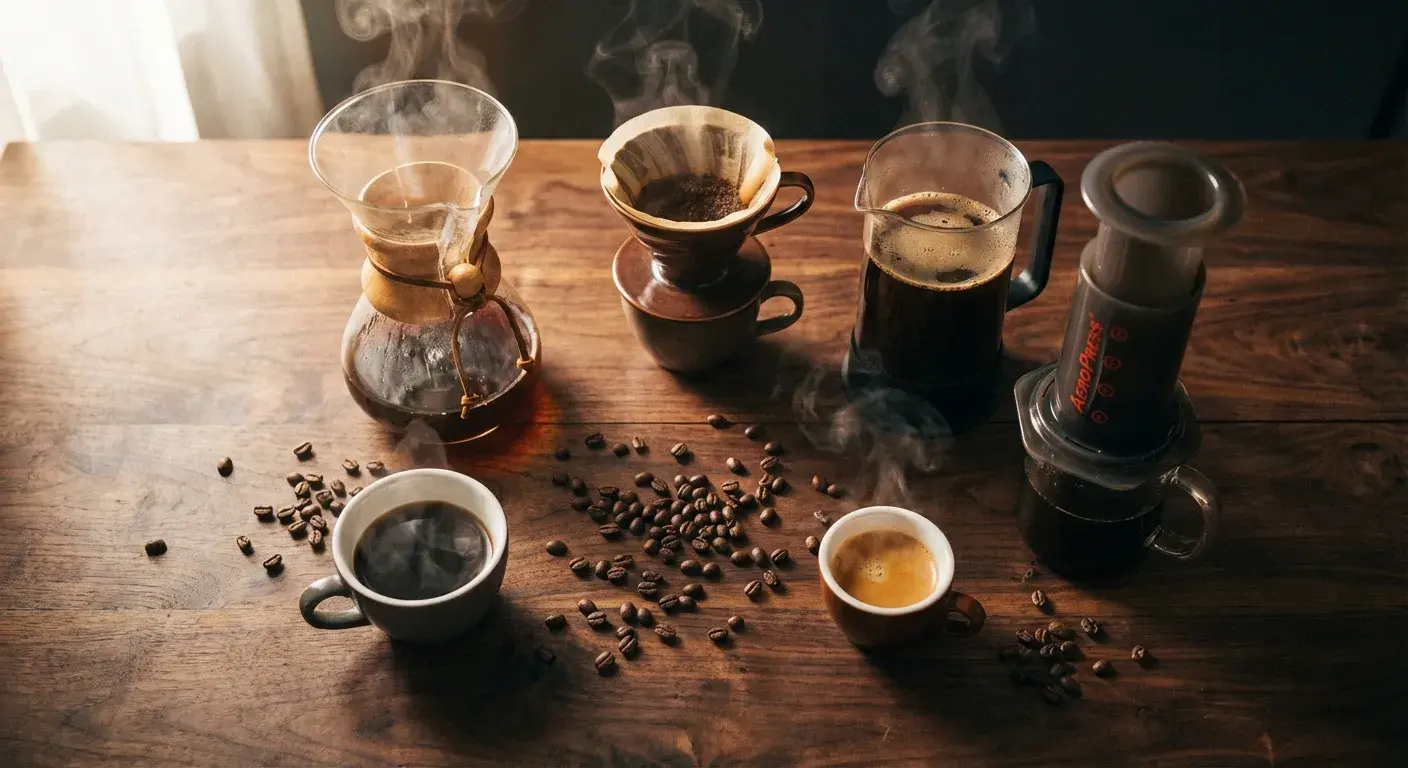
French press is one of eight brewing methods covered in our broader guide, and if you are trying to decide between it and pour over or AeroPress, we compare all three side by side in Pour Over vs French Press vs AeroPress.
What You Need
French press is low-barrier gear, but a few choices genuinely matter.
The press. A 34oz / 1L (8-cup) borosilicate glass press is the standard size and makes this recipe work without scaling. Glass is classic; double-walled stainless steel holds temperature better and is harder to break. Mesh quality matters more than the shell — a tight, well-machined mesh keeps grit out of your cup. Our Best French Press for Making Perfect Coffee Every Time guide breaks down the top options at each price point.
A burr grinder. This is the one place you cannot cut corners. A burr grinder produces the uniform coarse particles the French press needs. Blade grinders create a mix of boulders and dust, and in a press, that dust is what ends up on your tongue as sediment and over-extraction bitterness. A budget burr like the Timemore C2 or Baratza Encore will fix almost any "muddy cup" problem immediately. If you need a starting point, our Coffee Grinders Under $50 guide covers the best cheap options.
A kettle. You do not need a gooseneck for French press — a standard electric kettle is fine. A variable-temperature electric kettle is the upgrade worth making, because hitting 200°F (not boiling) is most of the battle.
A kitchen scale. A 0.1g digital scale is a $15 purchase that instantly makes your coffee more consistent than measuring by scoops.
A timer. The built-in Brew Timer has a French press preset with the 4-minute steep already loaded.
Fresh beans. French press loves medium and dark roasts — the full-immersion method pulls out chocolate, nut, and caramel notes beautifully. Our roundup of the best dark roast whole bean coffee has bean recommendations that shine in a press.
The Recipe
One canonical recipe for a standard 34oz / 1L press. This is the classic Hoffmann-influenced method — light agitation, proper steep, slow plunge, decant immediately.
| Variable | Target |
|---|---|
| Coffee dose | 30g |
| Water volume | 450ml |
| Ratio | 1:15 (coffee to water) |
| Water temperature | 200°F (93°C) |
| Grind size | Coarse (like sea salt) |
| Steep time | 4 minutes |
| Total process | ~6 minutes |
Start here: 30g of coarse-ground coffee, 450ml of water at 200°F, 4-minute steep. If you have a smaller 17oz / 500ml press, halve it: 15g coffee, 225ml water. Our Brew Ratio Calculator handles any brewer size instantly.
A note on the ratio: 1:15 is the standard starting point. Some people prefer 1:16 or even 1:17 for a lighter body, especially with bright single-origin coffees. Dial in the classic 1:15 first, then experiment.
Step-by-Step Guide
Step 1: Heat Your Water and Preheat the Press
Heat water to 200°F (93°C). If your kettle does not have a temperature setting, bring it to a boil and let it sit for 30 seconds off the heat — that drops it to roughly the right range. Boiling water (212°F) scorches the grounds and pulls out harsh, bitter compounds.
Pour some of the hot water into the empty press, swirl it around, and dump it. A preheated press keeps the brew temperature stable for the full 4 minutes, which matters more in winter or in a cold kitchen than people think.
Step 2: Grind Your Coffee Coarse
Grind 30g of coffee to a coarse consistency — the texture of raw sugar or flaky sea salt. On a Timemore C2 this is roughly 28-32 clicks from zero. On a Baratza Encore, somewhere around setting 28-30. On a Fellow Ode, setting 8-10.
Coarse is non-negotiable for French press. A medium or fine grind will over-extract during the 4-minute steep and leave fine dust that slips through the mesh, producing the muddy, gritty cup the press is infamous for. If you are finding sediment in your cup even at a coarse setting, your grinder is producing too many fines — that is a grinder quality issue, not a technique issue.
Step 3: Add Coffee, Pour, and Start the Timer
Add the 30g of ground coffee to the press. Place the empty press on your scale and tare to zero.
Start the timer and pour all 450ml of water in a steady stream, directly onto the grounds. Aim the stream to saturate every particle — you want no dry clumps. The full pour should take about 15-20 seconds.
You will see a thick crust of grounds float to the top of the water. Do not stir yet. Leave the plunger off and the lid off too. Let it sit.
Step 4: Break the Crust at 4:00
When the timer hits 4 minutes, it is time for the most important move in French press brewing: break the crust.
Take a long spoon and give the top of the coffee bed three or four gentle stirs — just enough to break the floating crust and let the grounds sink. The coffee you have been smelling for four minutes will bloom one more time here.
This step does two things. It ensures even extraction (the grounds at the bottom have been exposed to water the whole time, but the crust on top has been partially dry). And it dumps most of the grounds to the bottom of the press, which means you will plunge through clean water instead of a wall of sludge.
Step 5: Skim the Foam and Fines
After breaking the crust, you will see a layer of foam and a few floating grounds on the surface. Use two spoons to skim this layer off and discard it — that is the source of most bitterness and sediment in a typical French press cup.
This is a small, fussy step that James Hoffmann popularized, and it makes a real difference. The skimmed foam holds a disproportionate share of the bitter compounds and ultra-fine particles. Thirty seconds of skimming transforms the cup.
Let the press sit for another 5-8 minutes after skimming. This is the "extraction-preferred" move: instead of plunging immediately, you let the grounds settle to the bottom on their own. When you pour, you decant the coffee off the top and leave the sludge in the press.
Step 6: Plunge Gently (or Don't) and Pour Immediately
There are two finishing moves. Both are valid.
Classic plunge. Place the plunger on top, press down slowly and steadily — about 15-20 seconds of gentle pressure. If you feel real resistance, stop; you are pushing through a too-fine grind and will agitate fines into the cup. Pour all the coffee out immediately. Do not let it sit in the press; continued contact with the grounds over-extracts and turns bitter fast.
Skip the plunge. After skimming, let the press rest 5-8 minutes and pour carefully from the top without pushing the plunger down. This is what Hoffmann calls a "no-plunge" French press, and it produces a noticeably cleaner cup — closer to a dense pour over than a traditional press. The last inch in the press is sludge; leave it.
Do the classic plunge twice to learn the rhythm. Then try the skip-the-plunge variant and decide which you prefer.
Troubleshooting Table
| Problem | Likely Cause | Fix |
|---|---|---|
| Bitter, harsh taste | Over-extracted (grind too fine, steep too long, water too hot, or coffee sat on grounds after plunging) | Grind coarser, keep steep at 4 min, use 200°F not boiling, pour out immediately |
| Sour, thin taste | Under-extracted (grind too coarse, water too cool, steep too short) | Grind a hair finer, make sure water is 200°F, keep full 4-minute steep |
| Muddy, gritty cup | Grind too fine (too many fines), blade grinder, aggressive plunge | Use a burr grinder on coarse setting; plunge slowly or skip the plunge entirely |
| Weak, watery cup | Too little coffee or grind too coarse | Move to 1:15 ratio (30g / 450ml), check grind is coarse but not extra coarse |
| Sediment in every sip | Crust not broken properly, foam not skimmed, pouring to last drop | Break crust at 4:00, skim foam, leave the last inch in the press |
Tips from the Pros
Skim the foam. It is the single biggest upgrade to a press. The foam layer on top after you break the crust holds most of the ultra-fine particles and a chunk of the bitter compounds. Thirty seconds with two spoons turns a cup that has always had a slight edge into one that is clean and round. This is the move most home brewers skip.
Pour immediately or don't plunge at all. Leaving brewed coffee in the press after plunging is the reason the second cup always tastes worse than the first. The grounds keep extracting. Either pour the whole press out within 30 seconds of plunging, or skip the plunge, skim, wait, and decant carefully.
Dark roasts and a French press are a match. The heat tolerance and full-immersion extraction pull chocolate, cocoa, and caramel notes out of a medium-dark or dark roast in a way no paper-filtered method can. If your current beans are a light single origin and your press is tasting flat, try a darker roast — see our dark roast picks.
Preheat, always. Four minutes is long enough for a glass press to cool the water by 10°F. A quick preheat rinse keeps the brew temperature stable and the extraction consistent from the top of the press to the bottom.
Frequently Asked Questions
What is the best ratio for French press coffee?
1:15 (coffee to water by weight) is the standard starting ratio. For a 34oz / 1L press, that is 30g of coffee and 450ml of water. If you want a lighter body, try 1:16 (30g / 480ml) or 1:17 (30g / 510ml). Ratios below 1:14 produce a heavy, almost syrupy cup that some people love and others find too intense.
How long should I steep French press coffee?
4 minutes from the moment you start pouring water. Longer steeps extract more bitter compounds without adding much additional body or sweetness. If you prefer the no-plunge method, the coffee sits in the press for an additional 5-8 minutes after you skim the foam, but it is resting on settled grounds, not actively agitating — extraction essentially stops.
Why does my French press coffee taste gritty?
Grit in a French press cup is almost always caused by one of two things: a grind with too many fine particles (usually from a blade grinder), or pouring the press down to the last drop. The fix is a burr grinder on a coarse setting, and leaving the final inch in the press.
Do I need to boil the water for French press?
No — and you shouldn't. Target 200°F (93°C), not boiling. Boiling water (212°F) scorches the grounds and extracts harsh, bitter compounds from the very first second. If you don't have a variable-temperature kettle, bring water to a full boil and let it sit off the heat for 30 seconds before pouring.
Can I leave the coffee in the French press after brewing?
No. Coffee left sitting on the grounds continues to extract and becomes bitter within minutes. Pour the entire press into a mug or carafe as soon as you plunge. If you are brewing for more than one person, decant everything into a pre-heated thermal carafe immediately.
The Short Version
30g of fresh medium-dark beans, coarse-ground 3 minutes before brewing, 450ml of 200°F water, 4-minute steep, break the crust, skim the foam, pour it all out. Do the classic plunge twice to lock in the rhythm before you try the skip-the-plunge variant.