Manual vs Electric Coffee Grinder: Which Is Right for You?
 Tommie Chaney·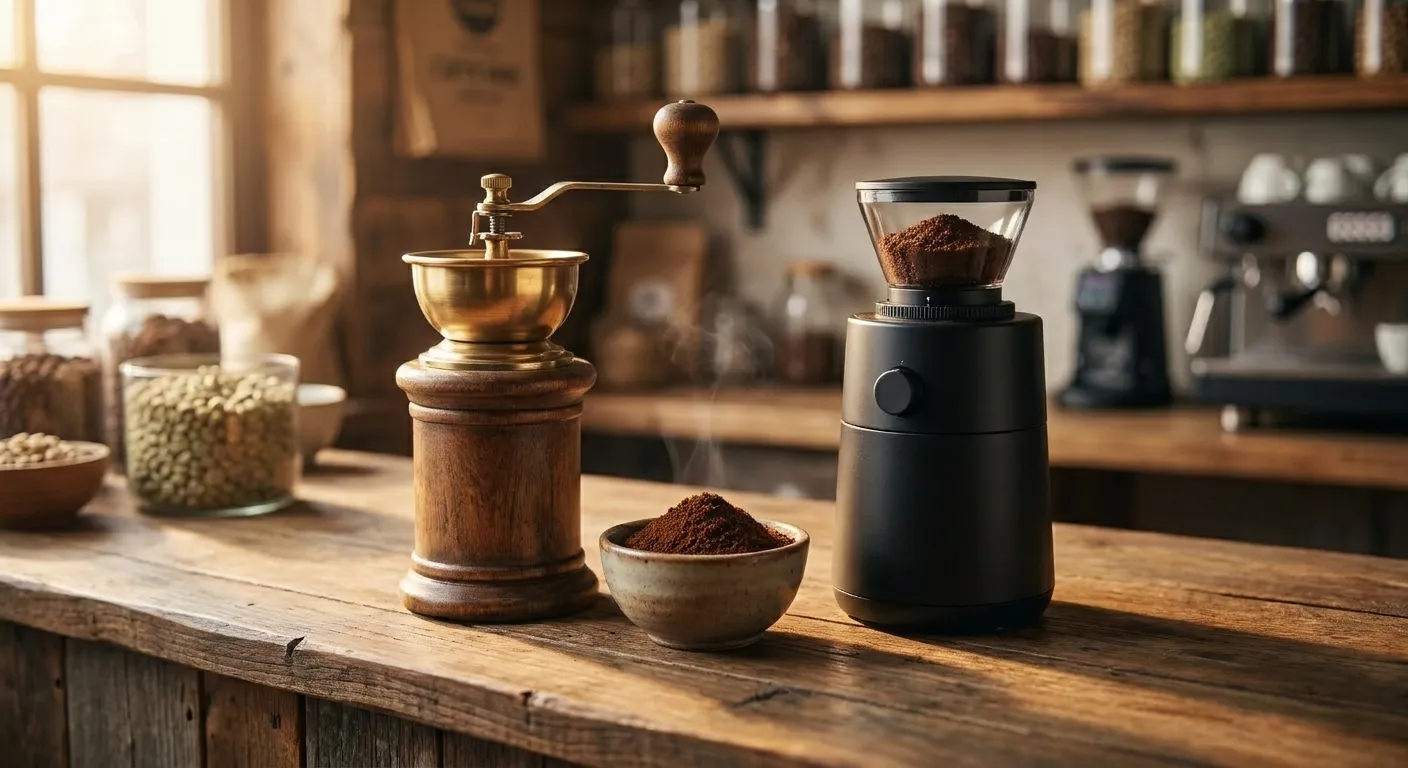
Affiliate disclosure: Sweeter Grind is a participant in the Amazon Services LLC Associates Program. We may earn commissions on qualifying purchases at no extra cost to you.
Once you've decided on a burr grinder (see burr grinder vs blade grinder if not), the next question is manual or electric. Both produce excellent grinds. The real tradeoff is quality-per-dollar versus convenience, and the right answer depends on how often you brew, how much time you have, and what the budget looks like.
Below: the actual differences on effort, cost, consistency, noise, and durability — plus the specific cases where each type wins, and why a lot of enthusiasts end up owning both.
For how grinders fit into your overall coffee kit, see our Ultimate Coffee Equipment Guide 2026.
The Core Tradeoff
The simplest way to frame this decision is:
Manual grinders deliver premium grind quality at low prices by asking you to do the physical work.
Electric grinders deliver convenience at higher prices by doing the work for you.
A $60 manual grinder produces grinds comparable to a $200–$300 electric grinder. You save $150–$250 in exchange for 60–90 seconds of cranking per brew. Whether that tradeoff is worth it depends entirely on your priorities.
Cost: The Most Dramatic Difference
| Price tier | Manual grinder | Electric grinder |
|---|---|---|
| $30–$50 | Entry-level manual with serviceable burrs | Blade grinders (avoid) |
| $50–$100 | Quality manual; good for filter + French press | Entry burr — noisy, limited range |
| $100–$200 | Enthusiast manual (Timemore C2/C3, 1Zpresso Q2) | Decent home burr grinder |
| $200–$400 | Premium manual (1Zpresso JX, Kingrinder K6) | Good mid-range electric |
| $400+ | Diminishing returns on manual | Where electric quality lives |
At the sub-$200 price point, manual grinders are simply better. This is not a minor difference — the grind consistency gap is large enough to taste. You do not have to pay for the electric motor, the housing, the timer, the control board, or the shipping weight; all of that cost goes into burrs instead.
At $400+, electric catches up and eventually pulls ahead in both features and ease of use. But most home brewers never need $400+ grinders unless they are pulling espresso shots.
Effort: The Daily Reality
A manual grinder takes effort — literally, physical effort. For filter-sized brews (15–25g of coffee at medium to medium-coarse grind), expect 30–60 seconds of cranking. For French press coarse, it is closer to 30 seconds. For espresso-fine, 90+ seconds and noticeable resistance.
Some people find this genuinely enjoyable — a small morning ritual, something between meditation and mild exercise. Others find it tiresome on day three and infuriating by week two. Your personal relationship to morning effort matters.
Factors that affect whether manual grinding feels tolerable:
- Daily dose — one cup (15g) is easy; two cups (35g) is noticeable; four cups (60g+) is a workout
- Grind fineness — coarser is faster; espresso-fine can be grueling on an inexpensive manual
- Bean hardness — lighter roasts are harder to grind than darker roasts
- Grinder quality — premium manuals grind faster with less resistance than cheap manuals
- Your morning energy — some people love repetitive motion; others despise it
If you are unsure, the honest test is this: try grinding 20g of coffee by hand right now. If it annoyed you, electric is your answer. If it felt fine, manual is an option.
Consistency: Mostly a Wash
At the same price point, manual grinders produce more consistent grinds than electric grinders. This is because manual grinders spend the entire budget on burrs and adjustment mechanisms — there is no motor, timer, or electronics stealing budget.
At a $100 price point, a manual grinder's grind distribution looks like that of a $250 electric. At $200, a manual matches a $500 electric. The gap narrows at higher prices but persists.
However — and this is important — both produce grinds good enough for excellent coffee. The differences are real but not night-and-day for filter brewing. For espresso, where particle distribution affects shot quality more dramatically, the gap matters more, and dedicated espresso grinders (electric) are designed for that specific demand.
Noise: A Clear Manual Win
Manual grinders are essentially silent. The mechanism is a gentle grinding sound from the burrs crushing beans, maybe a faint squeak from the handle bearing. You can grind coffee at 5 AM in an apartment without waking anyone.
Electric grinders are loud. Entry-level models can hit 80+ decibels — louder than a vacuum cleaner. Premium electric grinders are quieter but still produce a clear motor whine that is not apartment-friendly at early hours.
If you live with light sleepers, work from home on calls, or simply value quiet mornings, this is a real factor. Some enthusiasts keep a manual grinder specifically for "do not wake the house" mornings and an electric for the rest.
Speed: Clear Electric Win
An electric grinder dispatches 20g of coffee in 10–15 seconds. A manual grinder takes 30–90 seconds for the same dose. The gap compounds if you are grinding for multiple people — 80g on a manual grinder is a serious workout; 80g on an electric is 30 seconds of pressing a button.
For single-cup morning use, the speed difference is mostly noticed as "I have time to do something else while the grinder runs." For multi-cup or multi-person mornings, the speed difference is the whole ballgame.
Consistency of Daily Use
A subtle point: manual grinders produce slightly different grinds across different days depending on how vigorously and steadily you crank. An electric grinder spins at a constant speed regardless of your mood or arm strength.
In practice, this matters less than it sounds. Your grind dial setting dominates, and slight cranking variations are well within normal brew-to-brew noise. But if you are pursuing very precise espresso, electric removes one small source of variability.
Durability and Repair
Manual grinders are usually mostly metal construction with exposed burrs. There is nothing to fail electrically. Burrs are the only true wear item, and they last many years of daily use before replacement. Repair is almost never needed.
Electric grinders have motors, bearings, and electronic components. Quality electrics last 5–15 years; cheap electrics often fail in 2–4. Motor brushes wear out, capacitors die, control boards fail. Good brands offer replacement parts; off-brand grinders often cannot be repaired.
For longevity per dollar, manual is dramatically ahead. A $80 manual grinder can easily outlast two $200 electrics.
Portability
Manual grinders are travel-friendly: small, light, no power required. Dedicated travel models (Timemore C2, 1Zpresso Q2, Porlex) are designed to fit in a bag. An electric grinder is a countertop appliance — not going anywhere without a full-size kitchen.
If you travel frequently or camp, a manual grinder is essentially required. Many people with kitchen electrics also own a manual grinder specifically for travel.
Which Wins for Each Use Case?
Manual Wins
- Budget under $150 — quality per dollar is dramatically better
- One or two cups per day — effort is manageable
- Light sleepers in the house — nearly silent
- Travel or camping — portable and power-free
- You enjoy the ritual — some people genuinely love the morning crank
Electric Wins
- Three or more cups per day, or multi-person households — speed matters at volume
- Espresso — the fine grind is hard on manuals and consistency demands more
- Rushed mornings — press button, walk away
- Physical limitations — arthritis, wrist injuries, or shoulder issues make manual painful
- Budget over $400 — electric quality catches and surpasses manual
Both Win (And Are Owned Together)
Many committed home brewers end up with both. A kitchen electric for daily use and a manual for travel and early mornings. This is not overkill — it is two tools for two different jobs. Combined cost is often under $300 for reasonable options in both categories.
What About Espresso?
Espresso demands fine grinds and consistent particle distribution. Manual grinders can do espresso, but:
- Grinding fine is slow and effortful (90+ seconds per dose)
- Maintaining consistency across multiple back-to-back shots is harder
- Espresso-capable manuals cost $200+ — electric starts making sense at that price
For occasional espresso (AeroPress "espresso," Moka pot, occasional home espresso machine), a quality manual works. For daily espresso with a real machine, an electric grinder is effectively required. Budget $300+ for a decent espresso-capable electric grinder; much more for cafe-level performance.
Hybrid Grinders?
A few models exist that are "hand-crank-or-drill-attachable" — you can grind manually or attach a drill for faster grinding. Clever, but most home brewers find them gimmicky. Either buy a real manual (fast enough) or a real electric (even faster). Hybrid solutions tend to compromise both.
Frequently Asked Questions
Can a manual grinder really match an electric in grind quality?
At the same price point, manual grinders usually exceed electric in grind quality. The reason is cost allocation — manuals spend the whole budget on burrs. At higher prices (above $400), electric grinders with premium burrs catch up and, for espresso specifically, pull ahead.
How long does manual grinding take?
For filter coffee at a typical 15–20g dose, about 30–60 seconds. Coarser grinds are faster, finer grinds slower. Lighter roasts are slightly harder to grind than darker roasts. With a quality manual, you will settle into a rhythm within a few days.
Which manual grinder brands are worth considering?
Timemore, 1Zpresso, Kingrinder, and Comandante are the most reputable enthusiast manual brands. Entry-level Hario Skerton and Porlex grinders are also serviceable at lower prices, though consistency is a notch lower than the enthusiast brands.
Do manual grinders wear out?
Burrs wear slowly — typically hundreds of pounds of coffee before noticeable change. For home users, that is years of daily use. Some brands sell replacement burrs; others require full grinder replacement when burrs wear. Check before buying if long-term use matters.
Can I grind for espresso on any electric burr grinder?
No. Espresso requires specific fineness and stepped-or-stepless adjustment in very small increments near the fine end. Many entry-level electric grinders cannot go fine enough or have too-coarse adjustment steps for espresso. Look for "espresso-capable" or "50+ adjustment steps" when shopping for espresso electrics.
Related reading
- The Ultimate Coffee Equipment Guide 2026
- Burr Grinder vs Blade Grinder
- Do You Need a Coffee Scale?
- Coffee Brewer Buying Guide: What to Look For
- Coffee Grinders Under $50
- Brew Ratio Calculator
Which to Buy
Pick manual if: budget under $150, one or two cups a day, light sleepers in the house, or frequent travel.
Pick electric if: three-plus cups daily, espresso, rushed mornings, or physical limitations that make cranking unpleasant.
Many enthusiasts end up with both — one for daily kitchen use, one for travel and quiet mornings. Combined cost is often under $300 for reasonable options in both categories.