Collapsible Pour-Over Drippers for Travel and Camping
 Tommie Chaney·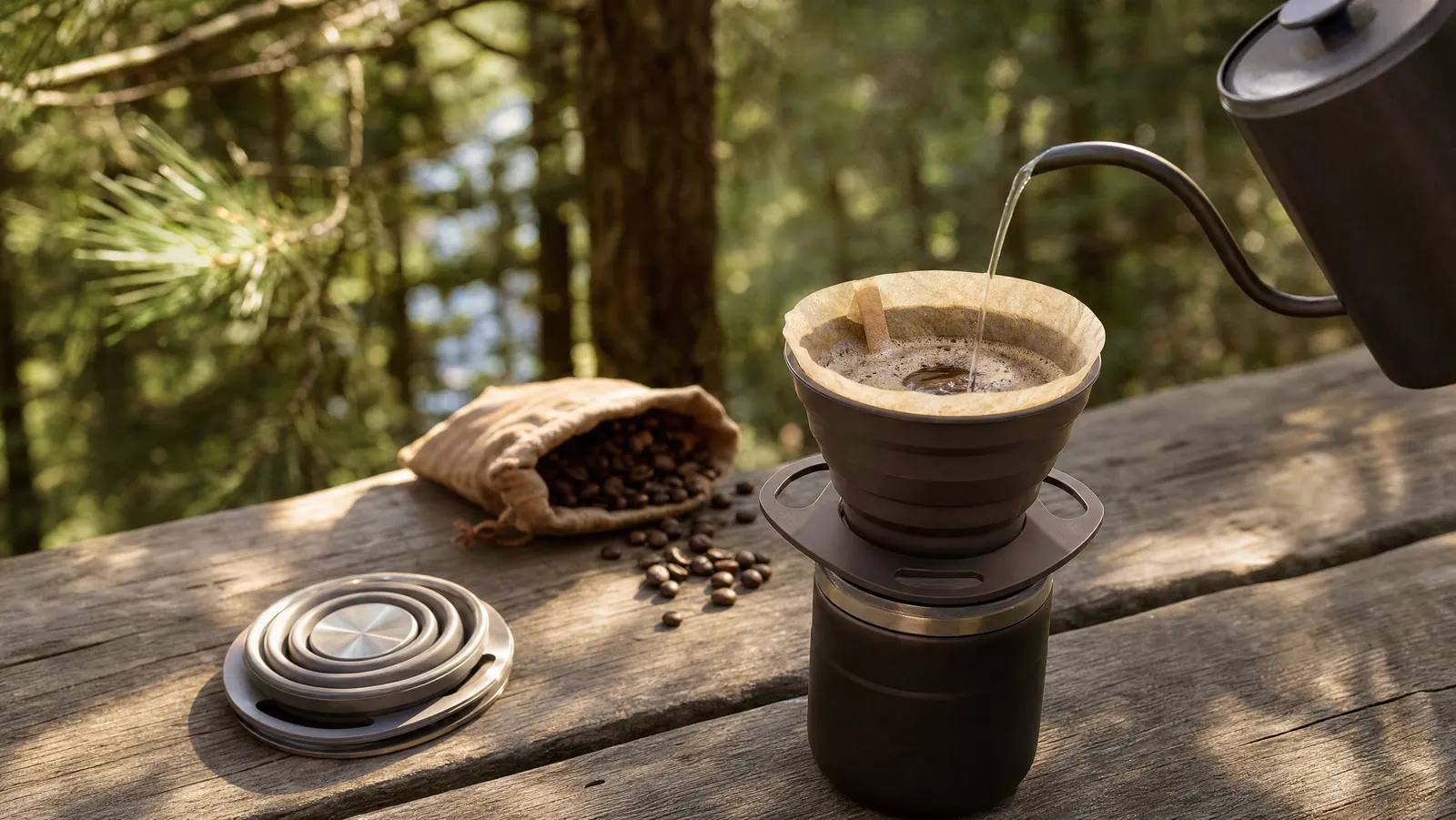
Affiliate disclosure: Sweeter Grind is a participant in the Amazon Services LLC Associates Program. We may earn commissions on qualifying purchases at no extra cost to you.
For trips where pack space is the real constraint, the right portable pour over coffee maker is a mesh-frame model that carries no paper at all. Sea to Summit lists its Frontier Ultralight Collapsible Pour Over at 2 oz with a reusable stainless steel mesh filter, priced at $30.95 on its own site as of September 2026, with retailers such as Scheels listing it at $29.95. It is about as small as a self-contained brewing system gets while still making recognizable pour-over.
The honest version of this comparison has an uncomfortable ending, so we will put it up front: a rigid plastic Hario V60 makes a better cup than every collapsible dripper we researched, weighs very little, and costs less than half as much as the folding steel and steel-mesh models here. Hario USA lists the plastic V60 size 02 at $13.00 as of September 2026. Packability is the only reason to give that up.
What follows compares form factors, not brands. If you are still assembling the rest of your kit, start with our overview of travel coffee gear and come back for the dripper decision.
Four Kinds of Portable Pour Over Coffee Maker
Every packable dripper is a variation on one of four ideas:
- Folding metal cones — flat steel plates or hinged legs that open into a cone and take a normal paper filter.
- Collapsible silicone cones — a full-size cone with a concertina wall that squashes down.
- Mesh frames — a silicone or plastic ring holding a permanent steel or nylon screen, so you carry no paper.
- Rigid light cones — ordinary plastic drippers that happen to weigh almost nothing.
The first three trade cup quality for pack volume. The fourth trades pack volume for cup quality. There is no design that wins both, and any review that says otherwise is selling something.
Folding Metal Cones: The Closest Thing to a Real Dripper
This design has the best claim on the coffee. A folding steel cone still holds a paper filter, still makes a cone-shaped bed, and still drains through one large hole — geometrically a V60 that happens to flat-pack.
Snow Peak's Collapsible Coffee Drip (model CS-113) is the reference point. Snow Peak lists it at $29.95 as of September 2026, and CampSaver's listing puts it at 4.9 oz (140 g) in stainless steel. OutdoorGearLab measured it at 4.8 oz and noted it packs down flat and works on top of many different-sized vessels.
The flat-plate variant goes further. The Munieq Tetra Drip is a set of interlocking plates that assemble into a cone and disassemble into something you can slide into a passport wallet. Munieq lists the plastic 01P at 12 g with a folded size of 103 x 69 x 4.5 mm, and the small stainless 01S at 23 g folded to 107 x 66 x 0.8 mm; some retailer listings quote slightly higher figures. Munieq's own store lists the small stainless 01S at ¥2,800 and the large 02S at ¥3,200 as of September 2026, though several US retailers now show the 01P and 02S as discontinued.
What it costs you: rigidity. OutdoorGearLab's Snow Peak review is blunt that the legs do not lock into place and the dripper can collapse while brewing if you are not careful. That is not a design flaw so much as the definition of the category.
Collapsible Silicone Cones: Packable, But Thermally Awful
Silicone cones are the cheapest way into a collapsible coffee dripper and the easiest to live with. They squash, they bounce back, they survive being crushed under a sleeping bag, and they take standard paper filters.
They are also the worst thermal performer of the four. Thin silicone has almost no mass and no insulating value, so a cone sitting in cold air sheds heat from the slurry throughout the pour. The Specialty Coffee Association recommends brewing water between 195°F and 205°F (90–96°C) at contact with the grounds — a window that is hard to hold on a 40°F morning with a thin-walled cone.
They are not especially light, either. OutdoorGearLab weighed the GSI Outdoors Collapsible Java Drip at 4.76 oz — essentially the same as the 4.8 oz it measured for the folding steel Snow Peak, so the silicone buys you no weight saving at all.
What it costs you: heat, and less pack volume than you expect. A collapsed silicone cone is still a disc the diameter of a mug. It packs flat, not small.
Mesh Frames: No Paper, More Body, Some Sediment
This is the design we reach for on longer trips, and the only one that changes what is in the cup rather than just how it packs.
A mesh frame replaces the paper with a permanent screen. Sea to Summit's Frontier Ultralight Collapsible Pour Over folds into its own polypropylene mount base; Sea to Summit says that base fits most mugs and wide-mouth bottle rims, and that the stainless mesh filter is sized for roughly 30 g of ground coffee. The earlier X-Brew — which retailer listings spec at 2.9 oz (85 g), 4 in diameter, 0.8 in compressed, in Nylon 66 and food-grade silicone with a reusable double mesh filter — has been superseded on Sea to Summit's own site by the Frontier model.
The featherweight option is GSI's Ultralight Java Drip, a nylon mesh bag with three clip-on legs. GSI lists it at 4.2 x 4.2 x 0.5 in packed, as a #2/#4 filter equivalent, describes it as weighing less than half an ounce, and prices it at a regular $10.95 as of September 2026. OutdoorGearLab measured it at 1.1 oz and flagged the downsides: delicate clips, fragile plastic legs, and a pour you must keep slow to get a bold cup.
What it costs you: clarity, and possibly your cholesterol reading. Screens pass oils and fine particles that paper retains. The 2020 Tverdal study in the European Journal of Preventive Cardiology found filtered coffee associated with lower mortality than unfiltered, and the European Society of Cardiology's summary notes unfiltered coffee carries roughly 30 times the concentration of the cholesterol-raising diterpenes cafestol and kahweol. If you are watching lipids, carry paper.
Rigid Light Cones: The Design Nobody Calls Portable
Hario's plastic V60 is not marketed as a packable pour over, which is precisely why it gets left out of these roundups. It should not be. Hario USA lists the plastic 02 at $13.00 as of September 2026, in acrylonitrile-styrene resin, at W137 x D116 x H102 mm with a 1–4 cup capacity. Hario does not publish a weight and retailer figures vary, so treat any number you see with suspicion — but nobody who has held one thinks it is heavy.
The rigid-steel version of the argument is the Kalita Wave 155: Kalita USA lists it at $38.00 as of September 2026 in stainless steel for 1–2 cups, with the flat bottom and three extraction holes that define the Wave. It does not fold. It is close to indestructible, which is a different travel virtue than packing flat.
What it costs you: a fixed cone of dead space in your pack. That is the whole bill. Fill that cone with socks and you have paid nothing.
Portable Pour Over Coffee Makers Head to Head
Figures are as listed by each manufacturer or, where noted, as measured by OutdoorGearLab. Prices are approximate, as of September 2026.
| Design | Example | Weight | Packs to | Filter needed | Cup character | Rough price |
|---|---|---|---|---|---|---|
| Folding steel cone | Snow Peak CS-113 | ~4.8–4.9 oz | Flat plate | Paper cone | Clean, close to a real V60 | ~$29.95 |
| Flat-pack plates | Munieq Tetra Drip 01P | ~12 g (plastic) | 103 x 69 x 4.5 mm | Paper cone | Clean, one small cup | ~¥2,800 (steel 01S) |
| Collapsible silicone | GSI Collapsible Java Drip | ~4.76 oz measured | Flat disc | Paper cone | Clean but heat-lossy | Not confirmed |
| Steel mesh frame | Sea to Summit Frontier UL | ~2 oz | Into its own base | None | Fuller body, fine sediment | ~$30.95 |
| Nylon mesh + legs | GSI Ultralight Java Drip | ~1.1 oz measured | 4.2 x 4.2 x 0.5 in | None | Light body, needs a slow pour | ~$10.95 |
| Rigid plastic cone | Hario V60 plastic 02 | Not published | Does not collapse | Paper cone | Best cup in the table | ~$13.00 |
Read the weight column carefully. Two of the three lightest entries are mesh, and the folding steel cone that brews closest to a real V60 is among the heaviest things here. Weight and cup quality are not on the same axis in this category — filter type and wall thickness are what move the cup.
What Collapsing Does to Your Brew
Three mechanisms explain almost every complaint about packable drippers, and understanding them is worth more than another spec table.
Unstable geometry. A cone that folds is a cone that can unfold. OutdoorGearLab's warning that the Snow Peak's legs do not lock and it can collapse while brewing is the extreme case; the everyday case is a slightly splayed frame letting the filter sag off-axis so water channels down one side. Channeled water over-extracts a narrow track and under-extracts everything else, so the cup reads bitter and thin at once.
Thin walls. With the SCA's 195–205°F target measured at contact with the grounds, a cone with no thermal mass sitting in wind is brewing the last third of your pour colder than the first. That is a real reason travel coffee tastes flat even when the recipe is right.
Ribs that do not seat the filter. A V60's spiral ribs hold the paper off the wall so air escapes and flow stays even. Flat-plate and folding designs mostly have no ribs, and OutdoorGearLab notes that certain filters hang very low in the Snow Peak because of its large bottom hole. A filter pressed flat against a wall drains unevenly — the same channeling problem by another route.
Mesh passes fines. A permanent screen lets fine particles through by design. They keep extracting in the cup and settle as silt. Grinding a click coarser is the fix, and our grind size guide shows where that lands relative to standard pour-over. For the underlying mechanics, our walkthrough of how to make perfect pour over coffee covers what each variable does before you improvise in a campsite.
Brewing on a Wobbly Surface
Field technique matters more here than gear choice. Five things we would do differently outdoors:
- Pre-warm the dripper and the mug. Pour a splash of hot water through the empty cone first. On thin silicone and thin steel this is the difference between a hot cup and a warm one.
- Cover the cone during the drawdown. A lid, an upturned bowl, even a hand over the top slows heat loss. Wind steals more temperature than cold air does.
- Grind one click coarser than at home, especially with mesh. Field grinders produce more fines than a good burr grinder, and mesh passes every one of them.
- Pour in fewer, larger pulses. Every pause is a cooling opportunity, and a wobbly surface punishes fussy multi-pour recipes. Bloom, two pours, leave it alone.
- Dose by the mug, not by habit. A 12 oz camp mug at 1:16 wants roughly 22 g of coffee and 355 ml of water. Our brew ratio calculator will size a recipe to whatever vessel you actually packed.
If the rig is going in a pannier or a bear canister rather than a jacket pocket, weigh it against the alternatives in our roundup of the best camping coffee makers first. Pour-over is a fussy outdoor method, and it is not always the right answer.
Who Should Just Bring a V60
We would skip the collapsible category entirely if any of these describe you.
You are driving. Car camping has no meaningful weight budget. Bring the rigid dripper, a real kettle, and the good beans.
You are staying in one place. A dripper only pays its packability tax while it is in the bag. If it lives on a rental kitchen counter for a week, folding flat buys you nothing.
You care about the cup more than the grams. At roughly $13 for the plastic 02, the V60 is cheaper than every folding design here except GSI's $10.95 nylon mesh drip, and brews better than all of them, because the ribs, cone angle and single large hole were designed together rather than reverse-engineered to fold. If price rather than pack size is the real constraint, our walkthrough of building a travel coffee kit under $100 puts that $13 dripper in context with the grinder, kettle and beans you still have to buy.
The genuine case for a collapsible coffee dripper is narrower than the marketing suggests: you are carrying it on your back, over distance, in a pack where a rigid cone would displace something you need more. That is exactly where the 2 oz mesh frames earn their place. For the fuller weight-optimized picture, including the methods that beat pour-over outright on a gram-counting trip, see ultralight backpacking coffee methods.
For everyone else: buy the cheap rigid one, put your socks in it, and spend the difference on better beans. If you want the whole travel pour over setup rather than just the brewer, our complete camping and travel coffee guide covers grinders, kettles and beans too.
Frequently Asked Questions
Do collapsible drippers work with standard V60 paper filters?
Most cone-shaped folding models do. OutdoorGearLab's testers used both V60 cone filters and Melitta basket filters in the Snow Peak Collapsible Coffee Drip, folding the flat-bottomed ones origami-style to fit, though they note certain filters hang very low because of the large bottom hole. Flat-bottom designs like the Kalita Wave need their own wave filters, which pack bulkier than flat cone papers.
Is a mesh filter dripper worth it to avoid carrying paper?
On a multi-day trip, yes. Paper is light but bulky, turns to pulp when wet, and forgetting it ends your coffee. A permanent screen removes that failure mode. The trade is a siltier cup plus the diterpene issue raised by the 2020 Tverdal study in the European Journal of Preventive Cardiology. For a weekend, paper is fine and tastes better.
What grind size should I use with a portable pour over coffee maker?
Start at standard pour-over, medium and roughly table-salt sized, then go one step coarser with a mesh screen or a wobbly hand grinder. Mesh passes fines that paper would trap, so a grind that tastes clean at home can taste muddy in the field. Coarser also slows channeling on an unstable cone.
Do these fit on a wide-mouth water bottle?
Some do. Sea to Summit says the Frontier Ultralight Collapsible Pour Over's mount base fits most mugs and wide-mouth bottle rims, and OutdoorGearLab found the Snow Peak works on many different-sized vessels. Clip-on designs like the GSI Ultralight Java Drip depend on rim thickness — OutdoorGearLab reported that thicker rims make secure attachment difficult.
Is a steel dripper worth the extra money over plastic?
For durability, yes. For flavor, no. Steel survives being sat on and cleans up with a rinse, which is why the Kalita Wave 155 at $38.00 as of September 2026 has a following among people who travel hard. But a $13.00 plastic V60 makes the same or better coffee. Pay for metal because you expect to abuse it, not because you expect it to taste different.