Best Travel Coffee Grinders (Hand Grinders That Pack Small)
 Tommie Chaney·
Affiliate disclosure: Sweeter Grind is a participant in the Amazon Services LLC Associates Program. We may earn commissions on qualifying purchases at no extra cost to you.
The best travel coffee grinder for most people is the TIMEMORE Chestnut C3, because its 25-gram capacity grinds two cups in one fill instead of making you crank twice before breakfast. If you are counting grams in a pack instead of minutes in a hotel room, the 1Zpresso Q Air is the lighter answer.
Everything in this category is a negotiation between three things: packed size, grind quality, and how long you are willing to crank. You cannot max all three. A grinder small enough to hide inside an AeroPress holds one dose. A grinder with the capacity to take 25 grams in one fill weighs 700 grams. A grinder fine enough for espresso takes over a minute per shot, by hand, before you have had any coffee.
We have sorted the six picks below by which of those three you care about most, the same way our wider camping coffee gear coverage sorts brewers by how far you carry them. Prices are as of September 2026 and move constantly, so treat them as a snapshot.
Quick Picks: Travel Grinders at a Glance
| Grinder | Our pick | Price | Burr | Capacity | Adjustment |
|---|---|---|---|---|---|
| 1Zpresso Q Air | Best Ultralight | $69.00 | Stainless steel conical | 15-20g | 30 clicks per rotation, internal |
| 1Zpresso Q | Best All-Metal Compact | $99.00 | Stainless steel conical | 15-20g | 30 clicks per rotation, internal |
| TIMEMORE Chestnut C3 | Best Value | $79.00 | 38mm stainless conical (S2C660) | 25g | Approx. 36 steps, internal nut |
| TIMEMORE C3 ESP Pro | Best for Portable Espresso | $99.00 | 38mm stainless conical (S2C660) | 25g | Approx. 36 levels, 0.0233mm per click |
| 1Zpresso X-Ultra | Best Premium | $159.00 | Heptagonal stainless steel | 25-30g | 60 steps per rotation, external |
| JavaPresse | Best Budget | $24.92 | Ceramic conical | Not stated | Over 18 settings |
All prices are as of September 2026. Capacity figures are the manufacturers' own; TIMEMORE lists the C3 ESP Pro at the same 25 grams as the standard C3.
What Actually Matters in a Travel Grinder
Capacity is the hidden spec, and almost every roundup skips it. A grinder rated for 15 to 20 grams makes one cup. That is fine alone in a hotel room. At a campsite with two people, it means two full grinding sessions every single morning — roughly double the cranking, forever. If you brew for anyone but yourself, buy 25 grams or more and stop reading spec sheets about weight.
Burr material changes how much work you do. According to Majesty Coffee's comparison of the two materials, steel burrs are sharper and grind faster, while ceramic burrs hold their edge longer and conduct less heat. On the road, sharpness wins: you are grinding a few hundred grams a year on a trip, not wearing burrs out, and the difference shows up in your forearm. Our burr grinder vs blade grinder explainer covers why both beat a blade grinder outright.
Adjustment resolution decides whether espresso is possible. A grinder with 18 stepped settings covers French press through drip comfortably. It is not a realistic espresso tool, because the useful espresso range can fall inside the gap between two of its clicks. That is the single hardest fork in this category.
Packed size is shape, not just weight. A 365-gram grinder with a fixed T-handle occupies more usable bag volume than a heavier grinder whose handle folds flat. Check for a folding crank before you check the number on the scale.
Effort per gram is the spec nobody publishes. According to CoffeeBlog UK, an 18-gram dose takes most cheaper, budget hand grinders around 60 to 90 seconds at the finest end of their range and 30 to 60 seconds towards the coarse end, while more premium grinders manage 30 to 45 seconds fine and 20 to 30 seconds coarse. Sharper, larger burrs cut that down, and espresso-fine settings sit at the slow end of it. If you want the settings themselves rather than the hardware, our grind size guide maps each brew method to a target.
1Zpresso Q Air: Best Ultralight Travel Grinder
This is the grinder for people whose real constraint is volume, not money. 1Zpresso says the Q Air is smaller than a soda can and nests inside the plunger of an AeroPress, which is a genuine packing win rather than marketing: the plunger cavity is dead space you are already carrying, and the grinder vanishes into it. If you travel with an AeroPress — and the recipes in our AeroPress techniques guide all work on a camp stove — this pairing is the smallest complete coffee kit that still involves fresh grinding.
The burr is stainless steel conical with 30 clicks per rotation and a numbered dial, and 1Zpresso rates the factory-calibrated burrs for 100 to 200 kg of grinding, backed by a one-year limited warranty. 1Zpresso's Q Series comparison lists it at 365g, the lightest in the range.
The real drawback: that same comparison table lists the Q Air as the only Q Series model without a foldable handle. So the thing that packs smallest still packs as a T-shape, and at 15 to 20 grams per fill it is emphatically a one-cup grinder. About $69.00 as of September 2026.
Check the current price on Amazon
1Zpresso Q: Best All-Metal Compact Hand Grinder
The Q is what you buy when the Q Air's build feels too light for how you travel. 1Zpresso describes it as crafted entirely from metal with dual bearings and a triaxial structure, running a stainless steel conical burr with the same 30 clicks per rotation, with the same 15 to 20 gram fill and the same 100 to 200 kg burr rating.
What you feel is axle stability. A hand grinder with slop in the shaft lets the burrs wander under load, and dual bearings are the standard fix. In our experience that shows up as a crank that tracks straight rather than wobbling at the top of each turn. 1Zpresso's Q Series comparison also lists this model with a folding handle, the practical packing advantage over the Q Air.
The real drawback: 1Zpresso lists the Q at 480g against the Q Air's 365g, and the capacity does not move. You are paying about $30 more as of September 2026 and carrying 115 more grams for the same one cup per fill. Buy it for the build and the folding handle, not for output.
Check the current price on Amazon
TIMEMORE Chestnut C3: Best Value Travel Coffee Grinder
The C3 is our default recommendation because it solves the capacity problem. TIMEMORE rates it at 25 grams, which is two pour-overs or one large French press in a single fill, and it does it with a 38mm CNC-machined stainless steel conical burr (the S2C660) that TIMEMORE specifies at 55 to 58 HRC hardness, on a double-bearing central axis.
Big burrs cut faster because more edge meets the bean per revolution. Brew Coffee Home measured the same burr set in the C3S at 25 seconds for 10 grams at a filter setting. Speed like that is a large part of the argument for spending about $79.00 rather than about $24.92 as of September 2026. TIMEMORE also says the grinder disassembles for brush cleaning, and that clockwise turns go finer, anti-clockwise coarser.
The real drawback: TIMEMORE lists it at 700g with a 52mm body — heavier than the 590g 1Zpresso lists for the X-Ultra, which makes it the heaviest grinder here and no one's ultralight pick. The adjustment nut is also internal, so changing grind size means pulling the handle and catch cup off rather than turning an external ring. About $79.00 as of September 2026.
Check the current price on Amazon
TIMEMORE Chestnut C3 ESP Pro: Best Travel Grinder for Portable Espresso
If a portable espresso maker is going in the bag, this is the grinder that goes with it. TIMEMORE rates the ESP Pro dial at 0.0233mm per click across roughly 36 levels — where the standard C3 gives you far coarser jumps. Brew Coffee Home puts the difference at 23 microns per step on the ESP versus 83 microns on the C3S, and notes that on the C3S the espresso range was unusable in practice: seven clicks ground too fine, eight clicks poured too fast, with nothing in between.
That is the whole case for the ESP Pro in one sentence. Espresso is dialled in increments smaller than a standard grinder's smallest move. Wacaco's own Picopresso listing describes the machine as compatible with ultra-fine grind, which grind guides for the machine describe as closer to Turkish-fine than the grind a standard home espresso machine wants. TIMEMORE publishes a starting map — 0.8 to 1.1 circles for espresso, 1.4 to 2.0 for pour over, 2.0 to 2.3 for French press — so you are not hunting blind. Pair it with something from our roundup of the best portable espresso makers in 2026, and read coffee extraction 101 before you start chasing a shot.
The real drawback: grinding espresso-fine by hand is genuine work. Brew Coffee Home recorded 1 minute 12 seconds for 17 grams on a C3 ESP at an espresso setting, and that is before you have had any caffeine. If you only brew filter on the road, the standard C3 grinds faster and costs less. About $99.00 as of September 2026.
Check the current price on Amazon
1Zpresso X-Ultra: Best Premium Travel Grinder
The X-Ultra is the one that stops feeling like a compromise. 1Zpresso rates it at 25 to 30 grams into a magnetic catch cup, which is the largest capacity here, and gives it external adjustment with 60 steps per rotation. External adjustment is the quality-of-life feature: you turn a ring on the outside of the body instead of stripping the grinder to reach a nut, which matters when you are switching between French press at camp and pour-over the next morning.
The burr is heptagonal stainless steel, which 1Zpresso positions toward pour-over and a light, sweet flavour profile. The crank folds, the grinder dismantles without tools for cleaning, and 1Zpresso quotes roughly 100 to 200 kg of grinding life and a one-year limited warranty. For a trip where coffee is part of the point rather than a logistics problem, it is the most complete package here.
The real drawback: about $159.00 as of September 2026 is roughly double the C3 for a capacity gain of five grams. And the burr profile 1Zpresso describes is aimed at filter, not espresso, so this is the wrong grinder for a Picopresso kit despite being the most expensive one here.
Check the current price on Amazon
JavaPresse Manual Grinder: Best Budget Travel Grinder
The JavaPresse exists to answer one question: is any grinder better than no grinder. Yes. It runs an adjustable ceramic conical burr with what JavaPresse describes as over 18 manual grind settings, no batteries and no cords, and at about $24.92 as of September 2026 — down from a $39.99 list price — it costs less than two bags of specialty beans.
Ceramic is not automatically the weaker choice. Majesty Coffee notes ceramic burrs hold their edge longer than steel and conduct less heat, and puts their working life ahead of steel. The real limitation is not the material, it is the resolution.
The real drawback: 18 stepped settings across the entire range from espresso to French press means each click is a large jump. For immersion brewing and drip that is fine, because those methods tolerate a wide grind window. For espresso it is not, whatever the listing title suggests — and the limit is the step size, not the burr material, since Majesty Coffee's comparison actually rates ceramic as the better performer at finer grinds and steel as better suited to coarser ones. Buy this for a camping trip, not for a portable espresso setup.
Check the current price on Amazon
What Happened to the 1Zpresso Q2?
If you searched for a Q2 review and landed here, the short version is that the Q2 is no longer the model 1Zpresso leads with. 1Zpresso's current Q Series page lists three grinders — the Q2 S, the Q, and the Q Air — all rated at 15 to 20 grams with heptagonal burrs and 30 clicks per rotation, at 465g, 480g and 365g respectively. The plain Q2 is not in that comparison.
The Coffee Chronicler describes the Q Air as a more affordable alternative to the Q2 Heptagonal and 1Zpresso's most affordable hand grinder to date, and notes a design difference in the internals: the original Q2 uses a less aggressive inner cone with a slimmer pre-breaking section, while the Q Air has more prominent pre-breakers, which changes both the grinding feel and the character in the cup.
So the Q2 is not vapourware, and it still turns up at specialist retailers. But if you want a Q-family grinder you can order today, the Q and the Q Air are the two we can verify as available. Both are reviewed above.
Do You Even Need to Grind on the Road?
Honestly, sometimes not. Ground coffee in a sealed, one-way-valve bag is fine for a two-night trip. Staling is driven by oxygen exposure and time, so if you grind the morning you leave and the bag stays shut, you are drinking coffee a couple of days past grinding rather than a couple of weeks — a difference most people cannot pick out around a fire. Our guide to storing coffee beans for freshness covers why the valve bag matters more than the container.
A grinder earns its space in three situations. Trips of four days or more, where the back half of the bag has genuinely flattened out. Trips where you want to change grind size, because pre-ground locks you into one method. And espresso, where grind freshness and grind resolution are both non-negotiable.
If you are still choosing the brewer itself, start with the best camping coffee makers in 2026 and pick the grinder afterwards. The brewer sets the capacity you need; the grinder follows.
Frequently Asked Questions
How long does hand grinding actually take?
According to CoffeeBlog UK, most cheaper, budget hand grinders take around 60 to 90 seconds for an 18-gram dose at the finest end of their range and 30 to 60 seconds towards the coarse end, while premium grinders manage 30 to 45 seconds fine and 20 to 30 seconds coarse. Brew Coffee Home measured 25 seconds for 10 grams on a TIMEMORE C3S at a filter setting. Fine grinding runs the other way: Brew Coffee Home recorded 1 minute 12 seconds for 17 grams on a C3 ESP at an espresso setting.
Can a hand grinder really make espresso?
Yes, but only one with fine adjustment steps. Brew Coffee Home puts the standard C3S at 83 microns per click against 23 microns on the C3 ESP, and found the C3S unusable for espresso in practice: seven clicks was too fine, eight was too fast, with nothing usable between them. If a grinder advertises 18 settings across its whole range, that is not espresso resolution. See how to make espresso without an espresso machine for what is achievable without one.
Ceramic or stainless steel burrs for travel?
Steel, in most cases. Majesty Coffee's comparison describes steel burrs as sharper and faster, with ceramic holding its edge longer and generating less heat, estimating ceramic at up to 14.4 years of service against about 9.6 years for steel at a pound of coffee per week. Longevity is the wrong thing to optimise for a grinder you use on holiday. Speed and effort are what you notice.
How do I clean a hand grinder without a sink?
Dry-brush it. Coffee oils build up on the burrs and in the catch cup, and a stiff brush removes almost all of it without water. TIMEMORE says the C3 disassembles for brush cleaning and 1Zpresso says the X-Ultra dismantles without tools, so both come apart at a picnic table. Save the wet clean for home, and dry every metal part fully before reassembly.
Is a $25 grinder good enough?
For French press, drip and percolator coffee on a camping trip, yes. Those methods have a wide grind window and forgive coarse adjustment steps. For pour-over you will notice the gaps between settings, and for espresso a budget grinder is not a viable tool at any price. Our comparison of manual vs electric coffee grinders explains where the money actually goes.
Which capacity should I buy for two people?
25 grams or more. A 15 to 20 gram grinder means one brew per fill, so two mugs is two grinding sessions before anyone has had coffee. The C3 at 25 grams and the X-Ultra at 25 to 30 grams both cover two cups in one go. Use our brew ratio calculator to work out the dose your brewer actually needs before you choose.
The Bottom Line
Buy the TIMEMORE C3 if you want the most coffee per crank for the money. Buy the 1Zpresso Q Air if grams and volume are your binding constraint and you brew alone. Buy the C3 ESP Pro only if a portable espresso maker is going in the same bag, and the X-Ultra if you want external adjustment and the largest capacity here without thinking about price. The JavaPresse is the answer to "I refuse to spend more than $25," and it is a perfectly reasonable answer.
Whatever you pick, the grinder is one line item in a kit. Match it to your brewer and your group size using the complete guide to camping and travel coffee, and you will not end up carrying a 700-gram grinder up a mountain for one cup a day.
Check the current price on the TIMEMORE C3 at Amazon
Related reading
- Best portable espresso makers in 2026
- Best camping coffee makers in 2026
- Manual vs electric coffee grinder
- Burr grinder vs blade grinder
- Grind size guide
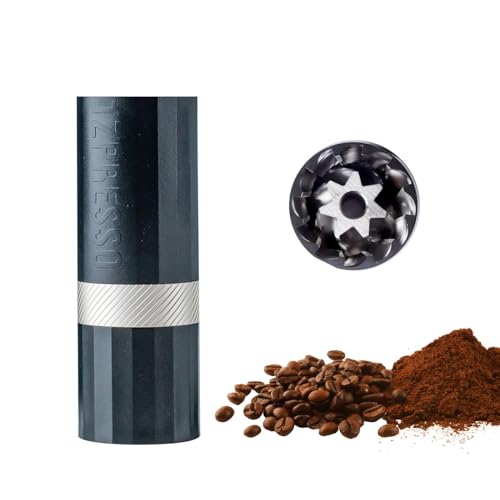
1Zpresso Q Air Manual Coffee Grinder
The lightest grinder in 1Zpresso's Q Series comparison, built around a stainless steel conical burr with 30 clicks per rotation and a numbered setting dial. 1Zpresso says the body is smaller than a soda can and nests inside the plunger of an AeroPress, and rates it for 15 to 20 grams of coffee per fill.

1Zpresso Q Manual Coffee Grinder
The all-metal sibling of the Q Air. 1Zpresso describes it as crafted entirely from metal with dual bearings and a triaxial structure, running a stainless steel conical burr with 30 clicks per rotation, and rates it for 15 to 20 grams per fill.

TIMEMORE Chestnut C3 Manual Coffee Grinder
A 25-gram-capacity hand grinder built around a 38mm CNC-machined stainless steel conical burr (S2C660) that TIMEMORE rates at 55 to 58 HRC hardness, with a double-bearing central axis and roughly 36 steps of internal adjustment.

TIMEMORE Chestnut C3 ESP Pro Manual Coffee Grinder
The espresso-tuned version of the C3, using the same 38mm S2C660 stainless conical burr but a dial TIMEMORE rates at 0.0233mm per click across roughly 36 levels, in an all-metal one-piece body with a foldable crank handle.

1Zpresso X-Ultra Manual Coffee Grinder
1Zpresso's premium travel-oriented grinder: a heptagonal stainless steel burr with external adjustment at 60 steps per rotation, a magnetic catch cup 1Zpresso rates at 25 to 30 grams, and a foldable crank handle.

JavaPresse Manual Stainless Steel Coffee Grinder
An adjustable ceramic conical burr grinder with what JavaPresse describes as over 18 manual grind settings and no batteries or cords. The cheapest way to stop travelling with pre-ground coffee.