Decaf Coffee: The Complete Guide to Processes, Beans, and Brewing
 Tommie Chaney··Updated
Affiliate disclosure: Sweeter Grind is a participant in the Amazon Services LLC Associates Program. We may earn commissions on qualifying purchases at no extra cost to you.
Decaf coffee is ordinary coffee — same species, same farms — that has had most of its caffeine pulled out of the green bean before roasting. It is not caffeine free. A cup usually holds a few milligrams. The bigger variable today is not the caffeine left behind. It is quality, which now ranges from genuinely excellent to genuinely awful.
For forty years decaf deserved its reputation as a punchline. Roasters bought the cheapest green they could find, shipped it off to be stripped, then roasted the damage out of it. Nobody complained, because the people drinking it had already given up on flavour.
That is no longer the whole story. Specialty roasters now buy decaf lots at the same cupping bar as their caffeinated coffee, and the processing has genuinely improved. In our view, decaf is now a quality question rather than a compromise — but only if you buy it like specialty coffee and brew it like a slightly different bean. The best decaf we have tasted in the last two years would hold its own on any menu. The supermarket bag roasted dark last year is exactly as bad as it ever was.
What Decaf Coffee Actually Is
There is no decaf plant. Nobody grows a caffeine-free coffee tree at commercial scale, and the low-caffeine varieties that occasionally make the news are research curiosities. Decaf is a processing category applied after harvest, not a species, a variety or an origin.
Every other variable still applies. A decaf can be a washed Ethiopian heirloom or a natural Brazilian, single origin or blend, roasted light or scorched, and the ultimate guide to coffee beans and roasts covers that landscape, and decaffeination is one extra step on top of it. Species matters too: Robusta carries roughly double the caffeine of Arabica and costs more to strip, which is one reason most quality decaf starts as Arabica — see Arabica vs Robusta.
The legal definitions are less tidy than the marketing suggests. Across Europe, national food laws generally cap coffee sold as decaffeinated at 0.1% caffeine by weight on a dry-matter basis for green and roasted coffee. The EU-level instrument people usually cite, Directive 1999/4/EC, actually covers coffee and chicory extracts rather than roasted beans: it permits the word "decaffeinated" on an extract only where anhydrous caffeine stays at or below 0.3% by weight of the coffee-based dry matter. Either way, it is a number you can test against.
The United States is vaguer. The widely repeated "97% of the caffeine removed" figure is what the National Coffee Association says the process achieves, but we could not find it written into a federal standard of identity the way the EU threshold appears in directive text. Treat 97% as a reliable industry convention rather than a statute.
How Decaffeination Actually Works
Every method solves the same problem the same way, and knowing that shape makes the marketing easy to read. Caffeine is water-soluble — but so are sugars, acids and aromatic precursors, which all want to leave with it.
So the job is never "remove caffeine." It is remove caffeine while leaving everything else behind, and every process is a different answer to that trade-off. That is the core of how decaf coffee is made, and it explains the price differences.
The sequence is almost always:
- Start with green beans. Decaffeination happens before roasting, at a dedicated facility far from the farm and the roaster.
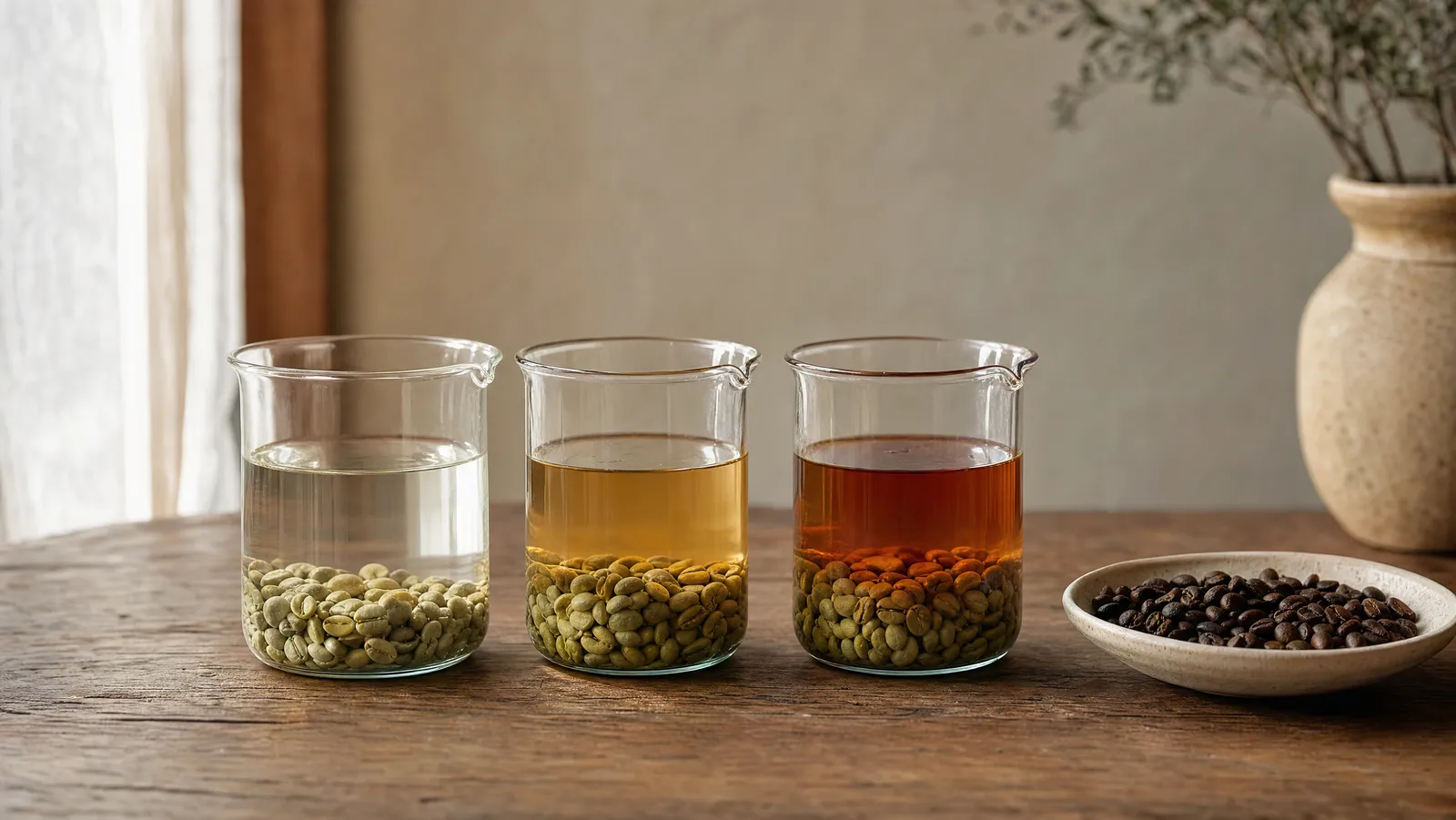
- Swell the bean with water or steam, opening the cell structure so caffeine can migrate out. Dry beans give up nothing.
- Introduce something that grabs caffeine — a solvent, a caffeine-depleted coffee extract, or pressurised CO2.
- Separate the caffeine from that carrier, usually with activated carbon, and recycle the carrier.
- Dry the beans back down and ship them to the roaster.
The caffeine does not vanish, incidentally — it is recovered and sold into soft drinks and pharmaceuticals, which is part of why decaffeination is viable at all.
The four families are direct solvent, indirect solvent, water-only and supercritical CO2. Direct means the solvent touches the bean; indirect means it works on the water the beans soaked in, and the beans go back into that water. None of this replaces the washed, natural and honey coffee processing methods that happen at origin — a coffee has both, and bags routinely list both.
Swiss Water, Sugarcane, and CO2
The three names you meet most often on specialty bags are Swiss Water, sugarcane EA and CO2, but solvent methods still carry most of the volume — the National Coffee Association calls the European Method, the direct methylene chloride process, the most common decaffeination method.
| Process | Caffeine carrier | Typical flavour outcome | Relative cost | On the label |
|---|---|---|---|---|
| Direct solvent ("European Method") | Methylene chloride, on the beans | Clean but often flat | Lowest | Usually unlabelled |
| Indirect solvent | Methylene chloride or ethyl acetate, on the soak water | Similar; gentler on the bean | Low | Rarely named |
| Sugarcane EA | Ethyl acetate from fermented sugarcane | Sweet, syrupy, a touch of molasses | Moderate | "Sugarcane process", "EA decaf" |
| Swiss Water | Caffeine-depleted green coffee extract | Transparent; keeps origin character | Higher | The Swiss Water logo |
| Mountain Water | Same principle, run in Mexico | Comparable to Swiss Water | Higher | "Mountain Water Process" |
| Supercritical CO2 | Pressurised carbon dioxide | Selective; good aromatic retention | Highest at small scale | "CO2 process" |
Some detail on the Swiss Water Process and its alternatives, since labels compress a lot.
Swiss Water. The company states its process uses only water, temperature and time, removing 99.9% of the caffeine via a proprietary Green Coffee Extract — water already saturated with coffee's solubles except caffeine, so caffeine diffuses out while flavour compounds have nowhere to go. Swiss Water puts the cycle at roughly 8 to 10 hours. That is a manufacturer claim about a trademarked process; it is also the most consistently good decaf we buy.
Sugarcane EA. Ethyl acetate occurs naturally in fruit, which is why this gets marketed as "natural decaf" — a phrase that on its own means almost nothing. In Colombia the EA is fermented from locally grown sugarcane. Cafe Imports describes steaming the coffee for about 30 minutes to open the pores, then draining and refilling an EA bath over roughly eight hours until caffeine is undetectable, then washing and a second steam to drive off residual solvent. Cuppers widely report added sweetness; in our experience sugarcane decafs are the most reliably pleasant, if not the most transparent.
Supercritical CO2. Carbon dioxide held above its critical point sits between gas and liquid and is unusually selective, taking caffeine and leaving carbohydrates and peptides largely intact. A life-cycle assessment of industrial CO2 decaffeination published in Chemical Engineering Transactions describes commercial conditions around 90°C and 250 bar, running about 11.5 hours for Arabica and 22 hours for Robusta to extract 97% of the caffeine. The catch is capital: FutureLearn chemistry material notes such a plant is only viable above roughly 3,000 tonnes a year, which is why CO2 decaf turns up in big brands and rarely on microlots.
How Much Caffeine Is Left
This is the question people came for, and the honest answer is a range rather than a number.
| Drink | Caffeine | Source |
|---|---|---|
| Brewed decaf, 8 fl oz | About 2–15 mg | National Coffee Association |
| Brewed decaf, 8 fl oz | About 2.4 mg | USDA FoodData Central |
| Brewed regular drip, 8 fl oz | About 95 mg | National Coffee Association |
| Brewed decaf, 16 oz (retail chain) | 12.0–13.4 mg | McCusker et al., J. Analytical Toxicology, Oct 2006 |
| Decaf espresso, single shot | 3.0–15.8 mg | McCusker et al., J. Analytical Toxicology, Oct 2006 |
| Brewed green tea, 8 fl oz | About 28.8 mg | International Food Information Council |
The McCusker study matters because it measured real drinks bought over a counter rather than laboratory samples. Across ten decaffeinated samples from various outlets, the researchers found caffeine ranging from 0 to 13.9 mg per 16-ounce serving — wide enough that "decaf" tells you the order of magnitude and nothing more precise. That spread is how much caffeine decaf actually contains in practice: green coffee starts at different caffeine levels, processes run to different endpoints, and brew strength varies enormously.
Volume is the variable people forget. At the top of the National Coffee Association's range — 15 mg per 8 ounces — a 16-ounce decaf lands near 30 mg, more than the 28.8 mg the International Food Information Council lists for an 8-ounce cup of green tea. Four large decafs is not a caffeine-free day. If you are counting, our caffeine calculator does the arithmetic across drink sizes.
For most people this is academic. If you are highly caffeine-sensitive, pregnant, or managing a condition where intake matters, treat the numbers as real and have the conversation with your doctor rather than a coffee blog.
The Health Questions
Two questions get tangled together: whether decaf carries the health associations coffee does, and whether the solvent used to make it is a problem. They deserve different answers.
On the first: the research is reassuring, and it is observational. A systematic review and dose-response meta-analysis published in Diabetes Care in 2014, covering 1,109,272 participants across 28 prospective studies, found coffee inversely associated with type 2 diabetes risk for both caffeinated and decaffeinated coffee — a relative risk of 0.91 (95% CI 0.89–0.94) per extra cup per day for caffeinated and 0.94 (0.91–0.98) for decaf. The proposed mechanisms centre on compounds that survive decaffeination, chlorogenic acids and magnesium among them. None of it establishes cause, and none of it means a cup of decaf does anything for you specifically.
On the second: methylene chloride is the live controversy, and it deserves precision rather than volume. Under 21 CFR 173.255(c) the FDA permits it as a residue from caffeine extraction at a level not to exceed 10 parts per million (0.001 percent) in decaffeinated roasted coffee and decaffeinated soluble coffee extract. That is the actual rule.
In December 2023, a coalition including the Environmental Defense Fund, Breast Cancer Prevention Partners, the Center for Environmental Health, the Environmental Working Group and Lisa Lefferts petitioned the FDA to revoke the food-additive authorisation for four solvents including methylene chloride, arguing the Delaney Clause bars carcinogenic additives from food. As Daily Coffee News reported, the FDA reopened a comment period on that petition which closed on 29 June 2026, and the agency has not issued a decision. The National Coffee Association opposes the ban; its president Bill Murray has said it would "defy science and harm Americans' health," and the association notes roughly 10% of US adults drink decaf daily, with the European Method the most common way it is produced. The NCA also cites the FDA as describing the risk from European Method decaf as "essentially non-existent."
Our reading: methylene chloride is volatile, boiling at around 40°C, far below roasting temperature. The most-cited testing of finished retail decaf comes from the Clean Label Project, which commissioned the accredited lab Eurofins to run double-blind tests on supermarket decaf and reported detectable methylene chloride in several major brands. Every result it published sat below the regulatory limit, though the group said the levels were 10 to 100 times higher than in its own 2020–2021 round. That is one advocacy-commissioned dataset rather than a settled body of evidence, so what a consumer can actually lean on here is genuinely limited. If the uncertainty bothers you, Swiss Water, Mountain Water, sugarcane EA or CO2 decaf removes the question for a few dollars a bag — a reasonable way to spend a few dollars, but not the same as establishing that solvent decaf is harmful.
The other recurring claim is acidity and reflux. Decaf is sometimes marketed as gentler on the stomach, and some people do find it sits better. The usual mechanism offered — caffeine driving gastric acid secretion — is only part of a picture that also involves chlorogenic acids and roast level, and responses vary too much for us to promise anything. If you are asking whether decaf coffee is bad for you because of a specific condition, that is a doctor question.
Why Decaf Tastes Different
Decaf does taste different, and the reasons are physical rather than psychological.
Flavour precursors leave with the caffeine. No process is perfectly selective. Sugars, amino acids and chlorogenic acids are all somewhat mobile in hot water or solvent, and some fraction goes down the drain. Those compounds are the raw material for Maillard browning, so a decaf bean reaches the roaster with slightly less to work with. The best processes minimise this. None eliminate it.
The bean itself is structurally altered. Perfect Daily Grind notes that decaf green coffee arrives a few shades darker than regular green, lighter and less dense, with cell structure degraded by the swelling-and-drying cycle.
It roasts faster and reads darker than it is. Lighter, more porous beans push the roast along faster after first crack, and second crack arrives sooner. Worse, surface colour runs ahead of actual development, so a decaf can look fully roasted while tasting underdeveloped — or blow past the target while the roaster is still reading colour. The same Perfect Daily Grind piece reports that Swiss Water's sample roasting of decaf uses a charge temperature of 375–400°F (190.5–204.5°C), and our guide to understanding coffee roast profiles explains what those decisions do to the cup. This one mechanism explains most bad decaf: treat it like a normal bean, watch the colour, pull late, and you get the burnt, hollow cup everyone remembers from the 1990s.
It off-gasses faster. More porous beans lose CO2 faster and let oxygen in more readily. Roasters who specialise in decaf tend to put the practical consequence in espresso rather than in flavour: one UK decaf specialist places the best crema window at roughly seven to twenty-one days post-roast and suggests buying small enough bags to finish inside about three weeks. Our guide to resting and storing freshly roasted coffee covers the degassing curve; with decaf, assume the useful part of it is shorter.
It grinds differently. Brittle, low-density beans shatter rather than fracture cleanly, producing more fines at any given setting. Fines extract fast and clog a bed, which is why a setting that gave balanced regular coffee gives a slow, muddy decaf.
Brewing Decaf Well
None of that is a reason to avoid decaf. It is a reason to stop brewing it on autopilot. The practical version of why decaf tastes different and how to brew it comes down to four adjustments.
- Grind a little finer, then check. Counterintuitive given the extra fines, but most decaf dial-in advice points the same way: the altered bean structure usually wants a click or two finer than your regular setting. Start there and taste; if the brew turns muddy and slow, go back. For per-method reference points, see our grind size guide.
- Treat temperature as a variable, not a setting. Roaster advice genuinely splits here: some decaf specialists brew hot, near 96°C, while others recommend easing down to 88–93°C on the grounds that porous decaf over-extracts easily. Try one direction, taste, and move the other way if the cup turns bitter or thin.
- Do not judge it on day 14. A decaf that was lovely in week one can be flat by week four. Buy smaller bags more often.
- Expect a different target, not a worse one. Decaf rarely delivers the high-acid sparkle of a great washed Kenyan. It delivers sweetness and body. Chase that instead.
If a cup comes out sour and thin, or bitter and drying, the diagnosis is the same as for any coffee — coffee extraction 101 covers reading those signals and which variable to move. The difference is that you will be moving them more often, because decaf bags vary more. One last thing: taste it slightly cooler than you would normally. The aromatics are subtler and read better once the cup drops below scalding.
Decaf for Espresso
Espresso is where decaf's physical differences stop being academic and start ruining shots. Brittle beans plus more fines means uneven particle distribution, and uneven distribution at nine bars means channelling. The classic symptom is a shot that looks fine for four seconds and then sprints — spurting streams from a bottomless portafilter, a cratered puck, and a sour, thin cup despite a "correct" yield. Home baristas and roasters converge on the same fixes:
- Go finer, sometimes noticeably finer. A step or two below your regular setting usually covers a medium-roast decaf, but two coffees both labelled decaf can want settings on opposite sides of your dial.
- Consider a slightly higher dose. Extra dose adds resistance and body, which can help counteract a fast flow. A standard recipe is still the sensible starting point — one decaf specialist suggests 18 g in for 36 g out in 25 to 30 seconds — and you can nudge the dose up a gram from there if the shot still runs away.
- Take puck prep seriously. A WDT tool and a level tamp do more for decaf than for any other coffee you own, because you are fighting a fines-heavy bed.
- Use it fresher. The compressed degassing window hits crema first; a decaf four weeks past roast pulls thin and pale even when the extraction is fine.
Roast level compounds all of this, since the weakened cell structure breaks down further at high temperature. When we go looking for the best decaf espresso beans, we want a medium roast with a recent roast date from a roaster who lists the decaffeination method — that last detail is usually a proxy for whether anyone in the building is paying attention.
What to Buy
Shopping for decaf is shopping for coffee, with one extra column and a much tighter deadline.
Roast date over everything. Not a tiebreaker — the whole game. A bag roasted inside the last three weeks by a competent roaster beats a more prestigious coffee that has been sitting for three months, every time. A "best before" date is not a roast date and tells you nothing useful.
Insist on a named process. Swiss Water, Mountain Water, sugarcane EA, CO2 — any of them. A roaster who names the process is telling you they chose it. A bag that says only "decaffeinated" is usually solvent-processed and, more tellingly, from someone who did not think you would care.
Insist on a named origin. "Colombia, Huila, sugarcane EA" is a coffee. "Decaf blend" is a category. That gap on the shelf is the gap between the two eras of decaf.
Read the rest of the bag properly. Variety, altitude, roast level, tasting notes that sound like a coffee rather than a candle — our guide on how to read a coffee bag label separates the real signals from the decoration.
Buy small. Given the compressed freshness window, a 250 g bag you finish in two weeks beats a kilo at a better unit price.
Specialty roasters beat supermarkets here by a wider margin than for regular coffee, because the failure modes — old stock, dark roasting, anonymous green — hit decaf hardest. When we shortlist the best decaf coffee beans, the filter is simple: recent roast date, named process, named origin, a roaster whose caffeinated coffee we already trust. Expect to pay a premium, since decaffeination adds a shipping leg, a processing step and some yield loss.
Instant and Convenience Decaf
We are not going to be snobs about this. Instant decaf and decaf pods have a legitimate place, and it is bigger than most specialty writing admits. Instant is a different product, not a worse version of the same one. At its best it is convenient, consistent and completely fine; at its worst it is flat and papery. The drying method is the biggest quality variable. Freeze-dried instant preserves far more aromatic character than spray-dried, which drives volatiles off with heat — the first thing we check on a jar.
Where instant wins: hotel rooms, office kitchens, camping, and the 9pm cup where the alternative is not brewing at all. Anyone hunting for the best decaf instant coffee should look for freeze-dried on the label, a named decaffeination process, and small jars rather than bulk, since instant stales quickly once opened. Pods sit in similar territory: real convenience, a lower ceiling, and pre-ground coffee that has been sitting longer than you would like.
Half-Caff and Tapering
Half-caff is the most underrated setting on the dial, and it is trivially easy to make yourself: weigh equal parts regular and decaf, grind them together, brew as normal. You control the ratio, you keep beans you actually like on both sides, and you pay nothing extra. Pre-blended half-caff coffee exists, but it locks you into someone else's ratio and usually someone else's mediocre decaf.
People arrive here for different reasons. Some are cutting caffeine gradually to avoid the headaches that come with stopping abruptly, shifting a quarter of the dose each week rather than going cold turkey. Some want a full-strength morning and a calm afternoon, and switch beans at noon. Some just want to sleep.
The argument we find most persuasive has nothing to do with milligrams. Coffee is a ritual, and the ritual is most of the value. Grinding, weighing, the smell of the bloom, ten minutes at the counter doing one thing — none of it depends on a stimulant. Decaf lets you keep the whole ritual and move it to 8pm. Grind the two coffees together at one setting, incidentally; grinding separately is fuss with no payoff we have ever tasted.
Where to Buy Fresh Decaf
The supply chain is the reason most decaf is bad, so it is worth being deliberate about where you buy.
Roaster direct is the default. Order from the roastery, get a roast date, get it within days. Most specialty roasters now keep a decaf in permanent rotation, and if they are serious it gets a named origin, a named process and its own roast profile.
Subscriptions solve freshness structurally. A bag every two or three weeks keeps you permanently inside the window. Set the interval to match how much you drink.
Local roasters are worth a phone call. Ask which decaf they carry and when it was last roasted. Anyone who answers in one sentence is worth buying from.
The supermarket is a last resort, with rules. Look for a roast date rather than a best-before, prefer valve-sealed bags to tins, and skip anything visibly oily or roasted near-black.
For anyone comparing options on where to buy fresh specialty decaf, one question sorts the field: will the seller tell you the roast date without being asked. Everything else follows.
Common Decaf Mistakes
- Buying on price. Decaf costs more to produce, so a cheap one was made cheap somewhere — old green, dark roasting, or both.
- Ignoring the roast date. The most expensive mistake. Decaf's freshness window is shorter, so age costs you more.
- Accepting over-roasted supermarket decaf as normal. If every decaf you have had tasted burnt, you were drinking coffee roasted dark to hide green-coffee defects — a purchasing problem, not a decaf problem.
- Brewing it identically to regular coffee, then blaming the bean for the flat result.
- Keeping a bag for three months. A kilo bought for the unit price spends its last month tasting of cardboard.
- Assuming the process does not matter. If you wrote decaf off on one bag, you tested one process.
Frequently Asked Questions
Does decaf coffee have any caffeine at all?
Yes. Decaffeination removes most of the caffeine, not all of it. The National Coffee Association puts a typical 8-ounce cup at roughly 2 to 15 mg, against about 95 mg for regular drip, and a USDA FoodData Central entry for brewed decaffeinated coffee lists about 2.4 mg per 8 fl oz. European food law generally caps decaf at 0.1% caffeine on a dry-matter basis for green and roasted coffee, and EU Directive 1999/4/EC sets 0.3% for coffee extracts, so the ceiling is regulated even if the figure in your cup is not.
Is decaf coffee bad for you?
The observational research does not suggest so: a 2014 Diabetes Care meta-analysis covering around 1.1 million participants across 28 prospective studies found both caffeinated and decaffeinated coffee inversely associated with type 2 diabetes risk. The open question is the solvent. The FDA permits methylene chloride residues up to 10 ppm in decaffeinated roasted coffee under 21 CFR 173.255, advocacy groups have petitioned to revoke that authorisation, and the agency has not ruled. The consumer-facing testing evidence is limited. If that uncertainty bothers you, water-process and CO2 decafs sidestep it — and anyone with a specific medical concern should ask their doctor.
Why is decaf more expensive than regular coffee?
Because there is an extra industrial step with real costs attached. Green coffee is shipped to a decaffeination facility, processed, dried and shipped on, and some mass is lost on the way. The water and supercritical CO2 processes are also capital-intensive — FutureLearn chemistry course material puts the viability threshold for a supercritical CO2 plant at roughly 3,000 tonnes of decaf a year — and those fixed costs land in the bag price.
Will decaf keep me awake?
For most people, no — a few milligrams per cup is well below the doses research typically links to disrupted sleep in adults. But sensitivity varies, and volume compounds: at the top of the reported range, two large decafs can carry more caffeine than a cup of green tea, which the International Food Information Council lists at about 28.8 mg per 8 ounces. If an evening decaf genuinely seems to affect you, take that seriously rather than dismissing it.
Does decaf actually taste worse than regular coffee?
Different, and sometimes worse — but far less often than it used to be. Decaffeination removes some flavour precursors with the caffeine, and the altered bean structure makes decaf harder to roast well. Those are real limits. Within them, a well-sourced, carefully roasted decaf can be excellent. It leads with sweetness and body rather than bright acidity: a different target, not a lower one.
Is Swiss Water actually better than other processes?
It is transparent about what it is and sidesteps the solvent question, which is a real advantage; the company states the process uses only water, time and temperature and removes 99.9% of caffeine. But process alone does not make a good coffee. A Swiss Water decaf from mediocre green, roasted dark, loses to a sugarcane EA lot from an excellent farm roasted with care. Treat process as one signal among several — origin, roast date and roaster still decide the cup.
Explore the full series
- How Decaf Coffee Is Made (All Four Processes Explained) — Solvent, sugarcane EA, Swiss Water and supercritical CO2 — what each one does to the bean.
- Best Decaf Coffee Beans in 2026 — Six picks with price-per-ounce arithmetic, and the buying framework that outlives them.
- Swiss Water vs Sugarcane EA vs CO2: Which Decaf Process Tastes Best? — Swiss Water, sugarcane EA and CO2 compared as a buyer — and why "chemical free" is a marketing frame.
- Does Decaf Coffee Have Caffeine? Here Are the Numbers — How much caffeine is actually left, what drives the spread, and what it means for sleep and medical limits.
- Why Decaf Tastes Different — and How to Brew It Better — The physical reason decaf tastes different, and the four adjustments that close most of the gap.
- Best Decaf Espresso Beans for Home Machines — Six bags for home espresso, with price-per-ounce arithmetic and which ones actually name their process.
- Best Decaf Instant Coffee in 2026 — Six jars and packets compared on real cost per cup, and the one spec that separates good instant from bad.
- Is Decaf Coffee Bad for You? What the Research Actually Says — The observational research, the 10 ppm solvent limit, and the petition still sitting with the FDA.
- Half-Caff Coffee: How to Cut Caffeine Without Losing the Ritual — Blend it yourself with a scale, what each ratio costs you in caffeine, and why pre-blended bags lose.
- Where to Buy Fresh Specialty Decaf (and What to Avoid) — Six buying channels ranked on one thing — whether you can see a roast date before you pay.
This series is complete — all ten guides above are published.