How Decaf Coffee Is Made (All Four Processes Explained)
 Tommie Chaney·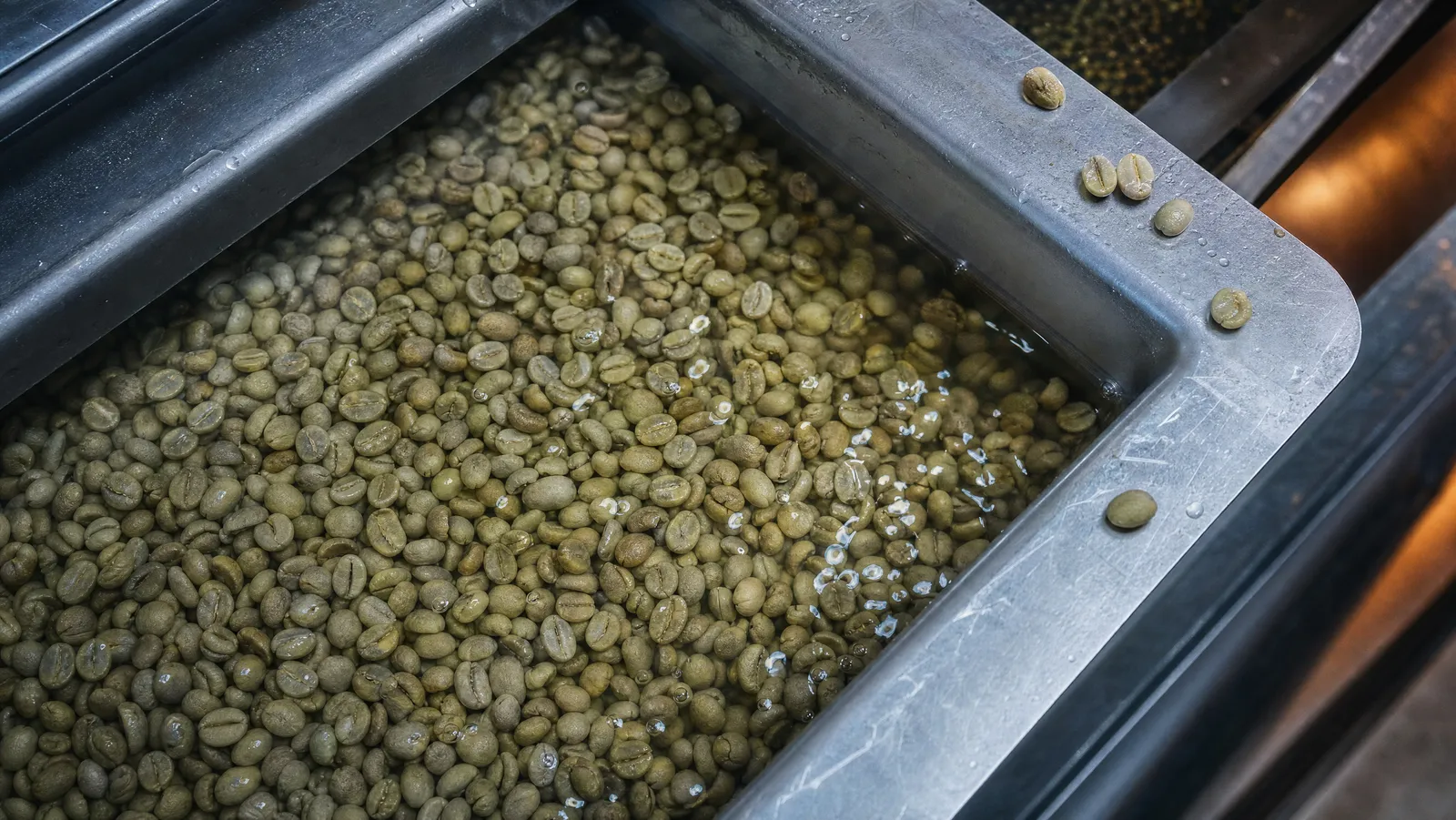
Affiliate disclosure: Sweeter Grind is a participant in the Amazon Services LLC Associates Program. We may earn commissions on qualifying purchases at no extra cost to you.
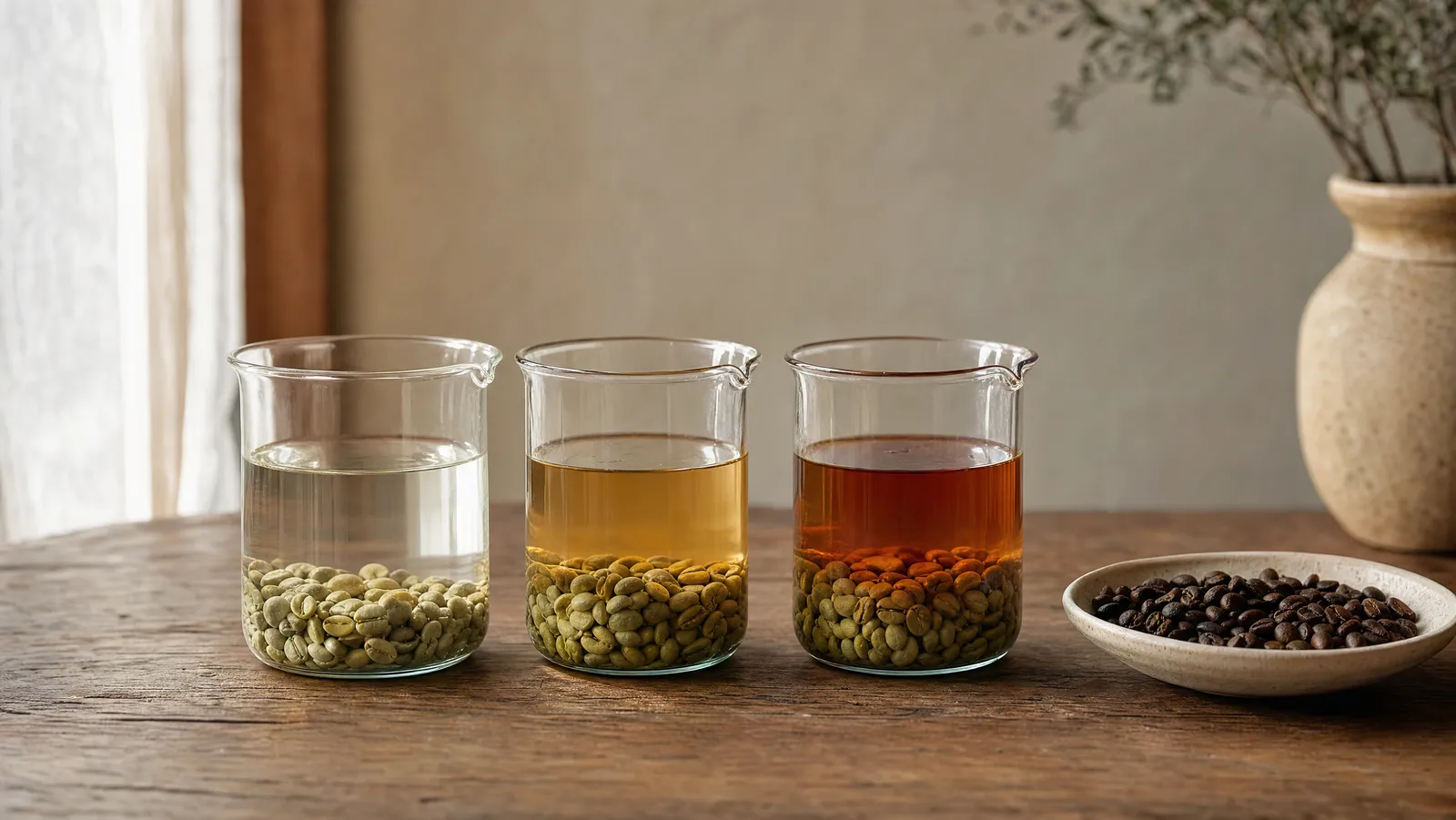
Every commercial decaf works the same way at the top level: green, unroasted beans are swollen with water or steam, then the caffeine is pulled out with one of three agents — a chemical solvent, water carrying a pre-loaded coffee extract, or pressurized carbon dioxide. That is how decaf coffee is made. The named processes on the bag differ only in which agent they use and how much flavor leaves with the caffeine.
Two things surprise most people. Decaffeination happens to green coffee, before roasting. And no process removes all of it. For what to buy and what to expect, start with our guide to decaf coffee; this is the mechanism underneath it.
The One Problem Every Process Is Solving
Caffeine dissolves in water. That is the easy part. So does nearly everything else that matters: chlorogenic acids, sugars, amino acids and the other soluble compounds that become aroma and sweetness in the roaster.
Soak a green bean in hot water and you do not get decaf. You get a tank of brown water and a bean with no future. Caffeine is only a small fraction of the seed by weight — more in robusta than arabica, as we cover in Arabica vs Robusta — so a slightly indiscriminate process takes far more flavor than caffeine.
Every method is an answer to one question: how do you make the caffeine leave while the flavor precursors stay?
The Four Families of Decaffeination
Four families, not four processes, with branded variants of each.
| Process | What pulls the caffeine out | Label wording you will see | Typical flavor cost | Where it is used |
|---|---|---|---|---|
| Indirect solvent | Soak water treated with methylene chloride or ethyl acetate, then returned to the beans | "European Method", "MC decaf", often nothing | Moderate; aromatics flatten | Supermarket, commercial |
| Direct solvent | Steamed beans washed repeatedly in the solvent itself | "Direct contact", or "naturally decaffeinated" if EA | Moderate | Commodity, mid-tier specialty |
| Sugarcane EA | Ethyl acetate fermented from sugarcane molasses | "Sugarcane process", "EA natural", "naturally decaffeinated" | Low; often adds sweetness | Colombian specialty, cafés |
| Water process | Caffeine-free green coffee extract plus activated carbon | "Swiss Water Process", "SWP", "Mountain Water" | Low to moderate; top notes soften | Specialty and organic lots |
| Supercritical CO2 | Carbon dioxide held between liquid and gas by pressure | "CO2 process", "carbon dioxide decaffeinated" | Low; the most selective | Very large batches, instant |
Where Decaf Came From: Roselius, Seawater, and Benzene
The German merchant Ludwig Roselius commercialized decaffeination in the early 1900s and sold the result as Kaffee HAG. His 1906 patent steamed green beans with a salt solution, then used benzene as the solvent — a chemical now classified as a human carcinogen and long abandoned as a coffee decaffeination solvent.
The origin myth deserves care. The usual telling is that a shipment of his coffee was soaked in seawater in transit and arrived with its caffeine gone and its flavor intact. Wikipedia's decaffeination entry states this as history; trade coverage hedges, with Barista Magazine writing that Roselius "is said to have accidentally stumbled upon the process." Our read: a good story rather than a documented event. The patent describes deliberate chemistry — brine, steam, an organic solvent — which is not what an accident looks like.
Solvent Processes: Methylene Chloride and Ethyl Acetate
Solvent decaffeination is the oldest surviving family and still the most widely used, particularly in commodity coffee. Two solvents dominate: methylene chloride (dichloromethane) and ethyl acetate. Indirect and direct describe where the solvent meets the coffee.
In the indirect method, as Coffee Review describes it, green beans soak in near-boiling water for hours. That water — loaded with caffeine and everything else soluble — is drained to a separate tank and treated with the solvent, which binds the caffeine. The stripped water, still carrying the oils and flavor compounds, returns to the beans so they reabsorb what they lost. The solvent never touches the coffee.
In the direct method, beans are steamed open, washed repeatedly in the solvent itself, then steamed again to drive off residues. Because the solvent boils far below roasting temperature, very little survives.
What the regulation actually says
In the United States, methylene chloride in decaf is governed by 21 CFR 173.255, which permits it as a residue from caffeine extraction "at a level not to exceed 10 parts per million (0.001 percent) in decaffeinated roasted coffee and in decaffeinated soluble coffee extract (instant coffee)."
Independent testing has found real-world levels below that ceiling, though with a wide spread. The Clean Label Project tested 17 decaf samples in 2022 and reported the methylene chloride traces it found as 10% to more than 99.5% below the FDA's limit — while noting that its own 2022 results came in higher than its 2020–2021 round. The petition to the FDA came from a different quarter: a coalition led by the Environmental Defense Fund filed it in December 2023, asking the agency to strike methylene chloride — along with benzene, trichloroethylene and ethylene dichloride — from the food additive regulations, as STAT News and FoodNavigator-USA reported. Advocates including the Clean Label Project have separately pushed state-level restrictions, notably California's Assembly Bill 2066.
The honest position is narrow: the residues measured in finished coffee are small and legal, and the objection is to the compound being permitted in food at all. If that ambiguity bothers you, buy water-process or sugarcane EA. That is a preference, not a health verdict.
"Naturally decaffeinated" is a marketing phrase
Ethyl acetate occurs naturally in ripening fruit and in wine, and Coffee Review notes bluntly that because of this, "some publicists and brochure writers have taken to calling coffees decaffeinated using ethyl acetate 'naturally decaffeinated.'"
Nothing there is untrue. It is also not what most shoppers hear. The phrase signals a solvent process using EA — which may be fermented from sugarcane, or synthesized industrially. If the bag does not say which, you cannot tell. Our how to read a coffee bag label guide covers the same pattern elsewhere.
Sugarcane EA: The Specialty Favourite
The version specialty roasters champion is Colombian. Sugarcane molasses is fermented into ethyl acetate, and that EA decaffeinates coffee grown in the same country — sold as "sugarcane process" or "EA natural."
Descafecol is the processor most often named on bags. Its importer partners describe it as the only decaffeination facility in Colombia's Andean region, drawing water from the Nevado del Ruiz snowcap and its ethyl acetate from sugarcane grown in Palmira.
The sequence, as those processors describe it: green coffee is steamed at very low pressure to remove silverskin; the beans are moistened with hot water so they swell and the caffeine — bound to salts of chlorogenic acid — hydrolyzes and becomes mobile; EA circulates through the beans, binding the freed caffeine; the coffee is steamed again to drive off residual solvent before drying.
Why roasters like it: it is fast, it happens at origin so the coffee is not shipped across the world twice, and the cup keeps its sweetness. Sugarcane EA decafs commonly show soft fruit, panela sugar and a faintly rum-like edge — charming in espresso, slightly odd in a delicate filter. Whether that edge is a feature or a fingerprint is the heart of any Swiss Water versus sugarcane EA comparison.
The Swiss Water Process, Step by Step
Most explanations of how decaf coffee beans are made get this one wrong by calling it "soaking the beans in water." That would produce washed-out coffee. The real trick is a saturated solution.
Step 1: Harvest and green grading
Decaffeination starts with ordinary green coffee already picked, graded and processed at origin — washed, natural or honey, as covered in our guide to coffee processing methods.
Step 2: Build the green coffee extract
A sacrificial batch of green beans soaks in hot water until everything soluble — caffeine, acids, sugars, aromatics — has moved into the water. Swiss Water calls the result Green Coffee Extract, or GCE.
Step 3: Strip the caffeine out of the extract
That extract passes through activated carbon filters tuned to capture caffeine while letting flavor and aroma compounds through — Swiss Water describes them as "100% chemical-free carbon filters that selectively trap caffeine molecules." What comes out is flavor-saturated water with essentially no caffeine in it.
Step 4: Soak the production batch in that extract
Now the real coffee goes in. Because the GCE is already saturated with every water-soluble compound green coffee contains except caffeine, sugars and acids have no gradient to travel down and nowhere to go. Caffeine is the one molecule with somewhere to be. That is the whole mechanism, and why the water process does not rinse coffee to death.
Step 5: Recycle until the target is met
The now-caffeinated extract cycles back through the carbon filters and returns to the beans, over and over. Published descriptions put a run at roughly eight to ten hours; Swiss Water's own account says variables are monitored across about ten hours.
Step 6: Dry, grade and ship as decaf green
The beans are dried back to a stable moisture content, graded and shipped. Swiss Water states that green coffee leaving its facility is 99.9% caffeine free, with 0.1% residual caffeine — the company's own guarantee, measured on green coffee, not a regulatory finding about your cup.
Swiss Water piloted the process in Delta, British Columbia in the mid-1980s, per Barista Magazine. It is not the only one: Descamex in Mexico works on the same principle, using water from the Pico de Orizaba glacier. Its Veracruz plant opened in 1980 and the company says it has been producing decaffeinated coffee since 1981; the Mountain Water Process itself was patented later that decade.
Supercritical CO2
Push carbon dioxide past a certain pressure and temperature and it stops behaving like a gas or a liquid and becomes both — dense enough to dissolve things, mobile enough to diffuse through a bean. According to the Max Planck Society, CO2 enters that supercritical state at around 30 degrees Celsius and pressures above 73.8 bar; the same source credits the discovery to its chemist Kurt Zosel, who observed in 1967 that caffeine dissolves in it.
Commercially, steamed green beans go into a sealed vessel and CO2 is pumped in. Published process descriptions put working conditions around 250 to 300 atmospheres and 65 to 90 degrees Celsius, with runs from roughly eight hours to twenty-plus for robusta, which holds its caffeine more stubbornly. The loaded CO2 is then washed with water or passed over carbon to recover the caffeine, and recirculated.
Its advantage is selectivity — it takes caffeine and largely leaves flavor precursors alone. Its disadvantage is capital cost: vessels rated for 300 atmospheres are not cheap, which is why the method serves enormous batches of commodity and instant rather than a roaster's microlot. The Bremen processor CR3 runs a variant using subcritical liquid CO2, which its partners describe as gentler on aromatics.
What Happens to the Caffeine
It gets sold. Recovered caffeine is a commercial product, not waste — purified and supplied to soft drink makers, pharmaceutical manufacturers and cosmetics companies. The IARC monograph covering coffee and methylxanthines (1991) notes that roughly 80 to 90 percent of the caffeine extracted from green coffee goes to the beverage industry, with most of the rest used pharmaceutically. There is a decent chance the caffeine taken out of somebody's decaf ended up in a cola or a headache tablet, and that resale is part of what makes decaffeination viable at scale.
Why Decaf Costs More
- The processing fee. Decaffeination is tolled work, charged by the pound. CoffeeGeek reports fees that ran roughly $0.60 to $0.90 per pound before 2023 climbing to about $1.20 to $1.80 by 2024 and 2025.
- Yield loss. Soaking, steaming and re-drying cost weight. CoffeeGeek puts the shrink at around 10 to 12 percent — real money evaporating on expensive green.
- Double logistics. Unless the coffee is decaffeinated at origin, as on the Colombian sugarcane route, it ships to a plant and then onward to the roaster — two freight legs, weeks of delay.
- Small lots. Decaf is a minority of most roasters' volume, so it rarely gets the leverage their house blend does.
CoffeeGeek reported that at peak market prices, the landed cost of decaffeinated green reached roughly 330 percent of its 2023 level. That is the pressure behind current shelf prices.
What This Means for Your Cup
Process is a real flavor variable, but not the biggest one. In our view the ranking is green coffee quality first, roast second, process third. A brilliant Colombian run through a competent solvent plant beats a mediocre one that went through Swiss Water.
Some patterns hold. Water-process decafs tend to be clean and true to origin, with the top aromatics a little quieter. Sugarcane EA gains sweetness and a soft, slightly fermented warmth. CO2 decafs are usually neutral in a good way. The flat, woody reputation decaf carries comes mostly from old solvent lots made with low-grade green and roasted dark to hide it — stale beans, not chemistry.
Two practical moves: buy decaf with a visible roast date, and expect to re-dial your grinder rather than reuse the setting from your caffeinated bag. Processed beans are more brittle and porous, so at the same setting they tend to shatter into more fines and extract differently; adjust by taste, in small steps, in whichever direction the cup asks for. Our guide to understanding coffee roast profiles covers the rest, and our caffeine calculator shows what a switch does to your intake.
When you are ready to buy rather than understand, our roundup of the best decaf coffee beans picks across all four processes. For caffeine content, health questions and brewing, see Sweeter Grind's complete guide to decaf coffee.
Frequently Asked Questions
Is decaf coffee chemically treated?
Some of it is. Solvent decaffeination uses methylene chloride or ethyl acetate, and 21 CFR 173.255 caps methylene chloride residue in decaffeinated roasted coffee at 10 parts per million. Clean Label Project testing found traces in major brands below that ceiling — by 10% to more than 99.5% in its 2022 round. Water-process and CO2 decafs use no chemical solvent, so look for "Swiss Water", "Mountain Water" or "CO2 process" to sidestep the question.
How does decaf coffee work if caffeine dissolves in water like everything else?
Each process exploits a different property of caffeine. Solvents bind to it preferentially; the water process uses an extract already saturated with every soluble compound except caffeine, so only caffeine has a gradient to move down; supercritical CO2 is simply more selective than water.
Does decaf coffee still contain caffeine?
Yes, a little. The National Coffee Association says decaffeination typically removes around 97 percent of the caffeine, leaving approximately 2 to 15 milligrams in an eight-ounce cup. Swiss Water separately guarantees its green coffee at 99.9 percent caffeine free — its own measurement, on green beans. We cover how much caffeine decaf actually contains in a separate article.
What does "naturally decaffeinated" mean on a coffee bag?
Almost always, that ethyl acetate was the solvent. Coffee Review points out that because EA occurs naturally in fruit, marketers began calling EA decaffeination "natural." Defensible rather than false — but unless the bag also says "sugarcane process," you cannot tell whether the EA was fermented or industrially synthesized.
Who invented decaf coffee, and when?
Ludwig Roselius commercialized it in Germany in the early 1900s, patenting his method in 1906 and selling the coffee as Kaffee HAG. It used benzene as the solvent, which is why it is long obsolete. The story that he found decaffeination after a shipment was soaked in seawater is usually told with hedging — Barista Magazine writes he "is said to have" stumbled on it — so we file it as legend rather than record.
Related reading
- the best decaf coffee beans — picks across all four processes
- coffee processing methods — washed, natural, honey
- how to read a coffee bag label — decoding marketing claims
- Arabica vs Robusta — why species changes the caffeine load
- the ultimate guide to coffee beans and roasts — the beans pillar
- our caffeine calculator — what a decaf switch does to your intake