Swiss Water vs Sugarcane EA vs CO2: Which Decaf Process Tastes Best?
 Tommie Chaney·
Affiliate disclosure: Sweeter Grind is a participant in the Amazon Services LLC Associates Program. We may earn commissions on qualifying purchases at no extra cost to you.
No single process wins. Swiss Water Process decaf and sugarcane EA both sit in the top tier, supercritical CO2 is close behind, and methylene chloride trails — but the gap between a good decaf and a bad one is almost always the green coffee and the roast date, not the letters on the bag.
The clean routes differ less from each other than any of them differs from a stale bag. Our guide to decaf coffee covers caffeine, health and brewing; this piece is the head-to-head on process alone.
What "Chemical Free" Actually Means
Water is a chemical. So is caffeine. "Chemical free" is a marketing frame rather than a chemistry one, and taking it literally makes the comparison impossible to reason about. What shoppers mean is narrower and more sensible: no synthetic solvent touched my beans. Two routes clear that bar without argument — the water processes and supercritical CO2. Neither adds a solvent at all.
Ethyl acetate is the interesting case. It is a solvent, and National Geographic reports it is sometimes called the "natural solvent" because it occurs naturally in fruits such as bananas and in sugarcane. A sugarcane EA decaf is therefore not solvent-free. It is solvent-processed, with a solvent fermented from a plant rather than made in a refinery. Whether that matters to you is a values question, not a chemistry one.
The fourth route, methylene chloride, is the one the phrase was coined to avoid — and, according to ConsumerLab executive editor Meredith Worthington speaking to National Geographic, the most widely used decaffeination method of the four.
The Three Routes at a Glance
Four rows, because a comparison that omits the most common process is not one. For the full mechanism behind each, see how decaf coffee is made.
| Process | What removes the caffeine | How it shows on the label | Flavour tendency | Typically used for |
|---|---|---|---|---|
| Swiss Water / water process | Caffeine-free green coffee extract plus activated carbon filters | "Swiss Water", "SWP", "Mountain Water", "water process" | Clean and origin-true; top aromatics a little quieter | Specialty and organic lots |
| Sugarcane EA | Ethyl acetate fermented from sugarcane molasses | "Sugarcane process", "EA natural", sometimes only "naturally decaffeinated" | Sweet and rounded; roasters report a soft, faintly fermented warmth | Colombian specialty, espresso and milk drinks |
| Supercritical CO2 | Carbon dioxide held between liquid and gas by pressure | "CO2 process", "carbon dioxide decaffeinated"; often unstated | Neutral and selective, with little obvious fingerprint | Very large commercial batches, instant coffee |
| Methylene chloride | Methylene chloride, applied directly or via treated water | "European method", "MC decaf" — very often nothing at all | Flatter aromatics in older commodity lots | Supermarket and commodity decaf |
Swiss Water: What the Certification Guarantees
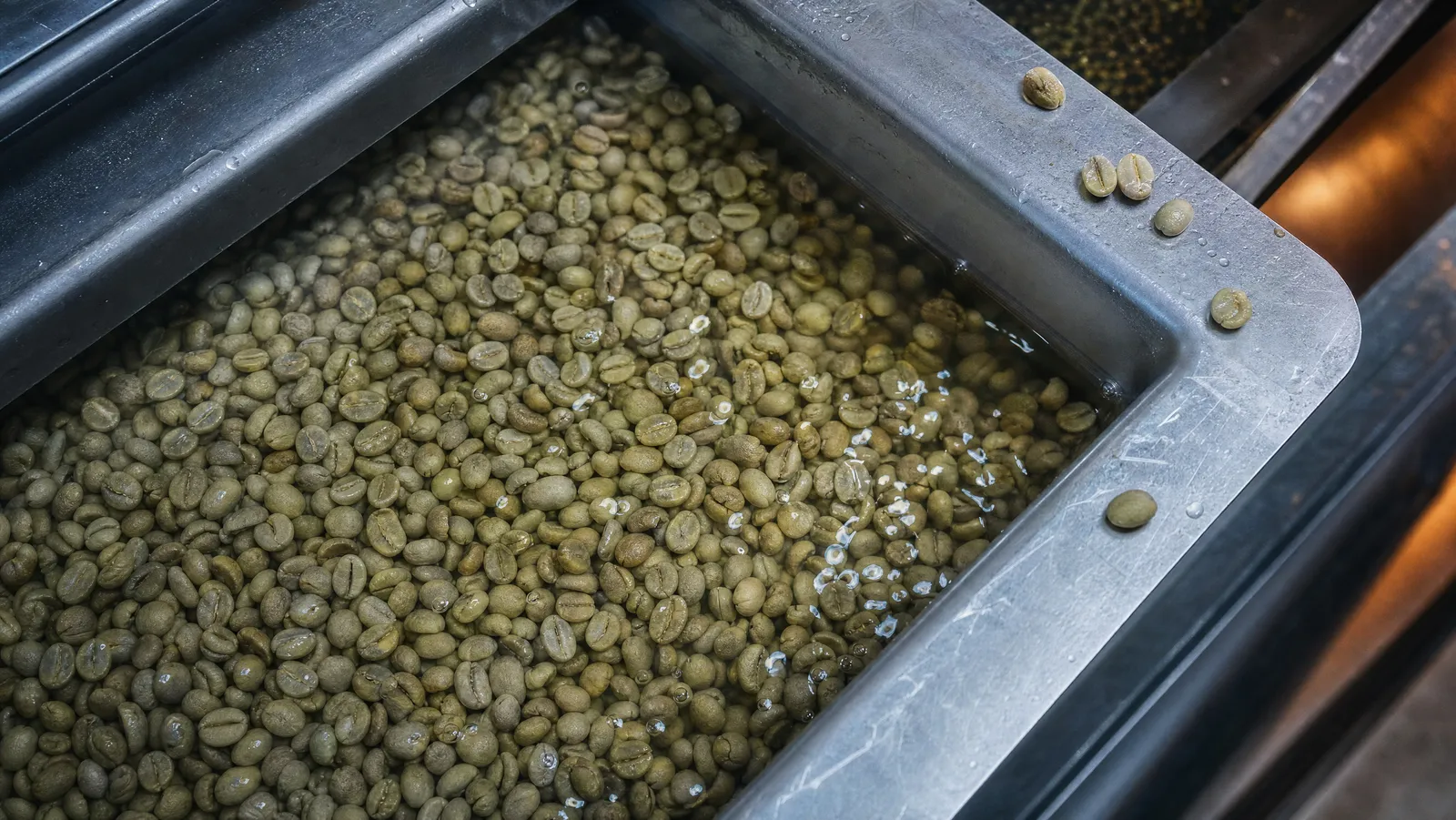
The mechanism, briefly: a sacrificial batch of green coffee is soaked until the water holds every soluble compound the bean contains, that extract runs through carbon filters that pull out the caffeine, and the production coffee then soaks in the result. Because the extract is already saturated with sugars, acids and aromatics, those compounds have nowhere to go. Caffeine is the only molecule with a gradient to travel down.
Swiss Water describes those filters as "100% chemical-free carbon filters that selectively trap caffeine molecules," and the resulting extract as "a 100% caffeine and chemical-free symphony of water and coffee's essential compounds." The company positions the method as "the first-ever alternative to chemical decaffeination."
What makes the label unusually reliable is not the chemistry — it is the trademark. "Natural process" means whatever the person printing the bag wants. Swiss Water is a registered mark belonging to one company, whose own site lists a single facility address at 7750 Beedie Way in Delta, British Columbia. You know which agent removed the caffeine and, unusually, where.
What the mark does not tell you matters more: the quality of the green that went in, who roasted it, and when. A Swiss Water mark on an anonymous commodity lot roasted eight months ago is still an anonymous commodity lot roasted eight months ago.
The 99.9% figure that circulates around water-process decaf is not specific to water processing — it is the European regulatory threshold. European rules cap coffee sold as "decaffeinated" at 0.1% caffeine by mass on a dry basis for roasted coffee, and EU Directive 1999/4/EC sets 0.3% for coffee extracts; 0.1% is simply 99.9% caffeine-free by mass. The United States has no equivalent percentage in regulation — the FDA's only decaf-specific coffee rule covers solvent residues — and the familiar "97% removed" figure comes from the National Coffee Association, which describes decaffeination as taking out "around 97%" of the caffeine. No process gets to zero, and we cover how much caffeine is left in decaf separately.
Sugarcane EA: The Specialty Favourite
The route specialty roasters adopted is Colombian and happens at origin. Sugarcane molasses is fermented to ethanol, the ethanol is combined with acetic acid to make ethyl acetate, and that EA circulates through steamed green coffee to bind the caffeine. The beans are washed and steamed again to drive off residual solvent.
Descafecol is the plant almost always named. According to the green coffee importer Belco, which sources from the plant, it sits in Manizales and was inaugurated in 1988 as the only decaffeination plant in Colombia; by the company's own account it is also the only facility sourcing its ethyl acetate specifically from sugarcane — a company statement, not an audited fact.
"Sugarcane" on the label is doing real work. Ethyl acetate can be fermented from cane or synthesized industrially, and the finished molecule is the same either way. The word on the bag is the only thing telling you which supply chain you funded.
Roasters like the route because it runs at origin, so the coffee makes one freight leg instead of two, and because the cup keeps its sweetness. That second point needs care. Sweetness retention is the consensus impression among roasters who sell sugarcane EA — people with an interest in selling it. Others argue the opposite: that repeated steaming and solvent contact dull the finest aromatics, so what reads as sweetness is partly an absence of brightness. Treat it as a tendency, not a law.
Supercritical CO2: The Industrial Workhorse
Push carbon dioxide past its critical point and it becomes dense enough to dissolve caffeine while still diffusing through a bean like a gas. Published working conditions vary by account. Scientific American describes high-pressure vessels "operating at roughly 250 to 300 times atmospheric pressure"; the Max Planck Society, whose chemist Kurt Zosel invented the method, describes CO2 heated to 70 degrees Celsius at 162 bar. Either way it is a serious pressure vessel, and Scientific American is blunt about the trade-off: the method is "capital-cost intensive, but it offers very good yields," typically extracting 96 to 98 percent of the caffeine originally present.
Vessels rated for hundreds of atmospheres only pay for themselves at volume. That is why you rarely see CO2 named on a 12-ounce specialty bag — the economics point toward container loads and instant production, not a roaster's two-bag lot. The irony is that CO2 is arguably the most selective agent of the four, pointed at coffee nobody was going to fuss over. If you find one from a roaster you trust, there is no flavor reason to avoid it.
And the One Most Decaf Actually Uses
Methylene chloride is, per National Geographic quoting ConsumerLab executive editor Meredith Worthington, the most widely used decaffeination method. Any comparison treating the category as a three-way race between clean processes is describing the specialty shelf, not the coffee aisle.
The regulation is specific. Under 21 CFR 173.255, methylene chloride is permitted as a residue from caffeine extraction at a level not to exceed 10 parts per million, or 0.001 percent, in decaffeinated roasted coffee and in decaffeinated soluble coffee extract.
Independent testing has come in beneath that, though not by a constant margin. Reporting in 2020 on the Clean Label Project's white paper, Food Safety Magazine wrote that the organisation tested 24 leading decaf brands and its lab detected methylene chloride in some of them at 50 to greater than 90 parts per billion — against an allowance of 10 ppm, or 10,000 parts per billion. The Clean Label Project's own follow-up paper reports that its February 2022 round came back "10x-100x higher than observed levels several years ago," while noting that, as in the earlier round, "all test results were all below regulatory limits."
The dispute is not about those numbers. A coalition led by the Environmental Defense Fund petitioned the FDA to remove methylene chloride, along with benzene, trichloroethylene and ethylene dichloride, from the food additive regulations, arguing that carcinogens should not be authorised in food at all. That petition remains under agency review, with a further public comment period run in 2026.
Our read: every published test result we could find stayed below the legal limit, and the petitioners' objection is a legal and precautionary one — the Delaney clause bars carcinogenic additives from food regardless of dose — rather than a finding about any particular cup. We are not qualified to tell you what that means for your health, and the agency has not ruled. If the ambiguity bothers you, buying water-process or sugarcane EA removes it. That is a reasonable preference, not a health verdict.
Does Process Actually Change the Taste?
It does, a little, and less than the marketing implies.
Decaffeination happens to green coffee, before roasting. No process adds quality that was not already in the lot — every one is a subtraction, differing only in how much flavor leaves with the caffeine. A well-sourced Colombian run through a competent solvent plant will beat a mediocre one that went through Swiss Water, because the ceiling was set at the farm and the process only decides how much survives.
The flat, woody reputation decaf carries is mostly not a process problem either. It comes from cheap green coffee, roasted dark to hide its defects, then sitting on a shelf for months because decaf turns over slowly. Fix those three things and the process differences shrink to details, as understanding coffee roast profiles sets out.
The tendencies are worth knowing, as tendencies. Water-process decafs read clean and true to origin, with the highest aromatics slightly subdued. Sugarcane EA reads sweeter and rounder, with a soft fermented edge that flatters espresso and milk and can sit oddly in a delicate filter brew. CO2 tends to be neutral in a good way. The lots that taste like cardboard are old commodity coffee — more the green and the age than the solvent.
Two practical notes. Buy decaf with a printed roast date and treat four weeks as your window. And expect to re-dial your grinder: decaffeinated beans are more brittle and porous, so your caffeinated setting will need adjusting by taste.
How to Tell What Your Bag Used
The decoder, in the order you will meet it:
- "Swiss Water" or "SWP" — water process, done at the Delta, British Columbia facility.
- "Mountain Water" — water process on the same principle, run in Mexico.
- "Sugarcane process", "EA natural", "caña de azúcar" — ethyl acetate fermented from cane, almost always Colombian.
- "CO2 process" or "carbon dioxide decaffeinated" — supercritical CO2.
- "Naturally decaffeinated" alone — ethyl acetate, source unstated; fermented or synthesized, you cannot tell.
- "European method", "MC decaf", or no process wording at all — most likely methylene chloride.
The absence of a process name is itself the signal. Water and sugarcane processing cost more, and nobody pays a premium then keeps quiet about it — the same logic we apply to roast dates in how to read a coffee bag label. To skip the detective work, our roundup of the best decaf coffee beans names the process for each pick.
Our Verdict
Buy a decaf that names its process and prints a roast date. That combination, not any one process, reliably predicts a good cup — and an unnamed process on an undated bag is the only real loser here.
If you want a tiebreaker anyway, this is ours. For filter brewing and single origins you want to taste clearly, Swiss Water Process decaf is the safest bet, because the mark tells you exactly what happened to the coffee. For espresso and milk drinks, sugarcane EA is our pick, on the strength of the sweetness roasters consistently report. Supercritical CO2 is good and rarely a choice you get to make. Methylene chloride is a decision about what you want permitted in your food.
Then ignore all of it in favour of a roaster you trust with a bag roasted three weeks ago. For caffeine, health research and brewing decaf well, read our complete guide to decaf coffee, or match one to how you brew with our coffee bean finder.
Frequently Asked Questions
Is Swiss Water Process decaf actually chemical free?
No added solvent is used, which is what the phrase is meant to convey. The process relies on water, a caffeine-free green coffee extract and activated carbon; Swiss Water describes the filters as "100% chemical-free carbon filters that selectively trap caffeine molecules." Water is itself a chemical, so read the phrase as "no synthetic solvent contacted the beans" instead.
Which decaf coffees are water processed?
Look for "Swiss Water" or "SWP", indicating processing at the facility the company lists in Delta, British Columbia, or "Mountain Water", the same principle run in Mexico. If a bag names no process, it is very unlikely to be water processed — roasters who pay for it say so.
Is sugarcane EA decaf the same as "naturally decaffeinated"?
Not quite. "Naturally decaffeinated" nearly always means ethyl acetate was the solvent, but it does not say where that EA came from. National Geographic notes EA occurs naturally in fruits such as bananas and in sugarcane, which is how marketers defend the word. Only "sugarcane process" or "caña de azúcar" tells you it was fermented from cane.
Does the decaffeination process change how the coffee tastes?
Yes, but less than the green coffee and the roast date do. Every process is a subtraction from what the farm produced, and each has a tendency — water process reads clean and origin-true, sugarcane EA sweeter and rounder, CO2 neutral. Those are impressions reported by roasters rather than measured outcomes, and a fresh bag of excellent coffee beats a stale bag of ordinary coffee either way.
Does any process remove 100 percent of the caffeine?
None do. European rules cap roasted coffee sold as "decaffeinated" at 0.1% caffeine by mass on a dry basis — which is 99.9% caffeine-free — while the United States has no equivalent percentage in regulation. The commonly quoted "97% removed" is the National Coffee Association's description of what the processes achieve, not a legal threshold. A cup still holds a small residual amount, so people who are sensitive to caffeine may want to account for it rather than assume zero.
Related reading
- how decaf coffee is made — all four mechanisms
- the best decaf coffee beans — picks, process named
- how much caffeine is left in decaf — "97 percent" in milligrams
- how to read a coffee bag label — decoding the rest of the bag
- understanding coffee roast profiles — the roasting half
- our coffee bean finder — match a decaf to your brew method