The Ultimate Guide to Coffee Beans and Roasts (2026)
 Tommie Chaney·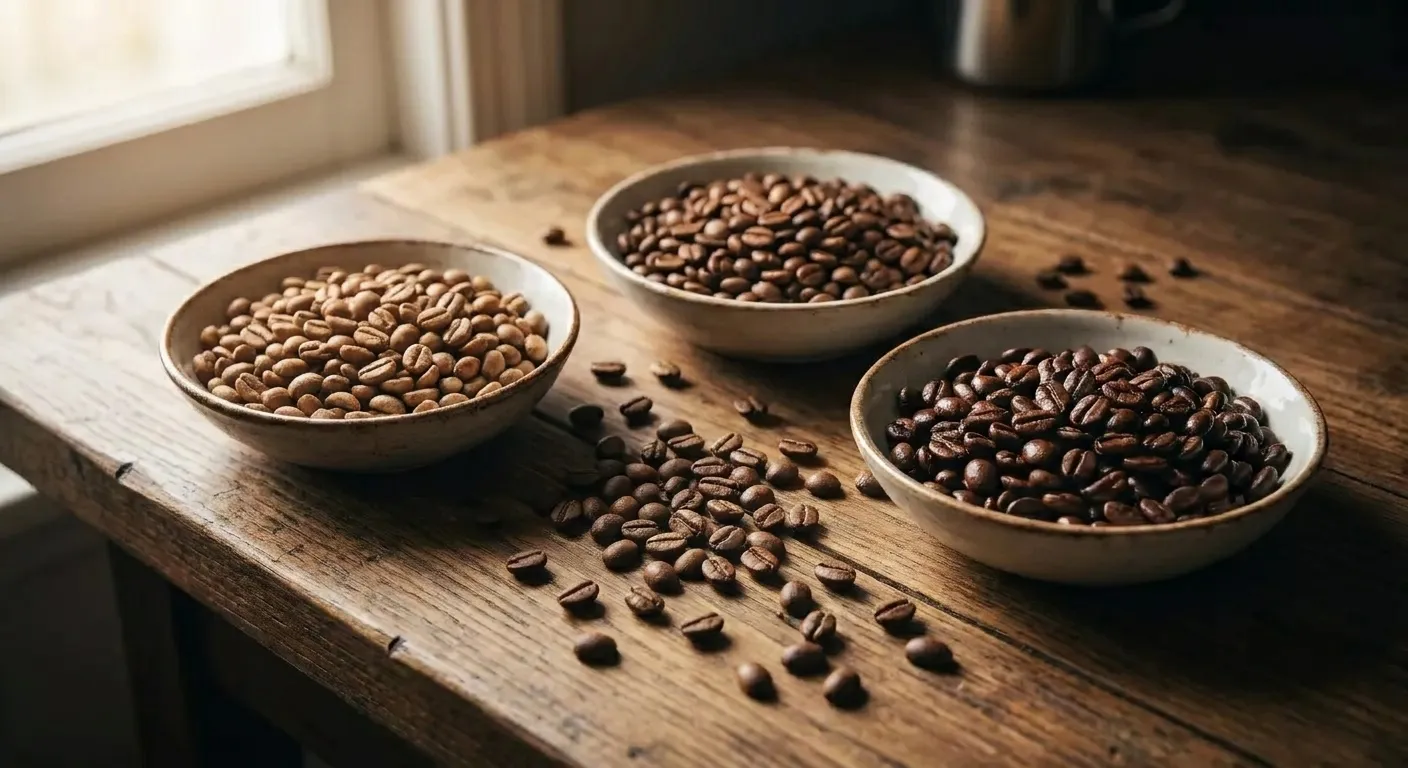
Affiliate disclosure: Sweeter Grind is a participant in the Amazon Services LLC Associates Program. We may earn commissions on qualifying purchases at no extra cost to you.
Walk down the coffee aisle at any grocery store and you are confronted with a wall of choices. Light roast. French roast. Single origin Ethiopia. "Breakfast blend." Natural process. Washed. Fair Trade. Organic. Rainforest Alliance. The labels are dense with jargon, and most of it is never explained on the bag.
The reason matters: the beans themselves determine more about how your coffee tastes than any brewer, grinder, or technique you will ever use. A great barista with bad beans makes mediocre coffee. A beginner with great beans makes surprisingly good coffee. If you only fix one thing in your coffee setup this year, fix what you are buying.
This guide maps the entire coffee bean landscape: the two species that matter, the three roast levels you will see on every bag, single origin vs blend, the major growing regions and their typical flavor signatures, the three processing methods that transform cherries into beans, how coffee is graded, how long beans stay fresh, and how to store them.
If you would rather skip to a brewing tutorial once you have the right beans, head over to our Complete Guide to Coffee Brewing Methods — our companion tower that covers pour over, French press, AeroPress, espresso, and more. Or use the Coffee Bean Finder to get a personalized recommendation in about 90 seconds.
What Makes a Coffee "Specialty Grade"?
The word "specialty" gets thrown around on every bag in every grocery store. Most of it is marketing. The technical definition comes from the Specialty Coffee Association (SCA), which grades green (unroasted) coffee on a 100-point scale. A coffee must score 80 points or higher to legally be called specialty grade. Below that, the bean is commodity-grade — fine for mass-market canned coffee but not what you want at home.
The score is based on a standardized cupping protocol. Trained Q-graders evaluate:
- Fragrance and aroma — the smell of the dry grounds and wet slurry
- Flavor — the primary taste on the palate
- Aftertaste — the lingering finish
- Acidity — brightness and liveliness (not sourness)
- Body — weight and texture in the mouth
- Balance — how well the elements integrate
- Clean cup — absence of off-flavors or defects
- Sweetness — natural sugar perception
- Uniformity — consistency across multiple cups
- Overall impression — the subjective quality judgment
Specialty coffee is also defect-limited: a 350-gram sample of green beans can have no primary defects (like a black bean or a sour bean) and only a small number of minor defects to qualify. Commodity coffee has no such restrictions, which is why cheap supermarket blends often taste dull, earthy, or rubbery — you are tasting the defects.
When you see "specialty grade," "80+ score," or a specific number like "86" on a bag, that is the real signal. Everything else — "artisan," "gourmet," "premium" — is marketing language with no legal meaning.
Arabica vs Robusta: The Two Species That Matter
Coffee comes from dozens of species in the Coffea genus, but only two are grown commercially at any scale: Arabica (Coffea arabica) and Robusta (Coffea canephora). The difference between them shapes everything about what ends up in your cup.
Arabica
Arabica accounts for roughly 60–70 percent of global coffee production and well over 99 percent of specialty coffee (fine-grade Robusta exists but is rare). It grows at higher elevations (typically 1,000–2,200 meters), in cooler climates, and takes longer to mature. The slower growth concentrates sugars and complex flavor compounds in the bean.
Arabica is characterized by:
- Higher acidity and brightness
- Complex, nuanced flavor — fruit, floral, chocolate, nut notes
- Lower caffeine (roughly 1.2–1.5% by weight)
- Higher sugar content
- A smoother, less bitter finish
- Higher price due to labor-intensive cultivation
Every single-origin bag you see at a specialty roaster is Arabica. Every world-class coffee — Ethiopia Yirgacheffe, Kenya Nyeri, Colombia Huila, Panama Geisha — is Arabica.
Robusta
Robusta is the workhorse of the commodity coffee industry. It grows at lower elevations (below 800 meters), tolerates heat and pests better, yields more per tree, and is cheaper to produce. Most instant coffee, supermarket pre-ground, and espresso blends designed for crema contain significant Robusta.
Robusta is characterized by:
- Lower acidity, often harsh or rubbery
- Earthy, woody, sometimes grain-like flavor
- Roughly double the caffeine of Arabica (2.2–2.7%)
- Lower sugar content
- Heavier body and more intense bitterness
- Thick crema when used in espresso
Robusta is not automatically bad — high-quality specialty-grade Robusta does exist, and some traditional Italian espresso blends use a small percentage of Robusta intentionally for body and crema. But most Robusta on the market is low-grade commodity material, and this is why cheap coffee tastes flat or harsh compared to specialty Arabica.
If you are buying whole-bean specialty coffee, you almost certainly have 100% Arabica. For a much deeper dive into the species difference and when each one makes sense, read Arabica vs Robusta Explained.
The Three Main Roast Levels
Roasting is where green coffee beans get transformed into the aromatic brown beans you recognize. During roasting, heat triggers hundreds of chemical reactions — the Maillard reaction, caramelization, and pyrolysis — that develop flavor, color, aroma, and body. The length of the roast determines which compounds dominate.
Inside the drum, beans go through several audible stages. The most important are:
- The drying phase (0–5 minutes) — residual moisture evaporates from the green bean; beans turn from green to yellow
- First crack (around 196–205°C / 385–401°F) — beans audibly "pop" as internal pressure vents; sugars caramelize; this is where edible coffee starts
- Development phase — the time and temperature after first crack where flavor is shaped
- Second crack (around 224–230°C / 435–446°F) — a different, higher-pitched popping as cell walls fracture and oils migrate to the surface
- Post-second-crack — rapid darkening, smoke, and loss of origin character
Roast names are not strictly standardized, but every roaster works within three broad bands defined by where the beans are pulled from the drum relative to these cracks.
Light Roast
- Color: light brown, matte, no oil on the surface
- Internal temperature reached: roughly 356–401°F (180–205°C), ending just after first crack
- Common names: Light, Cinnamon, New England, Half City, Nordic
Light roasts preserve the intrinsic flavor of the bean. Acidity is bright. Origin character is clear — you can actually taste the difference between an Ethiopian and a Colombian. Sweetness comes from preserved sugars rather than developed caramelization. Light roasts tend toward fruity, floral, tea-like, citrus, and berry notes.
Best for: pour over, AeroPress, drip. Less common in espresso because the higher acidity and density can make dialing in harder.
Medium Roast
- Color: medium brown, matte to very slightly glossy
- Internal temperature reached: roughly 410–428°F (210–220°C), between first and second crack
- Common names: Medium, City, American, Breakfast, Full City
The most popular roast level in the United States. Medium roasts balance origin character with developed sweetness. Acidity is softened, body is fuller, and caramelized sugars emerge. Expect chocolate, caramel, nut, baked fruit, and brown sugar notes.
Best for: drip machines, pour over, espresso, French press — basically anything. This is the "just works" roast level.
Dark Roast
- Color: dark brown to nearly black, often glossy with surface oils
- Internal temperature reached: roughly 437–464°F (225–240°C), at or just past second crack
- Common names: Full City+, Vienna, French, Italian, Spanish
Dark roasts push development past the origin. Acidity flattens. Sugars burn rather than caramelize, producing bittersweet and smoky notes. Origin differences largely disappear — a dark-roast Ethiopian tastes much like a dark-roast Sumatran. Expect dark chocolate, toast, smoke, roasted nut, and char notes.
Best for: espresso blends, French press, milk drinks, and anyone who genuinely prefers the bold, low-acid profile.
There is no "better" roast level. There is the roast level that fits what you like to drink. Light roast devotees and dark roast loyalists both have valid preferences — they are literally tasting different coffees at that point.
A Note on Common Roast Terminology Confusion
The naming conventions across roasters are notoriously inconsistent. "Medium roast" at one café may be noticeably darker than "medium" at another. Two factors explain this:
- Regional preferences. West Coast and Nordic specialty roasters tend to roast lighter across the board. Italian and Southern European roasters tend to roast darker. American East Coast and traditional commercial roasting sit in between.
- Drink-targeted roasting. An "espresso roast" from one café may be a medium, from another a dark — depending on what flavor profile the roaster wants in the cup.
If you are comparing bags across roasters, trust your first cup more than the label. Two bags labeled "medium roast" from different roasters can taste substantially different. One roaster's baseline calibration is not another's.
Roast Level and Caffeine: The Myth
A persistent myth says darker roasts have more caffeine because they are "stronger." The opposite is very slightly true: caffeine is extremely heat-stable, but roasting does remove a tiny amount and beans lose mass during roast (up to 15–20%), so by volume a dark roast scoop actually has marginally less caffeine than a light roast scoop of the same volume. By weight, the difference is negligible. The perceived "strength" of a dark roast is bitterness and body, not caffeine.
Single Origin vs Blends
Once you start reading specialty bags, you will see two broad categories: single origin and blend.
A single origin coffee comes from one specific place — one country, one region, one farm, or even one lot from one farm. The whole point is to taste the character of that place. A Kenyan single origin should taste distinctly Kenyan (blackcurrant, tomato, grapefruit). An Ethiopian Yirgacheffe should taste distinctly Ethiopian (jasmine, bergamot, stone fruit).
A blend combines beans from two or more origins to create a flavor profile that none of the components would produce alone. Good blends are engineered — the roaster might combine a fruity African coffee with a nutty Brazilian and a chocolatey Central American to produce a balanced, approachable cup. "Breakfast blend" and "espresso blend" are classic examples.
Neither category is better. Single origins are where you go for discovery and complexity. Blends are where you go for consistency, balance, and a reliable everyday cup. We break down the full comparison in Single Origin vs Blends: Which Is Better?.
What About "Microlots"?
"Microlot" means a small, highly specific lot of coffee — typically from a single farm's single harvest window or a specific planting within that farm. The numbers are not standardized; one roaster's microlot may be 20 bags (1,320 pounds) while another's is 500 pounds. The point is scarcity and traceability: microlots are separated, processed, and sold distinctly because the farmer and importer believe they offer something special.
Microlots are usually more expensive ($25–$50+ per pound) and often extraordinary. Most serious specialty roasters have a rotating shelf of microlots. They are great for special occasion brewing; for everyday use, a standard single origin or house blend is a better economic choice.
Major Coffee Growing Regions
Where coffee grows is the single biggest predictor of how it tastes. Soil, altitude, climate, varietal, and local processing traditions combine to produce region-specific flavor signatures that hold up across many roasters.
The four major regions are Africa, Central America, South America, and Asia-Pacific. Here is the ten-second version of each.
Africa
Ethiopia and Kenya are the crown jewels. Ethiopia is the birthplace of coffee and home to thousands of indigenous heirloom varieties. Ethiopian coffees tend toward bright, fruity, floral, tea-like profiles — jasmine, bergamot, blueberry, stone fruit. Coffee from Yirgacheffe and Sidamo dominate the specialty shelf; Guji and Harrar offer more intense fruit-forward naturals. Kenyan coffees are more intense: blackcurrant, grapefruit, tomato acidity, wine-like — a product of the SL28 and SL34 varietals grown on Mount Kenya's volcanic slopes. Rwanda and Burundi produce bright, berry-forward coffees in the Kenyan style but slightly softer. Tanzania, Uganda, and the DRC are emerging specialty origins.
Central America
Guatemala, Costa Rica, Honduras, Nicaragua, Panama, and El Salvador. Expect balanced, sweet, chocolatey, nutty, with clean acidity. This is the region where "just a really good, balanced cup of coffee" lives. Guatemala's Antigua and Huehuetenango regions produce some of the most consistent high-quality specialty coffee in the world. Costa Rica pioneered the modern honey process. Panama Geisha is the famous exception — an exotic variety that tastes explosively floral and jasmine-like and commands hundreds of dollars per pound at auction.
South America
Colombia and Brazil dominate global production, along with Peru and Bolivia. Colombian coffees are smooth, caramel, nutty, medium-bodied with pleasant acidity; Huila and Nariño produce the most distinctive specialty lots. Brazil produces low-acid, chocolatey, nutty, heavy-bodied coffees that form the backbone of most espresso blends in the world. Brazilian naturals from Cerrado or Mantiqueira de Minas are a great entry point for anyone curious about natural processing without the wilder Ethiopian intensity.
Asia-Pacific
Indonesia (Sumatra, Java, Sulawesi) and Vietnam. Indonesian coffees, especially wet-hulled Sumatrans, are earthy, woody, herbaceous, low-acid, full-bodied — the polar opposite of Ethiopian. Java offers a more balanced chocolate-forward cup; Sulawesi Toraja is complex and spicy. Vietnam is overwhelmingly Robusta and feeds the commodity market and the local iced-coffee tradition. India's Monsooned Malabar is a unique process worth trying at least once: beans are deliberately exposed to monsoon winds, producing a mellow, syrupy, low-acid cup.
For a full region-by-region flavor map, see Coffee Growing Regions and Flavor Profiles.
The Coffee Belt and Terroir
All of these regions share one geographic feature: they fall within the "coffee belt," the band of tropical latitudes between roughly 25°N and 30°S of the equator. Outside this belt, commercial coffee production at meaningful scale is impossible — the climate is wrong, the altitudes do not align, and the growing seasons do not work.
Within the belt, terroir — the combination of soil, altitude, climate, and local conditions — shapes how each coffee tastes. Two farms 10 miles apart at different altitudes and on different soil types can produce meaningfully different cups. This is why origin specificity matters so much on a bag: "Colombia" tells you very little; "Colombia Huila Acevedo" tells you a great deal, because you are hearing about a specific terroir.
Processing Methods
Before the green bean reaches the roaster, it has been processed — separated from the coffee cherry fruit surrounding it. The processing method has an enormous impact on flavor, often rivaling region and varietal.
Washed (Wet) Process
The cherry fruit is removed mechanically and the bean is fermented in water tanks to dissolve the remaining sticky mucilage, then washed clean and dried. Washed coffees taste clean, bright, and clear — origin character comes through without the flavor of the fruit interfering. Most Kenyan, Ethiopian Yirgacheffe, and Central American coffees are washed.
Natural (Dry) Process
The entire cherry — fruit and all — is laid out to dry in the sun on raised beds or patios. The bean absorbs flavors from the fermenting fruit as it dries. Natural coffees taste fruit-forward, wild, fermented, berry, wine-like. This is the traditional method in Ethiopia and is increasingly popular in Brazil and Central America.
Honey (Pulped Natural) Process
A middle ground: the skin is removed but some or all of the sticky mucilage is left on during drying. Honey-processed coffees taste sweet, syrupy, complex, with moderate fruit — less wild than natural, more textured than washed. The name comes from the honey-like appearance of the drying beans, not any added honey.
Full breakdown in Coffee Processing Methods: Washed, Natural, and Honey.
Experimental Processes
Beyond the big three, a wave of experimental processing methods has entered specialty coffee in the last decade:
- Anaerobic fermentation — the depulped beans (or whole cherries) are sealed in oxygen-free tanks, sometimes with added yeast strains or controlled CO2 pressure. Extended anaerobic fermentation can produce cinnamon-candy, cola, or rum-soaked-cherry flavors that taste unlike any conventional coffee.
- Carbonic maceration — borrowed from winemaking. Whole cherries ferment in sealed CO2-pressurized tanks. Dramatic fruit-forward results.
- Thermal shock, yeast inoculation, extended fermentation — various experimental methods continue to emerge from competition-focused producers in Colombia, Panama, and Costa Rica.
These experimental lots are often the most expensive and most polarizing coffees on specialty shelves. They can be genuinely extraordinary or can taste gimmicky, over-fermented, or one-note. For most drinkers, they are a worthwhile occasional splurge but not a daily-cup category.
How Coffee Is Graded
The SCA cupping score is the ultimate quality metric, but each producing country also has its own grading system based on bean size, altitude, or defects:
- Ethiopia: Grade 1 and Grade 2 are specialty; higher numbers indicate more defects
- Kenya: AA (largest beans), AB, and PB (peaberry) — size often correlates with quality
- Colombia: Supremo (largest), Excelso (smaller) — again, size-based
- Guatemala: SHB (Strictly Hard Bean) denotes beans grown above 1,350m; higher altitude means denser beans and better flavor
- Costa Rica: SHB (Strictly Hard Bean) grown above 1,200m
These grades are useful shorthand, but they do not replace the SCA cupping score. A Colombian Supremo can be mediocre and a Kenya AB can be exceptional. When quality matters, look for the cupping score or trust a specialty roaster's curation.
Coffee Freshness: The Single Biggest Thing People Get Wrong
Fresh coffee tastes like something. Stale coffee tastes like cardboard. The difference is dramatic, and the timeline is much shorter than most people realize.
The freshness window for roasted whole beans is roughly 2–5 weeks past the roast date. Here is the timeline:
- Days 0–3 post-roast: Beans are off-gassing heavily. Coffee may taste uneven, slightly gassy, or lack clarity. Not ideal for brewing yet.
- Days 4–14: Peak freshness. Beans are fully rested but still holding their aromatic compounds. This is the zone.
- Days 15–28: Still very good. Slight decline in aromatic intensity but flavor holds up.
- Days 29–45: Noticeable decline. Still drinkable, still better than grocery store.
- Days 45+: Staling becomes obvious. Flavor flattens, bitterness increases, aroma fades.
The CO2 degassing window is exactly why pre-ground grocery-store coffee tastes so much worse than whole beans: by the time it reaches the shelf, it has been stale for months. For a full breakdown of the degassing process and the bloom technique that compensates for it, see What Is the Coffee Bloom and Why Does It Matter?.
How to Store Coffee Beans
Storage is simple in principle and widely messed up in practice. Coffee has four enemies: oxygen, moisture, heat, and light.
The correct way to store whole beans:
- Leave them whole until you brew. Pre-grinding accelerates staling by 5–10x.
- Keep them in an airtight, opaque container at room temperature. A one-way-valve bag works, as does a vacuum canister.
- Store in a cool, dark cupboard — not next to the stove, not on a sunny counter.
- Buy only what you will drink in 2–3 weeks. Two bags at a time is fine. A giant 5-pound bag is not.
What not to do:
- Do not store beans in the fridge. It is humid, full of food odors, and causes condensation on the beans every time the container opens.
- Do not freeze beans you are actively drinking. (Freezing works for long-term storage of unopened bags only, and requires careful sealing.)
- Do not dump beans into a clear glass jar on the counter. Light and oxygen will stale them fast.
For the complete storage protocol including the freezer long-term storage technique and the roast-to-brew timeline, see How to Store Coffee Beans for Freshness.
How to Read a Coffee Bag Label
A specialty coffee bag is dense with information — if you know how to read it. The elements you want to find:
- Roast date (not a "best by" date) — should be within 2–3 weeks of purchase
- Origin — country, region, farm, and ideally cooperative or producer name
- Variety — Bourbon, Typica, Caturra, Geisha, SL28, heirloom, etc.
- Processing method — washed, natural, honey, anaerobic
- Altitude — higher is generally better; above 1,400 meters is a good sign
- Tasting notes — what the roaster tasted
- Cupping score — if listed, 85+ is excellent, 88+ is exceptional
If a bag has none of this — just a roast level, a brand name, and a "best by" date — that is a commodity product, not specialty. Our How to Read a Coffee Bag Label guide walks through every element in detail.
Certifications: What They Actually Mean
Specialty bags often carry certifications — USDA Organic, Fair Trade, Rainforest Alliance, Bird Friendly, Direct Trade. These are useful to understand:
- USDA Organic — grown without synthetic pesticides or fertilizers. An environmental and farmer-health claim, not a quality claim.
- Fair Trade Certified — guarantees minimum prices and certain labor standards for farmer cooperatives. Historically the price floors have been low; newer Fair Trade Plus programs pay more meaningful premiums.
- Rainforest Alliance — broader environmental and social sustainability standard.
- Bird Friendly (Smithsonian) — shade-grown; preserves migratory bird habitat. The strictest of the environmental certifications.
- Direct Trade — unregulated term used by roasters who source directly from farms, bypassing importers and the commodity market. Can be very meaningful with a reputable roaster who traces and pays fairly; meaningless if used as marketing without disclosure.
None of these certifications guarantees cup quality. Some of the world's best coffees are certified organic; others are not. Buy certified coffee if the ethical and environmental values align with your priorities, but separate that from quality assessment. The cupping score and roast date still tell you more about whether the bag will taste good.
Common Bean-Buying Mistakes
Even experienced drinkers make these. Avoiding them costs nothing and saves a lot of flavor.
1. Buying Bulk to Save Money
A 2-pound bag looks like a deal next to a 12-ounce bag when the per-pound price is lower. But by the time you reach the second pound, the beans are 4–6 weeks old and the flavor gap between "fresh" and "what you are drinking" is huge. A $2/lb savings is not savings when the coffee is mediocre. Buy smaller bags more often.
2. Buying Pre-Ground "For Convenience"
Pre-ground coffee begins losing flavor within minutes and is fundamentally stale within days, regardless of packaging. If you do not have a grinder, a $25 hand grinder or a budget electric burr grinder (see Coffee Grinders Under $50) pays for itself within weeks in flavor alone. There is no coffee storage strategy, container, or freezer trick that can preserve ground coffee the way whole beans stay preserved.
3. Judging Beans by Appearance
Oily, shiny beans do not mean "rich and full" — they usually mean either very dark roast (where surface oils have migrated out) or very old beans (where oils have oxidized). Dry, matte beans at a medium roast are typically a better flavor signal than glossy oily ones. The exception: freshly dark-roasted beans can have a thin sheen without being stale.
4. Trusting the Roast Level Label Alone
"Medium roast" varies massively across roasters. A Nordic roaster's "medium" may be lighter than a traditional Italian roaster's "light." Use the roast level as a rough guide but trust tasting notes and first-cup experience more.
5. Ignoring the Roast Date Entirely
Discussed above, but worth repeating. A "premium gourmet artisan small-batch single-origin Colombian" with no roast date or a 6-month-old roast date is not a good purchase. A no-name-brand but recently-roasted Colombian from a competent roaster is much better coffee.
6. Falling for Flavored Coffee
Hazelnut, vanilla, caramel, pumpkin spice. Flavored coffees use low-grade commodity beans with added flavoring compounds to mask defects. If you want hazelnut flavor in your coffee, add a hazelnut syrup to a decent unflavored cup. The underlying bean quality will be dramatically better.
7. Not Matching Bean Choice to Brew Method
A bright, fruity light-roast Ethiopian can be amazing in a pour over and awful in a French press (where the heavier extraction smears the delicate aromatics). A chocolatey Brazilian espresso blend may taste flat in a pour over but incredible pulled as espresso. Think about how you will brew before you buy.
Beans, Brewing, and Water: The Full Picture
Beans are the starting point, but they do not brew themselves. Once you have good beans, the next two factors in order of importance are:
- Water — the cup is 98%+ water. Bad water makes good beans taste bad. Our guide to Why Water Quality Matters for Coffee covers the SCA water standards and how to fix bad tap water cheaply.
- Extraction — the process of dissolving flavor compounds into the water. Our guide to Coffee Extraction 101 explains the 18–22% extraction sweet spot and the five variables that control it.
Get beans right, get water right, brew in the 18–22% extraction window, and you will make consistently excellent coffee regardless of equipment.
Frequently Asked Questions
How do I know which roast level I like?
Buy one light roast single origin Ethiopian, one medium roast single origin Colombian, and one dark roast blend. Brew each the same way (same method, same ratio, same grind setting, same water). Taste them side by side. You will know which one you like within a week. Your preference may shift over time — most people who get into specialty coffee gravitate toward lighter roasts once their palate adapts, but there is no wrong answer.
Is expensive coffee actually worth it?
Up to a point, yes. The jump from $8/lb grocery coffee to $18/lb specialty coffee is massive — it is the difference between "flat and bitter" and "actually tastes like something." The jump from $18/lb to $35/lb is smaller but real. The jump from $35/lb to $90/lb (Panama Geisha territory) is almost entirely about novelty and exotic flavor, not objective quality.
Can I buy green coffee and roast it myself?
Yes, and it is a rewarding hobby. You can roast in a popcorn popper, a dedicated home roaster, or even a skillet. Green coffee keeps for 6–12 months without losing quality, so home roasters can buy in bulk. Expect a significant learning curve — your first ten batches will not be great. This guide focuses on the 99% of coffee drinkers who buy pre-roasted beans, but home roasting is a fun path if you catch the bug.
Does organic or fair trade make coffee taste better?
Not directly. Organic and Fair Trade are ethical and environmental certifications, not quality certifications. Some of the world's best coffees are Fair Trade organic, and some are neither. Buy certified coffee if those values matter to you, but do not assume the cup will be better because of the label.
What is the difference between "100% Arabica" and specialty-grade Arabica?
"100% Arabica" only tells you the species — not the quality. A tin of supermarket ground coffee labeled 100% Arabica can still be low-grade commodity Arabica with defects. Specialty-grade means SCA-scored 80+, which is a quality claim, not just a species claim.
Related reading
- Arabica vs Robusta Explained — the two species in depth
- Coffee Processing Methods: Washed, Natural, and Honey — how raw cherries become beans
- Coffee Growing Regions and Flavor Profiles — the world flavor map
- Single Origin vs Blends: Which Is Better? — when to pick each
- How to Read a Coffee Bag Label — decoding the bag
- How to Store Coffee Beans for Freshness — the 2–5 week window
- Complete Guide to Coffee Brewing Methods — once you have the beans
- Coffee Extraction 101 — the science behind the cup
- Why Water Quality Matters for Coffee — the 98% ingredient
- Coffee Bean Finder Tool — get a personalized recommendation