Best Decaf Espresso Beans for Home Machines
 Tommie Chaney·
Affiliate disclosure: Sweeter Grind is a participant in the Amazon Services LLC Associates Program. We may earn commissions on qualifying purchases at no extra cost to you.
The best decaf espresso beans are the ones that hold up under pressure, and that is a shorter list than the best decaf beans generally. Our overall pick is the San Francisco Bay Decaf Espresso Roast: two pounds, medium-dark, Swiss Water process named on the bag, about $0.97 an ounce as of September 2026. Five more picks follow, including a Robusta-heavy Italian blend chosen purely for crema.
Here is why the two lists differ. Decaffeination soaks green coffee for hours before it is ever roasted, and the beans come out structurally weaker. As Home Barista Guide puts it, the cellular degradation from processing increases the bean's porosity, so decaf shatters rather than breaks cleanly and throws more fines when ground. At nine bars those differences get loud: decaf channels more easily, runs faster, and pulls a thinner, paler crema than the same roaster's caffeinated bag.
If you brew filter rather than espresso, our roundup of the best decaf coffee beans is the right list. One bag appears on both, the Allegro Bel Canto, and we would rather flag the overlap than call it a fresh discovery. For how decaf coffee is produced, start with our pillar guide.
Our Picks at a Glance
All prices are as of September 2026. Price per ounce is our own arithmetic from the listed size and price; the last column is the one we would read first.
| Pick | Bag | Size | Price per oz | Process named? |
|---|---|---|---|---|
| Best Overall | San Francisco Bay Decaf Espresso Roast | 2 lb (32 oz) | $0.97 | Yes, Swiss Water |
| Best Under $15 | Allegro Decaf Organic Espresso Bel Canto | 12 oz | $1.00 | No |
| Best for Crema | Bristot Decaf Italian | 1.1 lb (17.6 oz) | $1.14 | No |
| Best Dark Roast for Milk Drinks | Mayorga Decaf Cubano Roast | 2 lb (32 oz) | $1.12 | Yes, Swiss Water |
| Best Italian Bar Classic | Lavazza DEK | 1.1 lb (17.6 oz) | $0.95 | No, "natural process" only |
| Best Organic Bulk Buy | Organic Coffee Co. Decaf Hurricane Espresso Roast | 2 lb (32 oz) | $1.03 | No, "water processed" only |
Two of six name a process. That ratio is the most honest summary of this market.
Why Decaf Is Harder to Pull
Decaffeination is a subtraction. According to the National Coffee Association, the process typically removes around 97% of the caffeine naturally found in coffee beans, leaving roughly 2 to 15 mg in an 8 oz cup against about 95 mg for regular coffee. Other regulators write the rule as a ceiling instead of a percentage removed: Canada's Food and Drug Regulations cap decaffeinated coffee at 0.1% caffeine and decaffeinated instant coffee at 0.3%.
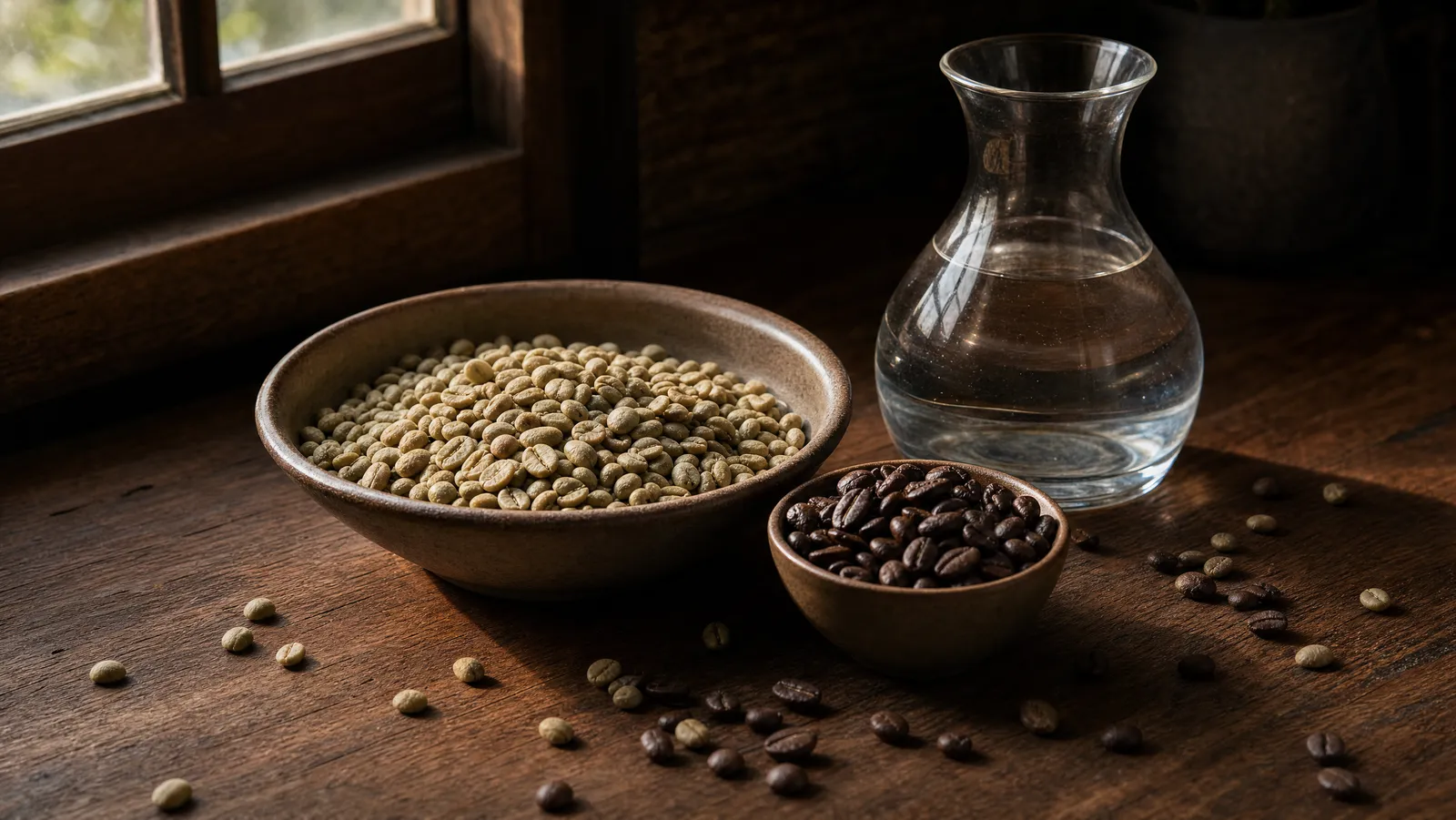
Removing it takes hours of soaking or solvent contact on green coffee. The beans that emerge are more porous and more brittle, and Sweet Maria's warns that decaf takes on colour very fast in the roaster without that colour reflecting the true roast level, which is why careful roasters profile decaf separately. The mechanics are in how decaf coffee is made.
For espresso, three consequences follow. Grinding throws more fines, so the puck channels more readily. Lower density changes how your dose sits in the basket. And pale crema is normal rather than a fault: the West Berkshire Roastery says in its decaf dial-in guide that "pale crema or no crema is normal with decaf", and puts it down to the more porous bean off-gassing faster, leaving less carbon dioxide to build foam at brew time. Bean choice matters more here than it does for filter.
Best Overall: San Francisco Bay Decaf Espresso Roast
This is the bag we would buy first, and the reason is printed on it. San Francisco Bay states that it decaffeinates all of its decaf coffees using the Swiss Water Process and no chemicals, which puts it in a minority of two here. Current price on Amazon.
The roast is aimed where you need it: a medium dark roast of 100% Arabica grown at high altitude in Central America, sold as a Decaf Espresso Roast rather than a general-purpose decaf you are expected to force into a portafilter. Medium-dark is the sweet spot, forgiving of an imperfect puck without tasting only of char.
Two pounds at $30.99 as of September 2026 is about $0.97 an ounce, the cheaper per ounce of the two bags that name a certified process.
The catch is size. A one-shot-a-day household will be drinking the last week of a two-pound bag flat, so buy it only if you pull two or three drinks a day.
Best Under $15: Allegro Coffee Decaf Organic Espresso Bel Canto
Twelve ounces, organic, medium roast, and Allegro's own tasting notes read deep, berries, cocoa powder. It is the only bag here under $15, at $11.99 as of September 2026, or almost exactly $1.00 an ounce. The Amazon listing sells it as a specialty espresso coffee.
We like it as the low-risk entry. A one-shot-a-day drinker clears 12 oz in roughly three weeks, so you can find out whether a lighter decaf suits you before committing to two pounds of something else.
Two caveats. Allegro names no decaffeination process in the listing, so "organic" describes the farming, not the caffeine removal. And a medium roast is the least forgiving choice here: less body, less solubility, less margin when the puck goes wrong.
Best for Crema: Bristot Decaf Italian Whole Espresso Beans
If your complaint about decaf is the sad beige layer on top, this is the fix. Bristot states the blend is 35% Arabica and 65% Robusta, and credits that ratio for the full body, rich aroma and velvety crema. The 500 g (17.6 oz) bag is roasted in Italy near the Dolomites by a company Bristot says dates to 1919, and at $19.99 as of September 2026 it is about $1.14 an ounce, the highest per-ounce price here. See it on Amazon.
The crema logic is not marketing. Robusta carries more protein and chlorogenic acid than Arabica, and those compounds help trap carbon dioxide into a stable foam, as a comparison published by dmcoffee.blog explains. Published figures put total chlorogenic acids at roughly 7.0 to 14.4 percent of dry matter in green Robusta against about 4.0 to 8.4 percent in green Arabica. In a coffee already stripped of structure, a Robusta majority is the most reliable lever available. Our explainer on Arabica vs Robusta covers the trade-off: Robusta brings bitterness with the body.
Bristot specifies a medium Full City roast, which Sweet Maria's defines as the end of development after first crack, stopped just before or at the onset of second crack. Stated notes are milk chocolate, bread crust and warm spices.
The drawbacks: no decaffeination method is named, and the best-by date is printed in European day/month/year order, which is easy to misread and is not a roast date anyway.
Best Dark Roast for Milk Drinks: Mayorga Decaf Cubano Roast
If most of your decaf goes into a cortado or a flat white, buy for weight rather than nuance. Mayorga's Cubano Roast is a Cuban-style dark roast of specialty-grade, 100% Arabica from Peru, Honduras and/or Nicaragua, with stated hints of vanilla and syrupy smokiness over a low-acid finish. Two pounds at $35.99 as of September 2026 is roughly $1.12 an ounce. It is on Amazon.
It is the second bag here that names a process. Mayorga states that Swiss Water uses pure water to gently remove caffeine and describes the result as 99.9% caffeine free. Treat that as Mayorga's claim, not a verified measurement of your bag; Swiss Water advertises the same 99.9% figure for a process that moves caffeine into a caffeine-free green coffee extract and strips it out through carbon filters. Mayorga also lists the coffee as organic, non-GMO, direct trade and shade grown.
The honest downside is the roast. A dark Cuban-style profile is what you want behind milk and what erases the origin detail you are paying specialty-grade money for. It is also the most expensive bag here outright.
Best Italian Bar Classic: Lavazza DEK Decaf Whole Bean
Lavazza DEK is our pick for anyone who wants the familiar Italian-style decaf shot rather than a project. The 1.1 lb (17.6 oz) bag is Arabica and Robusta blended and roasted in Italy, which Lavazza calls a creamy dark roast with notes of roasted cereals and barrique, recommended for espresso machines. At $16.73 as of September 2026, down from a $17.99 list price, it is about $0.95 an ounce, the cheapest per ounce here. Check Amazon for the current price.
Then there is the label, which is why it sits here rather than higher. Lavazza says the coffee is decaffeinated using a natural process. That is a phrase, not a method: no solvent, no water process, no certification, and we will not guess what sits behind it. Lavazza does not publish the Arabica-to-Robusta ratio either, so you cannot compare its body against the Bristot.
Best Organic Bulk Buy: Organic Coffee Co. Decaf Hurricane Espresso Roast
The Organic Coffee Co., part of the family-owned Rogers Family Company, sells Hurricane Espresso Roast as a bold blend of water-processed decaffeinated dark roasts built for a full-bodied cup with a calm aftertaste. Two pounds at $32.99 as of September 2026 is about $1.03 an ounce, on Amazon in whole bean.
The appeal is breadth. The maker lists it for drip machines, espresso makers, French press, AeroPress, pour over and moka pot, which makes it the sensible bulk buy for a household where only one person pulls shots.
The label needs a close read. "Water processed" is the maker's phrase and is not the certified Swiss Water Process. The listing names no certified process, and we will not infer one from two words. Between that and a blend of unspecified dark roasts, you are buying volume rather than transparency.
How to Choose Decaf Espresso Beans
These six bags will drift in price and availability. This framework will not.
Roast date beats everything else on the bag. A decaf with a visible roast date is worth more than a decaf with better marketing, because decaf's already-reduced aromatics have less to lose. Espresso is fussy in both directions: Happily Coffee suggests waiting at least five days after roasting and puts the usable window at 5 to 14 days, with 7 to 10 days the common sweet spot for medium and medium-dark roasts, because pressure amplifies residual carbon dioxide. Too fresh gushes and tastes sour; too old tastes of nothing. A bag showing only a best-by date, as the Bristot does, cannot place you on that curve.
A named process is a proxy for care. A roaster who prints "Swiss Water Process" or "sugarcane EA" has made a decision and stands behind it. A roaster who prints nothing may still buy excellent decaf, but you cannot verify it or deliberately buy the same thing twice.
Roast level sets how forgiving the bag is. Most supermarket decaf is dark roasted, and in our view darkness is partly a way of covering what the process removed. That does not make dark decaf bad; for espresso it is often the safer choice, because darker coffee is more soluble and more tolerant of a slightly wrong grind. You are trading origin detail and acidity for margin. If fines are your real problem, our guide to the best espresso grinders for home will change more than the beans will.
Buy the bag size your consumption justifies. Two pounds at $0.97 an ounce is a worse deal than 12 oz at $1.00 if the last half-pound goes stale. A double shot is around 18 g, so a one-double-a-day household needs about seven weeks to clear 32 oz. Two or three drinks a day is where bulk makes sense.
Blends usually beat single origins here. Blending is how a roaster rebuilds the body and crema that decaffeination removed, which is why four of these six bags are stated blends or multi-origin lots. A single-origin decaf can be lovely in a filter and thin under pressure.
What the Label Does and Does Not Tell You
Look again at the last column of the table. Of six bags aimed at home espresso, only San Francisco Bay and Mayorga name a method, and both say Swiss Water. The other four say nothing, or something that sounds like a method and is not one.
Two phrases do most of the damage. "Water processed", the Organic Coffee Co.'s wording, describes a family of approaches rather than one method; the certified Swiss Water Process is water-based, but so are others, and only Swiss Water carries the name and its verification. "Natural process", Lavazza's wording, is vaguer still. Ethyl acetate decaf is frequently marketed as "naturally decaffeinated" because ethyl acetate occurs in fruit and is often derived from fermented sugarcane molasses, as Decadent Decaf explains in its method spotlight, though that write-up notes commercial EA is often synthesised from ethyl alcohol and acetic acid instead. Lavazza's listing does not say ethyl acetate at all, so we will not claim that is what it is.
The lesson is short: do not infer a process from an adjective. "Natural", "chemical-free", "pure water" and "gentle" are words a marketing team can write without committing to anything. A method name is a commitment. We compare the two commonest in Swiss Water versus sugarcane EA.
An unnamed process is not a red flag by itself; it is simply less information.
Dialling In Decaf Espresso
Expect to re-dial after every new bag, including the next bag of the same decaf. Which direction to move is genuinely contested. Papel Espresso argues for going a step or two coarser, on the grounds that decaf shatters instead of breaking cleanly and the extra fines choke the puck. The West Berkshire Roastery and Home Barista Guide argue the opposite, for a step or two finer, because the more porous bean lets water through faster and the shot runs thin.
Both mechanisms are real, and which one dominates depends on the bag and the grinder. So pull the first shot at your caffeinated setting, read the time, and move from there: the first three shots from a new decaf bag are diagnostics rather than drinks.
Judge by time and taste, not by crema. Pale, fast-fading crema is normal for decaf, not evidence of a bad extraction. Fast and hollow, go finer. Choked and astringent, go coarser. Move one variable at a time, keeping dose and target yield fixed.
Why decaf tastes different and how to brew it covers the sensory side, and how to pull a perfect espresso shot covers the dose, yield and time mechanics.
The Bottom Line
If you want one recommendation, buy the San Francisco Bay Decaf Espresso Roast. It names its process, it is roasted for espresso rather than adapted to it, and at about $0.97 an ounce as of September 2026 it is the cheaper of the two transparent bags.
For crema above all, take the Bristot and accept the Robusta bitterness as the price. For milk drinks, the Mayorga. If you are not yet sure you like decaf espresso, spend the $11.99 the Allegro costs as of September 2026 and find out cheaply.
Whichever you choose, read the label the way this guide does: roast date first, method name second, marketing adjectives never. For everything upstream of the bag, Sweeter Grind's guide to decaf coffee is the place to go next.
Frequently Asked Questions
Do decaf beans really pull differently from regular beans?
Yes, and the difference is physical. Decaffeination happens on green coffee and leaves the bean more porous and more brittle, which Home Barista Guide attributes to cellular degradation during processing. That produces more fines and a less uniform puck, so the same grinder setting can give a shot that channels or runs fast.
Why is my decaf crema so pale and thin?
Because there is less carbon dioxide left to build it. Crema is a foam of carbon dioxide bubbles stabilised by proteins, melanoidins and other surfactants, and the West Berkshire Roastery attributes decaf's thin layer to the more porous bean off-gassing faster after roasting. Pale crema is normal for decaf, not a sign of bad extraction. A Robusta-heavy blend is the most effective fix, which is the argument for the Bristot at 35% Arabica and 65% Robusta.
Should I grind decaf finer or coarser than my regular espresso?
Sources split, so bracket it. Papel Espresso argues coarser, because decaf throws more fines and the puck resists more than the setting implies. The West Berkshire Roastery and Home Barista Guide argue finer, because decaf's porosity lets water through faster. Both mechanisms are real: pull one shot at your caffeinated setting, read the time, and adjust from there.
How much caffeine is left in decaf espresso?
Not zero, but very little. The National Coffee Association says decaffeination typically removes around 97% of the caffeine, leaving roughly 2 to 15 mg in an 8 oz cup against about 95 mg for regular coffee. A smaller serving does not automatically mean less caffeine, though. When McCusker and colleagues measured decaf drinks for the Journal of Analytical Toxicology in 2006, single decaf espresso shots came in at 3.0 to 15.8 mg, which is the same range as a decaf cup rather than below it.
Does "naturally decaffeinated" mean Swiss Water?
No. It is label language with no fixed meaning, often used for ethyl acetate decaf, because ethyl acetate occurs in fruit and is frequently derived from fermented sugarcane molasses. The Swiss Water Process is a specific named method using green coffee extract and carbon filtration, and bags that use it almost always say so. Treat an unnamed process as missing information, not a clue.
Related reading
- The best decaf coffee beans
- How decaf coffee is made
- Swiss Water versus sugarcane EA
- Why decaf tastes different and how to brew it
- How to pull a perfect espresso shot
- Arabica vs Robusta explained
- Best espresso grinders for home

San Francisco Bay Coffee Decaf Espresso Roast Whole Bean
A 2 lb (32 oz) bag of 100% Arabica whole bean built specifically as an espresso roast. San Francisco Bay calls it a medium dark roast made from Central American beans grown at high altitude, and states plainly that it decaffeinates using the Swiss Water Process with no chemicals. At $30.99 as of September 2026, that works out to roughly $0.97 an ounce.

Allegro Coffee Decaf Organic Espresso Bel Canto Whole Bean
A 12 oz bag of organic, medium-roast whole bean sold specifically as an espresso coffee, with Allegro giving tasting notes of deep berries and cocoa powder. It is the smallest bag on this list and the only one under $15. At $11.99 as of September 2026, that is almost exactly $1.00 an ounce.

Bristot Decaf Italian Whole Espresso Beans
A 500 g (17.6 oz) bag roasted in Italy near the Dolomites, which Bristot blends at 35% Arabica and 65% Robusta and takes to a medium Full City roast. The maker credits that Robusta-heavy ratio for the blend's full body and velvety crema, and gives flavour notes of milk chocolate, bread crust and warm spices. At $19.99 as of September 2026, that is about $1.14 an ounce, the highest per-ounce price in this roundup.

Mayorga Decaf Cubano Roast Organic Whole Bean
A 2 lb bag of certified organic, specialty-grade 100% Arabica in a Cuban-style dark roast, which Mayorga sources from Peru, Honduras and/or Nicaragua. Mayorga names Swiss Water as its decaffeination method and describes the result as 99.9% caffeine free, which is the company's own claim rather than an independent measurement. At $35.99 as of September 2026, that is roughly $1.12 an ounce.

Lavazza DEK Decaf Whole Bean Coffee
A 1.1 lb (17.6 oz) bag of Lavazza's decaf whole bean, blended and roasted in Italy from Arabica and Robusta in proportions the company does not disclose. Lavazza calls it a creamy dark roast with notes of roasted cereals and barrique, and recommends it for espresso machines. At $16.73 as of September 2026, down from a $17.99 list price, that is about $0.95 an ounce, the cheapest per ounce here.

Organic Coffee Co. Decaf Hurricane Espresso Roast Whole Bean
A 2 lb bag from the family-owned Rogers Family Company, built as a blend of dark roasts and sold as an espresso roast, although the maker also lists it for drip, French press, AeroPress, pour over and moka pot. The listing says only that the coffee is water processed, which is not the same as the certified Swiss Water Process. At $32.99 as of September 2026, that is about $1.03 an ounce.