Coffee Brewer Buying Guide: What to Look For in 2026
 Tommie Chaney·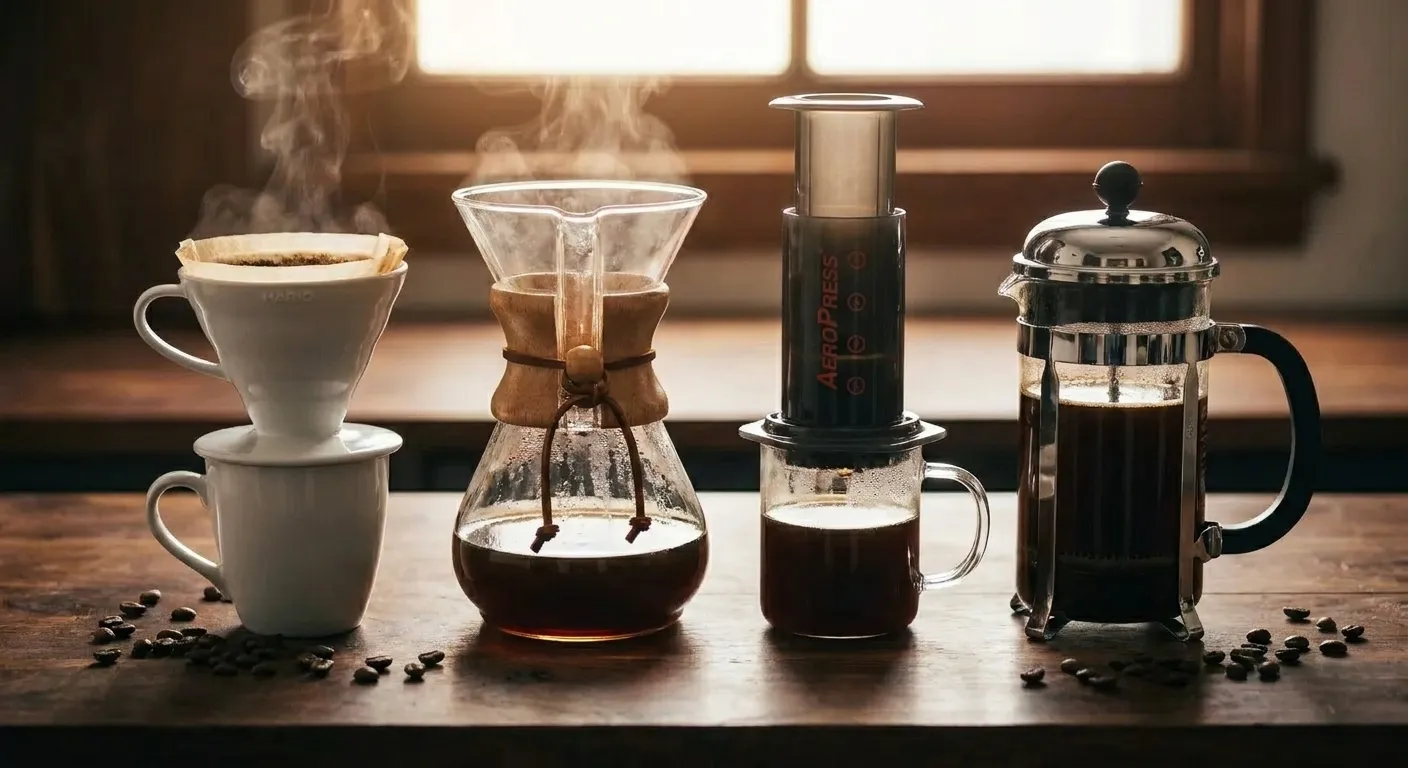
Affiliate disclosure: Sweeter Grind is a participant in the Amazon Services LLC Associates Program. We may earn commissions on qualifying purchases at no extra cost to you.
A coffee brewer is the most visible piece of your setup, but — contrary to popular belief — it is usually the least important to get right. A $15 dripper paired with a good grinder, scale, and kettle outperforms a $300 machine paired with bad inputs. Still, the brewer you pick shapes the cup in specific and predictable ways. Choosing well makes everything easier.
The decisions that actually shape the cup are filter type, carafe style, SCA certification, and pre-infusion behavior — in that order. Material, design, and brand matter less than any of them. What follows is how to evaluate each in any brewer format, manual or electric.
For how the brewer fits into your full coffee setup, see our Ultimate Coffee Equipment Guide 2026. For a framework on which brewing method suits you, see how to choose the right brewing method.
Manual vs Electric Brewers
The first fork: do you want to brew by hand or push a button?
Manual brewers (V60, Chemex, French press, AeroPress, Kalita Wave, Moka pot) require you to heat water separately, pour it yourself, and manage the extraction in real time. They are cheaper, more forgiving of budget, and offer more control over every variable.
Electric brewers (drip machines, espresso machines, batch brewers) handle most of the process automatically. They are faster, more convenient at volume, and more consistent once dialed in — but only if the machine is well-engineered. Cheap electric brewers produce mediocre coffee at the wrong temperature with uneven saturation.
For single-cup daily brewing, manual usually wins on value and quality. For multi-cup or multi-person households, a quality electric drip machine is genuinely excellent and faster.
Material
What the brewer is made of affects durability, heat retention, and sometimes flavor.
Ceramic
Common for pour over drippers (V60, Kalita, Origami). Ceramic retains heat well once preheated, which helps maintain brewing temperature. It is also heavy, stable, and looks premium on a counter. Downside: it breaks if dropped, and it takes a pre-rinse with hot water to avoid sucking heat out of the brew.
Glass
Chemex, some pour over drippers. Attractive, easy to clean, non-reactive. Chemex in particular uses borosilicate glass that can tolerate temperature swings without cracking. Downside: fragile and poor heat retention (though the Chemex's design mitigates this by brewing all at once into a retaining vessel).
Plastic
Hario V60 plastic, AeroPress, inexpensive drippers. Light, cheap, durable, travel-friendly. Modern food-grade plastics (BPA-free, often Tritan or polypropylene) are inert and do not affect coffee flavor. The AeroPress in particular has a devoted following despite being plastic. Downside: does not look as premium on a counter.
Metal
Stainless steel drippers (Able Kone, some Hario models), metal-filter French press, espresso portafilters. Durable, heat-conductive, dishwasher-safe. Downside: metal filters pass more oils and fines into the cup, which some people love and others do not.
For Drip Machines
Look for stainless steel internal components wherever possible. Plastic reservoirs and brew baskets are fine if food-grade. Avoid machines where hot water passes through plastic-with-visible-discoloration or where aluminum is used in heating elements (rare, but still happens in very cheap machines).
Filter Type
This is one of the biggest decisions, because it directly shapes the cup.
Paper Filter
Used in: V60, Chemex, Kalita Wave, AeroPress (standard), most drip machines.
Paper filters remove most of the oils and essentially all of the fine particles from the brew. The result is a clean, bright cup that showcases origin character, acidity, and complexity. Chemex filters are particularly thick (20–30% thicker than most) and produce the cleanest possible cup.
Upside: clearest flavors, easiest cleanup (just toss the filter), no sediment. Downside: disposable (small cost and waste), removes some body, occasionally contributes a faint paper flavor if not rinsed.
Pre-rinse paper filters with hot water before brewing. It removes the paper taste and preheats the brewer.
Metal Filter (Permanent)
Used in: French press, Able Kone in V60, metal filter AeroPress accessory, some drip machine permanent filters.
Metal mesh filters let oils and fine particles through. The result is a fuller-bodied, heavier cup with more texture and often a small amount of sediment at the bottom. Some people find this richness desirable; others find it muddied or sludgy.
Upside: more body, reusable forever (no waste), showcases oils that paper removes. Downside: cleanup is more involved (rinse grounds, scrub mesh), some sediment, pulls the cup in a heavier direction.
Cloth Filter
Used in: some siphon brewers, Nel drip, traditional tropical brewing methods.
Cloth filters sit between paper and metal — they catch more fines than metal but less than paper, and they let more oils through than paper but less than metal. They produce a rich, clean cup that many consider the best of both worlds.
Upside: unique flavor profile, reusable. Downside: must be stored wet in the fridge between uses (otherwise mold and rancidity), hand-washed, replaced every few months.
Filter Comparison at a Glance
| Filter | Body | Clarity | Oils | Cleanup |
|---|---|---|---|---|
| Paper (standard) | Medium | High | Low | Easy |
| Paper (Chemex, extra thick) | Light | Highest | Lowest | Easy |
| Metal mesh | Heavy | Medium | High | Medium |
| Cloth | Medium-Heavy | High | Medium-High | Hard |
Thermal Carafe vs Hot Plate
For drip coffee machines specifically, this is a make-or-break decision for cup quality.
Hot Plate (Glass Carafe)
The machine brews into a glass carafe sitting on a heated metal plate. The plate stays on to keep the coffee "hot" (actually to keep cooking it). Within 20 minutes, the coffee on the hot plate starts tasting burnt and harsh. Within an hour, it is close to undrinkable.
Verdict: avoid hot plate machines unless you plan to pour the carafe into an insulated vessel immediately.
Thermal Carafe (Insulated)
The machine brews into a double-walled insulated carafe that keeps coffee hot without additional heat. The coffee stays at a drinkable temperature for 2+ hours without continuing to cook. This preserves flavor dramatically better than hot plate machines.
Verdict: always prefer thermal carafe drip machines. The extra $50–$100 is the single best upgrade you can make to a drip coffee setup.
SCA Certification
The Specialty Coffee Association (SCA) tests drip coffee machines against strict brewing standards. Machines that pass receive certification, and as of 2026 that short list includes options from Technivorm, Breville, OXO, and Bonavita.
The SCA Home Brewer Certification Criteria
What an SCA-certified drip machine is required to do:
- Brew water temperature: 197.6–204.8°F (92–96°C) throughout the brew cycle
- Total brew time: between 4 and 8 minutes end-to-end
- Coffee bed saturation: at least 98% of the grounds wetted during brewing
- Final beverage strength: 1.15–1.35% TDS (total dissolved solids)
- Extraction yield: 18–22% of the soluble coffee mass actually extracted
These are the same targets a skilled pour-over brewer is aiming for by hand. The reason SCA certification matters is not marketing — it is that most drip machines fail at least one of these specs badly, usually brew temperature. Cheap machines brew at 180°F or below and saturate unevenly. The coffee that comes out is under-extracted, sour, and thin. Certified machines brew at the right temperature, shower the bed evenly, and finish in the right window.
The Currently-Certified Drip Machines Worth Knowing
As of 2026, these four are the drip machines we point readers at most often. All are SCA-certified, all have thermal carafes, all are available at major retailers.
- Technivorm Moccamaster KBGV Select — ~$350. The volume king. Copper boiling element, 6-minute brew cycle, brews full-carafe or half-carafe at the flip of a switch. Made in the Netherlands; lasts a decade-plus with minor maintenance.
- Breville Precision Brewer Thermal — ~$300–$350. The most flexible of the bunch. Six brew modes including "My Brew" custom profiles, a pour-over adapter that turns the showerhead into a V60-friendly dripper, and a strength selector.
- OXO Brew 9-Cup Stainless — ~$200. The value pick. Full SCA certification, rainmaker showerhead for even saturation, programmable start time. Smaller form factor than the Moccamaster.
- Bonavita Connoisseur 8-Cup — ~$180. The budget-friendliest SCA-certified option. Simple one-button operation, 60-second pre-infusion pause, thermal carafe. Not as feature-rich as the others but brews an excellent cup for the price.
If you are buying a drip machine, SCA certification is the single most important spec. Without it, you are almost certainly buying an underperforming machine.
Our roundup of the best automatic drip coffee makers covers SCA-certified options in detail.
Pre-Infusion (The Bloom)
Pre-infusion — sometimes called "bloom" — is a brief pause at the start of brewing where a small amount of water wets the grounds before the main brew begins. This lets the coffee degas (release trapped CO₂) and pre-saturates every particle, which creates more even extraction.
In manual brewing, you do this yourself: pour 2–3x the coffee weight of water, wait 30–45 seconds, then continue pouring. See our deep dive on what is coffee bloom for the science.
In drip machines, look for a "pre-infusion" or "pulse brew" setting. Quality machines (SCA-certified Moccamaster, Breville Precision Brewer, OXO) build this in automatically. Cheap machines dump all the water at once, producing uneven saturation.
Why it matters: skipping pre-infusion with fresh-roasted coffee leaves CO₂ trapped in the grounds, which repels water and creates channels. The result is under-extracted, sour coffee with inconsistent flavor. Pre-infusion fixes this for essentially free.
Capacity
Single-Cup Brewers (1 cup at a time)
V60 (1–3 cups), AeroPress (1–2 cups), Kalita Wave 155 (1–2 cups), single-serve drip machines.
Best for: solo drinkers, or households where each person wants a different roast/method.
Multi-Cup Brewers (2–8 cups at a time)
Chemex 6-cup or 10-cup, V60-02 or V60-03, Kalita Wave 185, large French presses, most drip machines.
Best for: households, guests, or anyone who wants multiple cups in one brewing session.
Batch Brewers (10+ cups)
Moccamaster, Breville Precision Brewer 12-cup, commercial batch brewers.
Best for: offices, large households, or people who want to brew a day's worth of iced coffee at once.
A note on "cup" size: coffee "cups" are usually 5 oz, not 8 oz. A "12-cup" drip machine makes roughly 60 oz, which is 7–8 standard 8 oz mugs. Check the actual ounces, not the "cup" count.
Brew Time
Every brewing method has a target brew time range. Too fast and extraction is weak (under-extracted, sour). Too slow and extraction is excessive (over-extracted, bitter).
| Method | Target brew time |
|---|---|
| V60 | 2:30–3:30 total |
| Chemex | 3:30–5:00 total |
| Kalita Wave | 3:00–4:00 total |
| French press | 4:00 steep |
| AeroPress | 1:00–2:30 total |
| Drip machine (full carafe) | 4:00–6:00 total |
| Moka pot | 4:00–6:00 on stovetop |
| Espresso | 25–30 seconds |
Our brew timer has presets for each of these methods. If your brew consistently falls outside these ranges, adjust grind size first — finer slows extraction (longer brew time), coarser speeds it up (shorter brew time).
What to Look For by Brewer Category
Pour Over Drippers (V60, Chemex, Kalita, Origami)
- Preheat before use (pour hot water through the filter and brewer)
- Paper filters — pre-rinse to remove paper taste
- Single hole (V60) = faster flow, more technique-sensitive. Three holes (Kalita) = slower flow, more forgiving
- See our Chemex vs Hario V60 comparison
French Press
- Stainless steel > glass (doesn't crack from thermal shock, keeps heat better)
- Mesh quality matters — cheap mesh lets excessive fines through
- Size to your needs: 34 oz makes ~3 cups, 51 oz makes ~5 cups
- Clean between uses — oils build up on the mesh fast
AeroPress
- Standard (Original) vs Go (travel version) vs XL — all use the same technique
- Metal filter accessory adds body and saves on paper
- Widely considered the best manual brewer for beginners and travelers
Drip Machines
- SCA certification, or skip it
- Thermal carafe, not hot plate
- Pre-infusion/bloom feature
- Water filter (optional but nice)
- Programmable start time (weekday mornings)
- Flat showerhead for even saturation
Moka Pot
- Stovetop aluminum is traditional but can impart a metallic taste over time — stainless steel versions don't
- Induction-compatible models exist (check base material)
- 3-cup or 6-cup sizes are standard (these are 2 oz "cups" — small)
Espresso Machines
- Entire separate buying category. See our Best Espresso Machines for Beginners 2026 roundup
- Bar pressure (must be 9 bar working pressure), PID temperature control, grinder quality all matter far more than price alone
Frequently Asked Questions
Does a more expensive brewer make better coffee?
Only up to a point. A $50 Chemex makes coffee indistinguishable from a $200 Chemex (they are the same brewer — price just varies by retailer). Spending more on the brewer itself rarely buys you more quality. Spending more on grinder, kettle, and scale does.
Is ceramic better than glass?
Slightly, for heat retention. Ceramic holds temperature better mid-brew, which helps extraction. Glass is fine if you preheat thoroughly. Both produce excellent coffee.
Do I need SCA certification for a non-drip brewer?
The SCA certification program is specifically for drip machines. Manual brewers (V60, Chemex, French press) do not go through SCA certification because the brewing process is controlled by the user, not the device. The spec does not apply.
How often should I replace my brewer?
Most brewers last indefinitely unless broken or worn. Ceramic and glass last until dropped. Plastic AeroPress can last 5+ years of daily use. Metal French press mesh eventually loosens after years and benefits from replacement. Drip machines last 5–10 years before electronics or heating elements fail.
Does the color or design of the brewer affect coffee?
No. Color and external design are purely aesthetic. Internal geometry (angle of the dripper walls, hole size, filter shape) affects flavor. External trim does not.
Related reading
- The Ultimate Coffee Equipment Guide 2026
- Do You Need a Coffee Scale?
- Gooseneck Kettle vs Regular Kettle
- Complete Guide to Coffee Brewing Methods
- How to Choose the Right Coffee Brewing Method
- Best Automatic Drip Coffee Makers
The Short Version
Pick a brewer that matches the cup you want: cleaner and brighter (paper filter, pour over), fuller and richer (metal filter, French press), or set-and-forget (SCA-certified drip machine with thermal carafe). Pair it with a good grinder, scale, and kettle. The brewer itself does not need to be expensive.