Chemex vs Hario V60: Which Pour Over Coffee Maker Should You Choose?
 Tommie Chaney·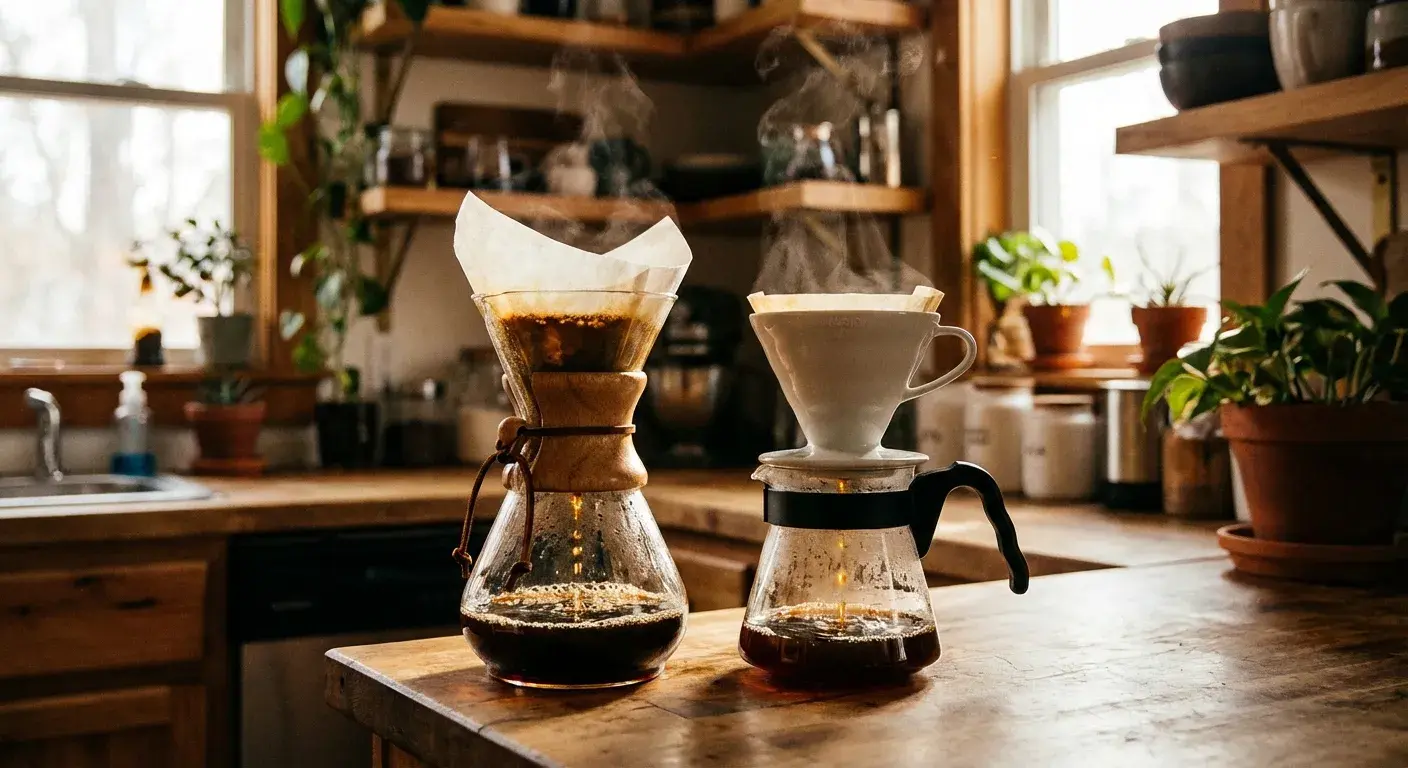
Both the Chemex and the Hario V60 are pour over coffee makers. Both use hot water, ground coffee, a paper filter, and gravity. Both sit in the kitchens of serious coffee enthusiasts worldwide, and both have been used to win barista championships. On paper, they are remarkably similar devices.
In practice, they produce noticeably different cups and suit different brewers. The choice between them comes down to one question: do you want absolute cleanliness and elegance, or maximum nuance and control?
This article contains affiliate links. We may earn a commission if you make a purchase through our links, at no extra cost to you.
The differences are almost entirely about the filters. Chemex filters are 20–30% thicker than V60 filters, and every other distinction — taste, technique, forgiveness, price — flows from that one fact.
Quick Verdict
| Chemex | Hario V60 | |
|---|---|---|
| Taste | Very clean, sweet, balanced | Bright, nuanced, slightly more body |
| Filter thickness | Very thick (20–30% thicker than standard) | Standard thin paper |
| Brew time | 3.5–4.5 minutes | 2.5–3.5 minutes |
| Forgiveness | More forgiving | Less forgiving |
| Capacity | 3–10 cups | 1–2 cups (single brewer) |
| Entry price | $35–$55 | $10–$25 |
| Design | Iconic hourglass, lab glass | Cone with spiral ribs, many materials |
| Cleanup | Moderate | Easy |
| Best for | Clean cup, multiple servings, aesthetics | Flavor exploration, budget, portability |
Design and Build Quality
The Chemex is one of the most recognizable objects in American design. Invented in 1941 by chemist Peter Schlumbohm, it was inspired by a laboratory Erlenmeyer flask. The hourglass shape is made from non-porous borosilicate glass — the same type used in chemistry labs — and tied at its narrow neck with a polished wooden collar and leather tie. The Museum of Modern Art added it to its permanent collection in 1943, just two years after its invention. It is not just a coffee brewer; it is an object people put on display.
The Chemex is available in 3-cup, 6-cup, 8-cup, and 10-cup sizes. All brewing happens in the same vessel — no separate carafe needed.
The Hario V60 takes a completely different approach. The name comes from the V-shaped cone at 60 degrees. Where the Chemex is monolithic and sculptural, the V60 is minimalist and functional. Its defining features are the spiral ridges running up the inside of the cone (which create airspace for even extraction) and the single large hole at the bottom (which gives you control over flow rate via grind and pour speed).
The V60 comes in more materials than almost any other brewer on the market: plastic, ceramic, glass, copper, stainless steel, and even dripper-specific iron. The plastic version costs around $10 and brews coffee just as good as the copper version. The V60 requires a separate server or carafe to brew into.
The Filters: Where Everything Starts
The real difference between these two brewers is their filters, and the taste, technique, and learning curve all flow from that single factor.
Chemex bonded filters are proprietary, square-folded paper filters that are 20 to 30 percent thicker than standard paper filters. They are made from laboratory-grade paper designed to remove not just coffee grounds but also the natural oils (lipids), fine particles, and bitter compounds that pass through thinner filters. The result is exceptional clarity and sweetness in the cup.
Hario V60 filters are noticeably thinner and allow more of the coffee's natural oils to pass through into your cup. This adds texture, body, and a slight richness that you do not get from the Chemex's heavier filtration.
The practical difference: Chemex filters are thicker, which means water drains more slowly — requiring a slightly coarser grind to prevent over-extraction. V60 filters drain faster, requiring a finer grind to achieve adequate extraction. You cannot swap filters between the two brewers; they are incompatible in size and shape.
On cost: Chemex filters run around $10–14 for 100. V60 filters run around $7–10 for 100. If you brew daily, V60 filters save you $15–40 per year.
Brewing Experience
Technique and Forgiveness
Both methods use the same general technique: bloom the grounds with a small amount of hot water, wait 30 seconds, then continue pouring in slow circles. But the margin for error differs.
The Chemex is more forgiving. Its thicker filter slows the drawdown and smooths out inconsistencies in your pour. Uneven saturation, slightly off grind sizes, and imprecise water temperature have less impact on the final cup. This makes it a good entry point for someone transitioning from drip coffee to manual brewing.
The V60 is less forgiving and more rewarding. Its thinner filter and single large drain hole mean that your pouring technique, grind size, and water temperature have a direct, immediate effect on the cup. A poorly executed V60 brew can taste flat, sour, or astringent. A well-executed V60 brew can be extraordinary. Many experienced home brewers prefer the V60 precisely because the feedback loop is so tight — you develop skill faster and the ceiling is higher.
Capacity
This is a significant practical difference. A Chemex can brew 3 to 10 cups in a single batch, making it an excellent choice for households brewing for two or more people, or for anyone who wants to brew a full carafe and keep it warm on the stove.
The V60 is a single-cup brewer. The largest standard size (V60-03) can technically brew two cups but requires a larger server. If you regularly brew for multiple people, you will either need multiple V60s, a larger server, or to accept serial brewing one cup at a time.
Taste Comparison
This is what most people care about most.
Chemex produces a very clean, sweet, balanced cup. The thick filter removes virtually all oils and fine particles. What you are left with is a remarkably smooth, tea-like brew with defined sweetness and muted acidity. Harsh notes are softened. The finish is clean and quick. Some describe it as the most "elegant" cup in coffee — everything unwanted has been filtered away.
The downside is that some complexity is also filtered out. The thick filter removes not just bitterness and grit but some of the more delicate, volatile aromatic compounds that give a light roast its most distinctive character.
V60 produces a brighter, more nuanced cup with slightly more body. The thinner filter lets more of the coffee's character come through. Acidity is better defined and more pronounced. Floral and fruit notes on a natural-processed Ethiopian bean, for example, are often more vivid from a V60 than a Chemex. The cup has slightly more texture.
The direct comparison: if you took the same coffee, ground it correctly for each brewer, and tasted both side by side, the Chemex would taste cleaner and more balanced while the V60 would taste more vibrant and expressive. Neither is objectively better. It depends entirely on whether you prefer refinement or intensity.
Grind and temperature guides:
| Chemex | Hario V60 | |
|---|---|---|
| Grind size | Medium to medium-coarse | Medium to medium-fine |
| Water temperature | 93–96°C (199–205°F) | 93–96°C (199–205°F) |
| Coffee-to-water ratio | 1:15 to 1:17 | 1:15 to 1:16 |
| Total brew time | 3.5–4.5 min | 2.5–3.5 min |
Price and Value
The Hario V60 wins decisively on price. A plastic V60-02 costs around $10 to $15. The ceramic version is $25 to $30. Even the premium copper version stays under $100. Filters are cheap and widely available. This is one of the best value propositions in all of specialty coffee equipment.
The Chemex costs more across the board. The classic 6-cup glass Chemex runs $40 to $55. The 8-cup version is slightly more. Filters are also pricier and harder to find in physical stores outside major cities. If you break the glass — which happens — you are buying a new brewer, not just a new dripper.
If budget is any constraint, the V60 is the obvious choice. The coffee it produces at $15 is equal to or better than what you get from a $50 Chemex in the hands of a skilled brewer.
Who Should Buy the Chemex
- You brew for two or more people regularly
- You want a brewer that doubles as kitchen decor
- You prefer a clean, balanced, sweet cup over maximum brightness
- You are new to pour over and want more forgiveness while you learn
- You want to impress guests and enjoy the ritual of a beautiful object
Who Should Buy the Hario V60
- You brew one cup at a time for yourself
- You are serious about flavor and want to develop pour over technique
- Budget matters and you want the best coffee per dollar spent
- You want a lightweight, portable dripper for travel or work
- You enjoy experimenting with recipes and variables
Frequently Asked Questions
Can I use V60 filters in a Chemex or vice versa? No. Chemex filters are square and folded into a proprietary cone shape designed for the wide Chemex opening. V60 filters are a different size and cone angle. They are not interchangeable.
Which brewer is better for dark roast coffee? Both work for dark roasts, but the Chemex's heavier filtration smooths out the bitter compounds that dark roasts can emphasize — making it marginally more forgiving with darker beans. The V60 will produce a slightly more intense dark roast experience.
Is the Chemex difficult to clean? The main Chemex vessel is easy to rinse but the narrow neck makes it difficult to clean by hand. Chemex sells a dedicated cleaning brush. Putting it in the dishwasher (after removing the wooden collar) works well. The V60 is much simpler — a quick rinse after each use is all you need.
Does the material of the V60 affect taste? Minimally. Ceramic and glass retain heat better than plastic during brewing, which can produce slightly more consistent extraction in cold environments. In a warm kitchen, the difference is negligible. The plastic V60 brews coffee just as well as ceramic in most real-world conditions.
Which to Buy
Choose the Chemex if you want a beautiful, forgiving brewer that makes a clean, balanced cup for multiple people.
Choose the V60 if you want maximum flavor expression, a lower price point, and a platform for developing real pour over technique.
For every pour over brewer worth considering at each price point, see Best Pour Over Coffee Makers 2026. If you're still deciding whether pour over is the right category at all, the Complete Guide to Coffee Brewing Methods maps out every option.