Air Popper Coffee Roasting Guide: The $30 Starting Point
 Tommie Chaney·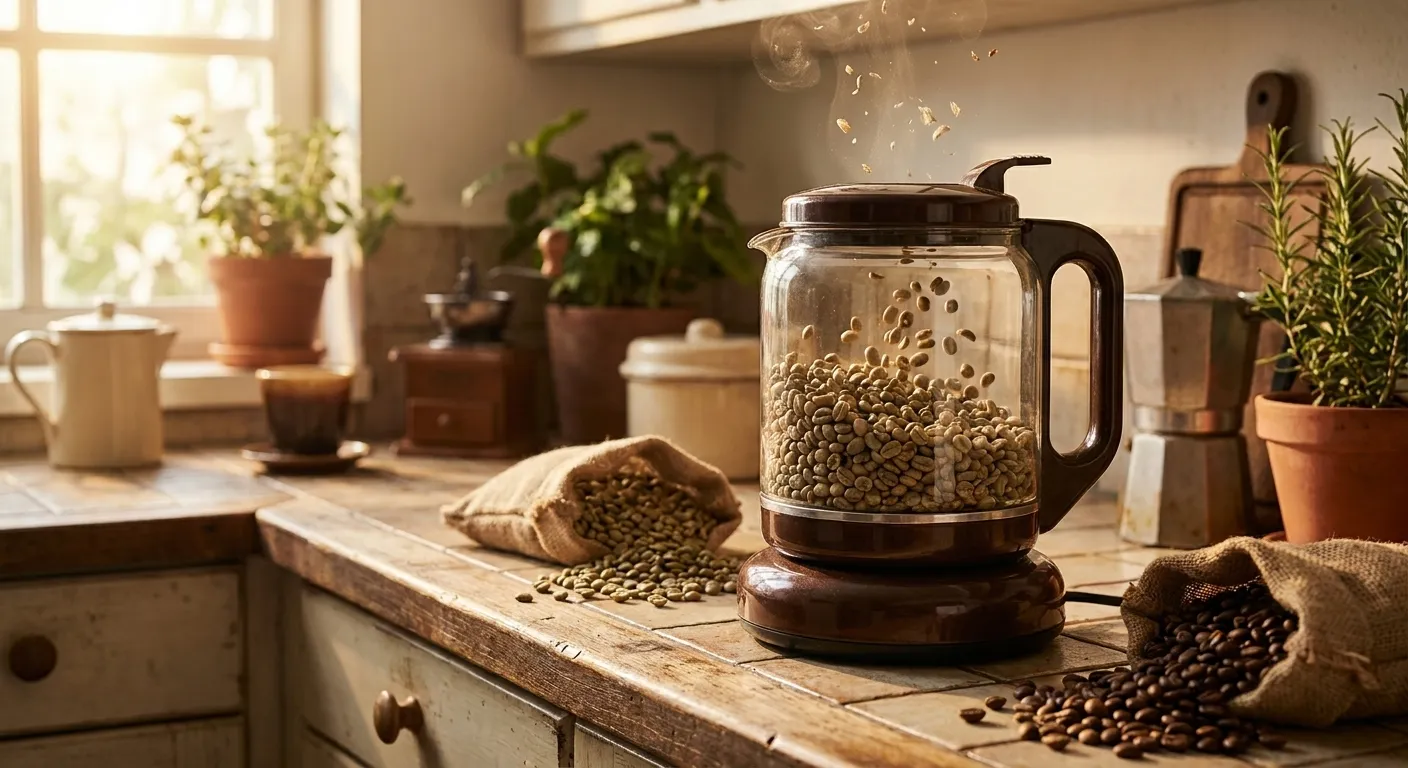
Affiliate disclosure: Sweeter Grind is a participant in the Amazon Services LLC Associates Program. We may earn commissions on qualifying purchases at no extra cost to you.
The $30 popcorn air popper is home roasting's gateway drug. It is cheap, widely available, surprisingly effective, and genuinely fun to use. A huge percentage of today's specialty roasters — including people now running commercial operations — cut their teeth on a Presto PopLite or a West Bend Air Crazy at their kitchen counter. You can be one of them this weekend.
What follows is the canonical popper roast: picking a model, the 4-ounce batch rule, the 4-to-7-minute timeline, how to hear the cracks over the fan, managing chaff, safe modifications, and the honest signs that you have outgrown the method.
For the bigger picture on home roasting, see How to Roast Coffee at Home or home roasting methods compared if you're still choosing between approaches.
Why an Air Popper Works for Coffee
A popcorn air popper is, mechanically, a miniature fluid-bed coffee roaster. It has a heating element at the bottom of a chamber and a fan that blows hot air up through the beans, suspending them in a turbulent column while they heat. That is also exactly how commercial fluid-bed coffee roasters like the Loring and Sivetz operate — just at a much smaller scale.
The core advantages:
- Even heat exposure. Beans are constantly moving, so no single bean sits against a hot surface long enough to scorch.
- Fast roast times. 4–7 minutes total means you can iterate quickly.
- Easy cleanup. Dump the beans, brush out chaff, you are done.
- Low learning investment. Most people get a drinkable roast on attempt 1 or 2.
The core limits:
- Small batches. 3–4 ounces of green coffee (yielding 2.5–3.4 oz roasted) is the realistic maximum. Overloading stalls the airflow, produces an uneven roast, and can burn out the motor.
- Limited top-end temperature. Many poppers cap out around 210–220°C / 410–428°F bean temperature, which is just past first crack. Dark roasts are unreliable or impossible.
- Short lifespan at coffee duty. Popcorn makers are not designed for repeated high-heat, bean-mass loads. Expect 20–60 batches before motor fatigue, depending on model.
- Temperature sensitive to ambient conditions. Roasting in a 55°F garage vs. a 75°F kitchen produces noticeably different results.
Accept the limits and the air popper is excellent at what it does.
Choosing the Right Popper
Not every popcorn popper roasts coffee well. Two requirements matter:
1. Side-vented airflow, not bottom-vented. Look inside the chamber. If the air vents come up the sides of the chamber (pushing beans in a rotating circle), it is a coffee-capable design. If the vents are a single ring in the bottom pushing straight up, the airflow is uneven and the roast suffers.
2. At least 1,200–1,400 watts of heating power. Lower-wattage units cannot reach the bean temperatures needed to drive first crack. A minimum of 1,300W is a safe threshold.
Well-known popper models that roast coffee reliably:
| Model | Wattage | Chamber Vent Style | Notes |
|---|---|---|---|
| West Bend Poppery II (vintage) | 1,500W | Side-vented | Legendary for coffee; scarce, sold at premium |
| Presto PopLite 04820 | 1,400W | Side-vented | Current production, commonly recommended |
| Nostalgia APH200 | 1,200W (check label) | Side-vented | Entry-level; only usable if the specific unit is rated ≥1,200W |
| West Bend Air Crazy | 1,200W | Side-vented | Budget-friendly, small chamber |
The vintage West Bend Poppery II is a cult classic — if you see one at a thrift store for under $15, buy it. Of the current-production units, the Presto PopLite is the safest default recommendation.
What You Need Before You Roast
Minimal setup checklist:
- Air popper (obviously)
- 4 ounces of green coffee beans
- Two metal colanders (for cooling)
- A wooden spoon or silicone spatula (to gently stir during the first 60 seconds, optional)
- An outdoor location or kitchen with range hood ventilation
- A kitchen timer or stopwatch
- Optional: an infrared thermometer, a stainless bowl for chaff capture, a silicone funnel extender
About ventilation: even a small roast produces real smoke. Roast outside on a porch or in a garage if at all possible. Indoor roasting requires a range hood that vents outside, or at minimum an open window with a strong fan exhausting air out.
The 4-Ounce, 4-to-7-Minute Roast
The canonical popper roast, step by step:
1. Preheat (30 seconds). Turn the popper on empty for 30 seconds to bring the heating element up to temperature. Do not run it empty for more than 60 seconds — airflow without beans causes the chamber to overheat.
2. Charge with 4 oz green coffee (or less). Start conservative. If your popper bogs down and beans stop circulating, you have overloaded it; dump half out immediately.
3. First 60 seconds — stirring phase. For the first minute, some beans may not circulate freely because the cold bean mass is heavier than the hot airflow can lift. Gently stir with a wooden spoon until rotation becomes self-sustaining. (Do not stir on a metal-chamber popper without protecting the element.)
4. Minutes 1–4 — drying and Maillard. Beans will transition from green to yellow to tan. Chaff will begin to shed — you may see it flying out the top of the popper or into whatever catch system you have rigged. Smoke will start rising as you approach minute 4.
5. Minutes 4–5:30 — first crack. The sharp, popcorn-like crackling of first crack begins. Start your development timer.
6. Minutes 5:30–6:30 — development. This is the only window where you are choosing a roast level.
- Drop at 30 seconds past first crack start = very light, tea-like
- Drop at 60 seconds past first crack start = classic light
- Drop at 90 seconds past first crack start = light medium
- Drop at 120 seconds past first crack start = medium (approaching the popper's limit)
7. Dump and cool. The moment you hit target, dump the beans from the popper into one colander. Pour back and forth between two colanders for 2–3 minutes to bring the beans down below 50°C / 120°F fast. Rapid cooling stops the roast from continuing internally.
8. Rest. Store in an open bowl for the first 12 hours (beans are actively off-gassing CO2), then transfer to a one-way valve bag or canister. Full details in resting and storing freshly roasted coffee.
Total elapsed time from cold to cool beans: about 10–12 minutes.
Managing the Chaff
Chaff is the papery silverskin of the coffee bean. It sheds aggressively during the Maillard and first-crack stages, and an air popper blows it everywhere.
Three chaff-management strategies:
- Roast outside. Cleanest solution. Chaff blows away on the breeze.
- Chaff collector add-on. A stainless bowl with a cut bottom or a commercial roaster chaff chimney (search "air popper chaff collector" on Etsy or coffee forums) slides over the top of the popper.
- Line your roast area. A paper bag taped around the popper's output area or a designated cardboard box catches most of the fallout. You still vacuum afterward.
Chaff is combustible, so do not let it accumulate inside or near the popper. A quick shake-out and brush after every roast keeps things safe.
Safe Modifications
Popper-modding is a minor hobby unto itself. A few commonly-done, safe modifications:
- Add an external dimmer or variac. Lets you control heating element voltage, which lets you stretch or shorten the roast. Only do this if you understand AC electrical work. Do not modify a popper without unplugging it first.
- Drill a second thermowell. For inserting a thermocouple probe to log bean mass temperature. Requires a high-speed drill and a stainless drill bit.
- Attach a chaff chimney. Extends the output with a small bowl, sieve, or cardboard cone to capture chaff.
Modifications you should not do without deep electrical knowledge: bypassing thermal fuses, removing heat-element safety limits, or running the unit past its rated voltage.
A stock, unmodified popper is perfectly capable of producing good coffee. Skip the modding until you know you want it.
Typical Popper Roast Problems
"My beans look uneven — some dark, some pale." Either you overloaded the chamber (reduce to 3 oz next batch) or your popper's airflow is uneven. Side-vented poppers roast more evenly than bottom-vented.
"I never hear first crack." Most likely: ambient noise is drowning it out. Get close, turn off the range hood briefly, listen carefully around the 4-minute mark. Secondary cause: very stale or old greens, which crack weakly.
"The beans stop circulating after the first minute." Too many beans, or beans too dense. Dump some out, or switch to a lighter/less-dense bean like a Colombian or Ethiopian.
"My popper is getting hot to the touch and making a strange smell." Stop. This is thermal stress. Let it cool completely, reduce batch size, and consider whether you have burned out the motor (a burning plastic smell is a bad sign).
"I cannot reach second crack." You probably cannot, and that is normal. Popper limitations mean light-to-medium is the reliable range. Medium-dark is occasionally possible in a 1,500W vintage unit with a dense bean. Dark is not the popper's job.
When to Graduate
You know it is time to upgrade past an air popper when:
- You are roasting more than twice a week and wanting 6+ oz batches
- You consistently want darker roasts than the popper can reach
- You can taste the difference between your roasts and want more control to steer them
- You have burned out one popper already and are buying a second
- You are bored — you have done 30 batches and want to see what manual heat + airflow control feels like
The standard upgrade path from a popper is a FreshRoast SR540 or SR800 ($200–$265), which is essentially a purpose-built coffee fluid-bed roaster with manual heat and fan control, a larger batch size (up to 8 oz), and a dedicated cooling cycle. The roasting mechanics are familiar, but the control is dramatically better.
FAQ
How many batches will one popper survive for coffee? 20–60, depending on the model, how hard you push it, and how much chaff you let accumulate. When the motor starts struggling to sustain rotation, it is time for a new unit.
Can I roast dark roasts in a popper? Not reliably. Most poppers cap out before or just past first crack. Medium roasts are realistic; dark roasts are outside the method's capability.
Is it dangerous to roast coffee in a popcorn popper? No more than making popcorn, if you follow basic rules: do not overload, do not leave it unattended, keep chaff cleaned out, roast with ventilation. Coffee oil ignites around 240°C / 464°F — well above normal popper temperatures.
Do I need special coffee beans for a popper? Any specialty green coffee works. For your first few batches, pick a moderate-density bean like a washed Colombia, Guatemala, or Ethiopia — these are forgiving and widely flavored. Avoid super-dense beans (high-grown Kenyans, some Burundians) until you have practice.
How long do the beans need to rest before I brew them? Minimum 24 hours, ideally 2–5 days for drip/pour-over, and 5–10 days for espresso. Fresh-off-the-popper coffee is still actively venting CO2 and will taste flat or sour.
How loud is first crack in a popper? Louder than the fan, but not dramatically so. Get close, stop talking, and you will hear it clearly.