Do You Need a Coffee Scale? Why Brewing by Weight Beats Scoops
 Tommie Chaney·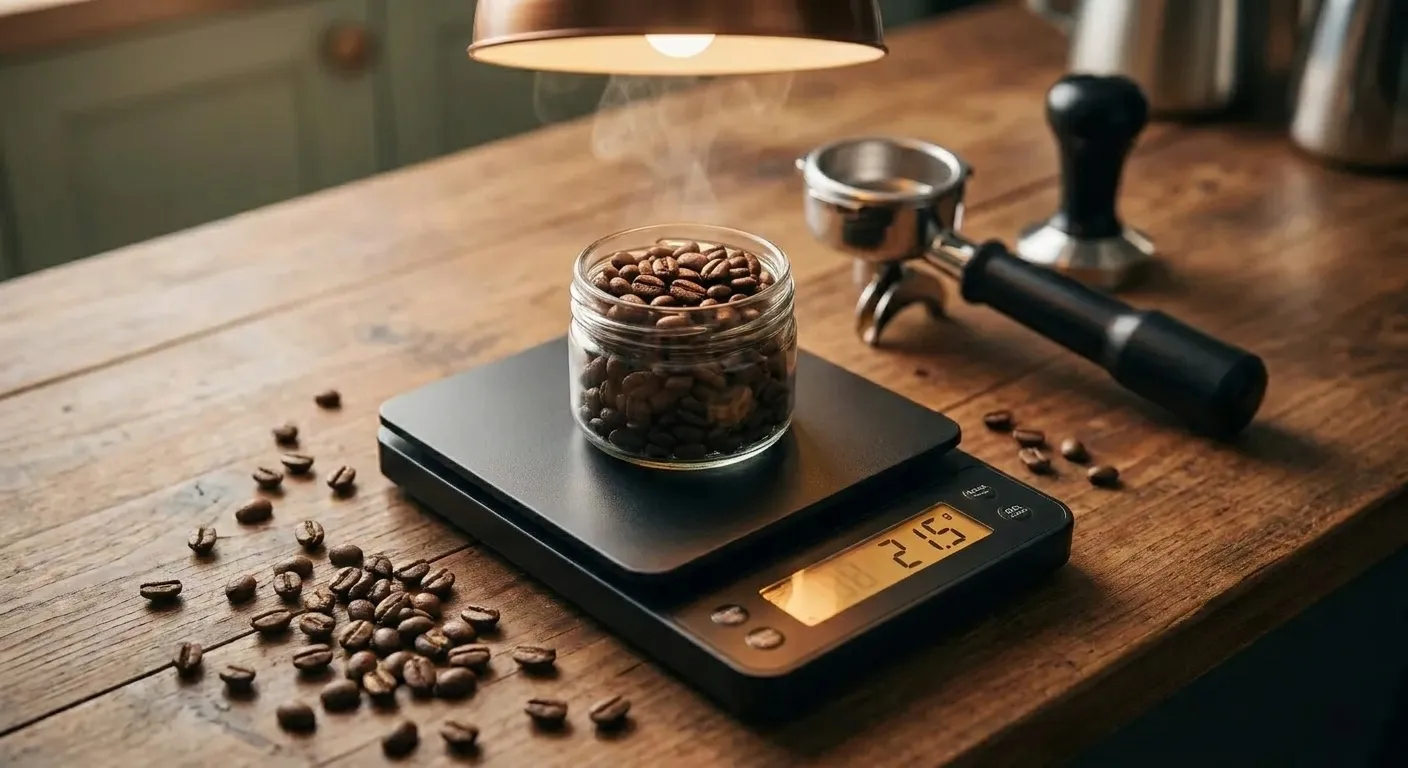
Affiliate disclosure: Sweeter Grind is a participant in the Amazon Services LLC Associates Program. We may earn commissions on qualifying purchases at no extra cost to you.
A coffee scale is the smallest upgrade with the largest return in home brewing. For $20 to $40, a scale turns guesswork into measurement, and measurement is the difference between a great cup today and a great cup tomorrow, next week, and next year. If you only ever buy one accessory beyond your grinder and brewer, make it a scale.
Below: why brewing by weight beats scoops, what precision you actually need, and what features to look for in an inexpensive scale. If you've ever made a great cup and been unable to repeat it, a scale is almost certainly the missing piece.
For the broader view of where the scale fits in your full setup, see our Ultimate Coffee Equipment Guide 2026.
Why Scoops Fail
A "scoop" — usually a tablespoon — sounds precise. It is not. The mass of coffee that fills a tablespoon varies enormously depending on three things:
- Bean density — light roasts are denser than dark roasts. A tablespoon of light roast Ethiopian might weigh 7g; a tablespoon of dark roast Sumatran might weigh 5g.
- Grind size — whole beans take up more space than ground coffee. Fine grounds pack tighter than coarse grounds.
- How you scoop — a level tablespoon vs a heaping tablespoon is a 30%+ difference in mass.
The result: a "2 tablespoon" measurement can be anywhere from 10g to 16g of actual coffee. At a 1:16 ratio, that's a difference of 96g of water — more than a third of a cup. Your "same recipe" produces totally different coffee from day to day, and you have no idea why.
Volume measurement also falls apart for water. Different kettles have different spouts, and "6 ounces" in your mug looks different from "6 ounces" in a measuring cup. Even if you use a measuring cup every time, the coffee volume uncertainty alone guarantees inconsistency.
What a Scale Actually Fixes
Weight is the same everywhere. 18 grams of light roast Ethiopian is 18 grams of dark roast Sumatran. 300 grams of water is 300 grams of water no matter what vessel it is in. When you measure both coffee and water by weight, you eliminate all three sources of scoop variability in one move.
This unlocks something specific: ratio control. Professional coffee brewing revolves around coffee-to-water ratios expressed by weight (1:15, 1:16, 1:17, etc.). Once you are measuring both in grams, the ratio becomes a dial you can deliberately turn.
Want a stronger cup? Change from 1:16 to 1:15. Want a lighter cup? Go to 1:17. Our brew ratio calculator does the math for you — you enter your preferred coffee dose and it tells you the exact water weight. This only works because you have a scale to measure the output.
What Precision You Actually Need
A coffee scale does not need to be a laboratory instrument. For filter brewing (pour over, French press, AeroPress, drip), 0.1g precision is the sweet spot. Anything less precise (1g or 0.5g) becomes imprecise enough to matter at small doses. Anything more precise (0.01g) is unnecessary unless you are pulling espresso shots.
For espresso, 0.1g is still usually enough, though 0.01g scales exist for people who want to measure the exact yield of a shot. Worth it if you are competition-obsessed, optional for everyone else.
The capacity needs to cover your largest brew. 2kg (2000g) capacity is overkill for single-cup brewing but useful if you ever brew a 1-liter batch. 3kg is standard on many coffee-specific scales and gives you headroom.
Features Worth Looking For
Essential
- 0.1g precision — as covered above
- Tare function — one-button zero, used constantly to weigh coffee then water on the same platform
- Fast response — the reading needs to settle in under a second, especially during pouring
Highly Useful
- Timer — a built-in timer is convenient for pour over. Not essential if you use a phone or our brew timer, but nice to have both in your line of sight
- Splash resistance — coffee gear gets wet. A scale with a sealed top or removable silicone pad outlasts one with a mesh speaker grille on the weighing surface
- Auto-off — turns the scale off after a period of inactivity, saving batteries. Most coffee scales have this, some have an override for brewing sessions longer than the default
Nice But Optional
- Bluetooth / app integration — useful for data-obsessed baristas who want to log every brew. Unnecessary for everyday use
- Auto-tare on cup detection — some premium scales detect when you set a cup on them and tare automatically
- Pour rate feedback — advanced scales can display the current pour rate in g/s, helpful for pour over training
Brands Worth Knowing
Several brands have built reputations specifically for coffee scales:
Hario — The V60 dripper maker also makes coffee scales. The V60 Drip Scale is an industry classic: 0.1g precision, built-in timer, simple two-button interface. Durable, well-designed, widely available.
Timemore — A newer brand that has taken the enthusiast market by storm. The Timemore Black Mirror and Black Mirror Basic are popular mid-range coffee scales with 0.1g precision, auto-tare options, and a clean aesthetic. The Black Mirror Nano is a smaller travel-friendly version.
Acaia — The premium end. Acaia Pearl and Lunar are the scales you see in competition and high-end cafes. 0.1g precision with app integration, fast response, and long battery life. Costs 3–5x more than the Hario or Timemore options. Not necessary for home brewing, but the build quality is obvious.
Brewista — Known for their Smart Scales with fast response and auto-pour features. Often sold alongside their gooseneck kettles in enthusiast bundles.
Felicita — Another enthusiast favorite, particularly the Felicita Arc and Parallel scales. Competes directly with Acaia at a slightly lower price point.
You do not need the premium end. A Hario V60 Drip Scale or a Timemore Black Mirror at roughly $30–$80 does everything a home brewer needs for years.
What About a Regular Kitchen Scale?
It depends on the scale. Many kitchen scales only show 1g increments. That is too coarse for coffee — a 1g difference is meaningful at typical doses (15–30g). If your kitchen scale shows 0.1g and responds quickly, use it. If it shows 1g or 5g, buy a dedicated coffee scale.
One other issue: kitchen scales often have slow response times (1–2 seconds), which makes live pouring awkward. You pour, wait, pour, wait. A scale designed for coffee responds in under a second and lets you pour continuously while watching the number climb.
How to Use a Coffee Scale (The Simple Workflow)
- Place empty brewer on the scale. V60, French press, AeroPress, carafe — whatever you are brewing into.
- Tare to zero. The brewer's weight disappears from the reading.
- Add coffee grounds. Watch the scale until you hit your target dose (e.g., 18g).
- Tare again. Coffee weight disappears. Scale reads zero.
- Pour water. Watch the scale until you hit your target water weight (e.g., 300g).
- Start brewing. Use the built-in timer or our brew timer.
That's it. Three taps of the tare button, two pours, and you have a perfectly measured brew. Once you have done it twice, it takes less time than eyeballing scoops and produces dramatically more consistent results.
Ratios, Once You Have a Scale
A scale unlocks the ability to dial in your preferred strength. Standard ratios for filter brewing:
| Ratio | Strength | When to use |
|---|---|---|
| 1:14 | Very strong | You like bold, intense coffee; dark roasts |
| 1:15 | Strong | Classic "full" cup; most daily brewing |
| 1:16 | Balanced | SCA-recommended default starting point |
| 1:17 | Medium | Clean, bright, tea-like; light roasts |
| 1:18 | Light | Showcases delicate origins; lighter roasts |
Pick your starting ratio, taste, and adjust from there. Our brew ratio calculator handles the math for any coffee dose and any ratio.
Why 0.1g Precision Matters (and When It Doesn't)
A 0.1g scale sounds like overkill until you do the math. Typical pour over dose: 15g coffee to 250g water. A 1g scale's minimum step is 6.7% of your coffee dose. Guess wrong by 1g in either direction, and you have changed your ratio from 1:16.7 to 1:17.9 or 1:14.9 — a meaningful swing that you will taste. A 0.1g scale, by contrast, keeps every brew within 0.7% of your target.
For espresso, the impact is larger still. Espresso is typically 18g in, 36g out. A 1g error on the dose is 5.5% — enough to change a shot from balanced to sour or bitter. Espresso scales that measure 0.01g (hundredths of a gram) exist for this reason, though 0.1g is usually adequate for home use.
Where 0.1g doesn't matter: French press at large doses. If you are making a 50g French press for a whole household, a 1g error is 2% — small enough to be lost in normal brewing noise. A kitchen scale at 1g precision works fine at scale.
The Scale-Timer-Kettle Workflow
A scale becomes far more useful when combined with a kettle and timer. The workflow most enthusiasts settle into:
- Preheat brewer. Pour hot water through the brewer and filter; discard.
- Weigh coffee. Grind to your target weight (e.g., 20g). Tare the scale first with the brewer on it.
- Dose into brewer. Tare again. Scale reads zero.
- Start kettle. Water heats to target temperature while you prep.
- Start timer and first pour. Pour bloom water (2–3x coffee weight), start the timer simultaneously.
- Watch the scale. As you pour, the scale climbs from zero. Stop at bloom weight. Wait.
- Main pours. Continue pouring in stages per your recipe. Watch scale and timer together.
- Finish at target total water weight. Stop pouring.
Once this is muscle memory, a full pour over takes 3–4 minutes of active attention and produces predictable, repeatable results. A scale alone cannot do this — it needs the kettle for temperature and the timer for pacing — but without the scale, the other two tools are pointless.
Scale Maintenance
A coffee scale lasts years if treated well. A few habits extend its life:
- Wipe spills immediately. Water and coffee oils work their way into seams over time.
- Store dry. Don't leave your scale next to the sink or directly under a kettle.
- Use rechargeable batteries or remove batteries during long storage. Coffee scales with disposable batteries can corrode if left unused for months.
- Don't overload. Every scale has a maximum capacity. Exceeding it once usually does no damage; repeated overload weakens the load cell.
- Don't drop. The load cell inside most scales is the most delicate component. A hard drop can knock it out of calibration or break it.
If your scale readings drift or become erratic, most coffee scales have a calibration mode (usually described in the manual). Some come with calibration weights; others let you use known household weights (a US nickel weighs exactly 5.00g and works as a quick check).
Frequently Asked Questions
Is a coffee scale worth it if I only make one cup a day?
Yes — in fact, more so. At small doses, scoop-based measurement is most error-prone (the percentage error is larger on smaller amounts). A scale fixes this at the lowest cost of effort.
Can I use my phone as a scale?
Not reliably for coffee. Phone "scale" apps use touchscreen pressure and are not actually calibrated. A dedicated $25 scale is cheaper than the frustration of trying to fake it.
Do I need a waterproof scale?
Waterproof is rare in this price range, but splash-resistant is common and sufficient. Coffee drips happen. Avoid scales with fabric or mesh on the weighing surface.
My scale's battery dies constantly. Why?
Cheap scales often have poor auto-off behavior or power-hungry displays. Look for coffee-specific scales with proper auto-off and replaceable batteries. Rechargeable models exist (Timemore, Acaia) and are worth it if you brew daily.
Do I need a scale for espresso?
Yes, arguably even more than for filter brewing. Espresso is a game of 18g in, 36g out in 25 seconds. Without a scale, you are guessing at every step. Many espresso-specific scales include auto-start timers that begin when liquid hits the cup.
Related reading
- The Ultimate Coffee Equipment Guide 2026
- Burr Grinder vs Blade Grinder
- Coffee Brewer Buying Guide: What to Look For
- Coffee Extraction 101
- Brew Ratio Calculator
- Brew Timer
The Short Version
Skip the fancy features. Get 0.1g precision, a tare button, and a timer if you want one. Hario and Timemore make perfect home scales at $30–$80. Buy one, weigh the coffee, weigh the water. Every cup after that is under your control in a way scoops never allow.
, scale, [WDT tool](https://www.amazon.com/s?k=WDT%20tool&tag=sweetergrind-20), and [knockbox](https://www.amazon.com/s?k=knockbox&tag=sweetergrind-20)](/images/espresso-accessories-you-actually-need-hero.webp)