Espresso Machine Types: Manual, Semi-Automatic, Super-Automatic
 Tommie Chaney·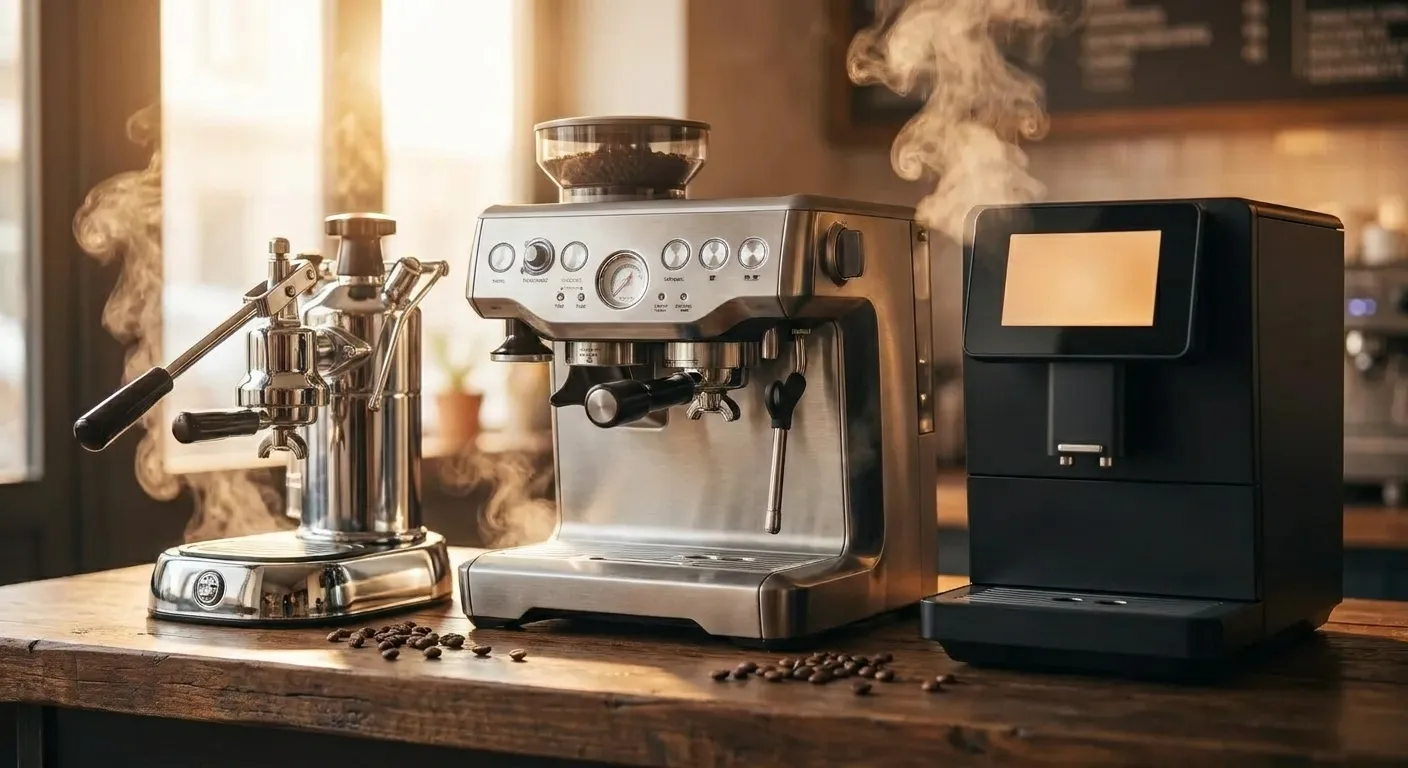
Affiliate disclosure: Sweeter Grind is a participant in the Amazon Services LLC Associates Program. We may earn commissions on qualifying purchases at no extra cost to you.
The first decision in home espresso isn't which machine to buy. It's which category. Pick the wrong category and any specific machine inside it will frustrate you. Pick the right category and even an entry-level model in that category will deliver.
The categories — manual lever, semi-automatic, super-automatic — represent fundamentally different relationships with the machine. A manual lever asks you to apply the 9 bars yourself. A semi-automatic does the pressure but leaves you everything else. A super-automatic does everything and asks for a button press. Each tradeoff produces a different drink, a different daily routine, and a different price ceiling.
This is the buying-decision article. For specific model picks within categories, see Best Espresso Machines for Beginners 2026. For where the machine fits in the broader setup, The Complete Home Espresso Guide 2026.
The Decision Tree
Start here. This routes you to the right category in 4 questions.
Question 1: How many drinks per day, total?
- 1–2 drinks/day → almost any category works
- 3–6 drinks/day (multi-person household) → semi-auto with dual boiler, or super-auto
- 6+ drinks/day or office → super-auto or commercial-grade
Question 2: Do you make milk drinks (cappuccino, flat white, latte)?
- Yes → semi-auto with steam wand OR super-auto with milk system
- No (espresso/Americano only) → any category, including manual lever
Question 3: How much do you care about cup quality vs convenience?
- Quality matters most → semi-auto (any tier)
- Convenience matters most → super-auto
- Craft / hobby angle matters most → manual lever
Question 4: Counter space + budget?
- Tight budget ($100–$500), small counter → semi-auto, single-boiler (Stilosa, Bambino Plus, Gaggia Classic)
- Mid budget ($500–$1,500), normal counter → semi-auto, single-boiler upgrade (Bambino Plus + grinder, Gaggia Classic Pro upgrade)
- Mid-high budget ($1,500–$3,500) → semi-auto, dual-boiler (Lelit Bianca, Profitec Pro 600)
- High budget ($3,500+) and convenience-focused → super-auto (Jura, Breville Oracle Touch)
- Any budget, craft-focused → manual lever (Flair 58, Cafelat Robot, Profitec Pro 800 lever)
If you didn't get routed to a clear answer, the default for most home users is single-boiler semi-automatic (Breville Bambino Plus territory). That's the right answer for the largest number of buyers.
Manual Lever Machines
Manual lever machines have no pump. You apply the 9 bars yourself by pulling a lever or operating a piston. Some have boilers; some require you to bring your own hot water.
How They Work
The classic design: a piston connects to a lever. You preheat with hot water, load the portafilter, lock it in, and pull the lever down. Pulling the lever forces a spring (or your direct force) to push water through the puck at high pressure. Release time, pressure profile, and yield are all controlled by your wrist.
Modern variants:
- Cafelat Robot ($400) — Hand pump, no electronics. Bring your own hot water. Pull two levers down to pressurize.
- Flair 58 ($500) — Plumbed-in piston design with a built-in heating element. Lever-pulled.
- La Pavoni Europiccola ($1,000–$1,500) — Vintage Italian lever with a small boiler. Two-lever pull.
- Rok Espresso GC ($150) — Entry-level lever. Mostly toy; not real 9 bars.
Pros
- Cheapest path to real 9-bar espresso. A Cafelat Robot at $400 produces shots competitive with $1,000+ semi-autos.
- No pump, no PCB, almost nothing to break. Devices last decades.
- Pressure profiling by feel. You can change pressure mid-shot — slow start, ramp up, taper. Useful for advanced extractions.
- Travel-friendly (some models). Cafelat Robot fits in a briefcase. Bring your own hot water.
- Educational. Pulling lever shots forces you to understand pressure, dose, grind in a way semi-autos abstract away.
Cons
- Physical effort. Each shot requires 10–30 seconds of arm work. For 5+ shots a day, this is fatiguing.
- Temperature stability is your problem. No internal PID. You preheat, time the pour by feel, and accept variability between shots.
- Steam wand is rare or absent. Cafelat Robot has no wand. Flair 58 has an add-on. La Pavoni has a small boiler-driven wand. For milk drinks, manual levers are limited.
- Steep learning curve. First 50 shots will be inconsistent. The technique takes weeks to dial in.
- Single-cup pace. Pulling 4 levers in a row is slow.
Who It's For
- Solo drinkers (1–2 shots/day) who prefer espresso straight or as Americanos
- Espresso hobbyists who want to learn pressure profiling
- Travelers who want espresso on the road without a power outlet (Cafelat Robot)
- Buyers who refuse to spend $1,500+ but still want real 9-bar performance
Who Should Not Buy a Manual Lever
- Households with milk drinkers (limited steam capability)
- High-volume drinkers (the arm fatigue is real)
- People who want consistency over craft
For the deeper alternatives if you don't want a real machine at all: How to Make Espresso Without an Espresso Machine covers moka pot, AeroPress espresso-style, and French press double-dose techniques.
Semi-Automatic Machines
The category 95% of home baristas use. The machine handles temperature and pressure. You handle dose, grind, tamp, time, and milk.
Semi-automatics split into three subcategories defined by boiler architecture:
Single-Boiler Semi-Automatics
One boiler does both brew water and steam. The catch: brew temperature is around 200°F (93°C), but steam temperature is around 250°F (121°C). The boiler can be in one mode or the other, not both — so you brew, then wait 30–60 seconds for steam-up, then steam.
Examples:
- De'Longhi Stilosa (~$99) — Entry-tier. 15-bar pump, manual steam wand. Pressure delivery is inconsistent.
- Breville Bambino Plus (~$485) — The most-recommended beginner machine. ThermoJet single-boiler heats in 3 seconds; automatic steam wand.
- Gaggia Classic Evo Pro (~$499) — Vibration pump, manual steam wand, classic Italian design. The "modder's machine" — extensive aftermarket upgrades available.
- Rancilio Silvia (~$800) — Single-boiler semi-pro. Better build than the Bambino, more demanding to learn.
Pros (Single-Boiler)
- Cheapest entry to real espresso machines. Stilosa at $99, Bambino Plus at $485.
- Compact footprint. Fits in any kitchen.
- Lower power draw. 1200–1450W. Works on standard outlets.
- Real espresso quality. Properly dialed in, single-boiler shots are nearly indistinguishable from dual-boiler shots.
Cons (Single-Boiler)
- Wait time between brewing and steaming. 30–60 seconds for the boiler to switch modes. Annoying for back-to-back drinks.
- Steam pressure is moderate, not strong. Texturing milk takes 25–30s for 6oz on a Bambino Plus, vs 10–15s on a dual-boiler.
- Tank capacity is small (1–2 L). Frequent refills.
Dual-Boiler / Heat-Exchange Semi-Automatics
Two separate boilers (dual) or a heat-exchanger system that produces both brew water and steam simultaneously. You can brew and steam at the same time — start the shot, start steaming milk, both ready in 30 seconds.
Examples:
- Profitec Pro 500 (~$1,500) — Heat-exchange. The entry to "no compromise" semi-auto.
- Profitec Pro 600 (~$2,000) — Dual-boiler with PID. The most-recommended mid-tier semi-auto.
- ECM Synchronika (~$3,000) — Dual-boiler with rotary pump. Quieter, more refined.
- Lelit Bianca (~$3,500) — Dual-boiler with PID, paddle for pressure profiling, manual flow control. Power-user favorite.
- La Marzocco Linea Mini (~$6,000) — Saturated group head, commercial-grade build, the prosumer reference.
Pros (Dual-Boiler / HX)
- Brew and steam simultaneously. Latte ready in 30s flat.
- Strong steam pressure. Microfoam in 10–15 seconds.
- PID temperature control with degree-level precision. Better shot consistency.
- Larger tanks (2–3+ L). Less frequent refills.
- Build quality. These machines are designed to run daily for 10–20 years.
Cons (Dual-Boiler / HX)
- Cost. $1,500 floor; $3,000+ for serious dual-boilers.
- Footprint and weight. Large machines (12–17 inches deep, 25–60 lbs).
- Power draw. Many require dedicated 15–20A outlets.
- Heat-up time. 25–35 minutes for full thermal stability (PID assists faster).
Who Single-Boiler Is For
- New home baristas
- Solo drinkers or 1-couple households (1–4 drinks/day)
- Tight budgets ($100–$1,000)
- Anyone whose primary constraint is counter space
Who Dual-Boiler Is For
- Multi-drinker households (3+ drinks back-to-back)
- Anyone who's spent 6 months on a single-boiler and is frustrated by the brew-steam wait
- Hobbyists who want the next ceiling
The Honest Truth About Single-Boiler vs Dual-Boiler
For a single drinker making 1–2 drinks a day, a Bambino Plus + good grinder produces shots indistinguishable from a $3,500 Lelit Bianca + same grinder to most palates. The cup-quality differences exist but are small.
What you get for $3,000 more is convenience and durability. Brew-steam simultaneity. Better thermal stability over 4–6 drinks back-to-back. Build quality that runs for 15+ years.
If you make 1–2 drinks a day and don't need to steam milk during the brew, the dual-boiler is a luxury, not a necessity. If you make 4+ drinks a day or have multiple users, the dual-boiler pays for itself in saved time and frustration.
For specific model picks: Best Espresso Machines for Beginners 2026.
Super-Automatic Machines
You add beans and water. The machine grinds, doses, tamps, brews, and (sometimes) steams milk automatically. Press a button, get a drink.
Examples:
- Jura E8 (~$2,200) — The reference Swiss super-auto. Built-in grinder, milk system, multi-drink menus.
- Philips 3200 LatteGo (~$700) — Entry-tier. Built-in conical grinder, basic milk frother.
- De'Longhi Magnifica (~$700) — Italian super-auto, automated milk frother.
- Breville Oracle Touch (~$2,800) — Hybrid: super-auto workflow with semi-auto-grade brew system. The fanciest single category-blend.
Pros
- One-button convenience. No skill required. Walk up, press latte, get a latte.
- Consistency. Same drink every time, regardless of who's making it.
- No skill curve. Anyone in the household can operate it.
- All-in-one footprint. Grinder + machine + milk system in one box.
- Self-cleaning cycles. Most run automatic descaling and rinse routines.
Cons (Be Honest)
The drinks are convenient coffee, not espresso. Here's why:
- The built-in grinders are weak. Most use small (40–50mm) conical burrs with limited adjustment range. Particle distribution is inconsistent compared to even a $300 standalone grinder.
- The doses are small (typically 7–9g, not 18g). Super-auto basket sizes are 7–11g; they pull single shots, not doubles. The "double" button doses 12–14g, not the 18g standard for proper double basket.
- Pre-infusion is non-existent or token. No real 5–10 second low-pressure phase before 9 bars. The shot is full pressure from start.
- Pressure profiling is impossible. You get one fixed pressure curve. Channeling can't be diagnosed because you can't see the puck.
- Milk frothers produce textured-but-not-microfoam. They aerate and heat the milk, but the texture is closer to "barista oat" than to true wand-steamed microfoam. Drinkable; not flat-white-grade.
- Cup quality ceilings hard. A $2,500 super-auto pulls drinks roughly equivalent to a $485 Bambino Plus + $300 grinder + a flat white poured by a competent home barista. The semi-auto path costs less and produces a better cup.
Who It's For
- Offices, vacation rentals, AirBnB hosts
- Households where most users won't engage with a real machine and one user values convenience over quality
- People who explicitly value button-press convenience over cup quality
- Time-constrained drinkers who would otherwise drink Nespresso or instant
Who It's Not For
- Anyone learning espresso as a craft
- Specialty coffee drinkers (the cup quality ceiling will be reached fast)
- Buyers comparing $2,000+ super-autos to similarly-priced semi-auto + grinder setups (the latter is dramatically better)
The honest verdict: super-automatics make convenient coffee with crema, not espresso. The drinks are real. The category just isn't competing in the same league as semi-autos. Position your purchase accordingly — if you want convenience, super-auto is the right answer. If you want espresso, it's not.
Pod Machines (Nespresso, Keurig K-Café, Etc.)
Briefly worth mentioning. Pod machines are not espresso machines. They are pressurized coffee extractors using pre-portioned pods. Pressure is typically 19 bars, not 9 — a higher number, but it's spike pressure rather than the sustained 9-bar profile that defines espresso.
Pros: cheapest path to something resembling espresso ($100–$300), zero skill curve, fast.
Cons: not espresso. Beans are stale (pods sit in warehouses). No grind, dose, or technique control. Cup quality is consistent but capped low.
If your alternative is no espresso at all, a Nespresso is a reasonable middle ground. If your alternative is a $99 Stilosa + a $25 hand grinder + a $30 scale + a $10 tamper, the home-espresso path beats Nespresso decisively.
The Three-Year Lens
Here's how to choose with the long view:
Will you still be using this machine in 3 years?
- Manual lever: yes, almost always. They're hobbyist tools that don't outgrow you.
- Single-boiler semi-auto: maybe. Many users upgrade after 12–24 months when they hit the brew-steam wait wall or want stronger steam.
- Dual-boiler / HX semi-auto: yes, almost always. These machines are end-game for most home baristas.
- Super-auto: depends. If you bought for convenience, you'll keep using it. If you bought thinking it'd compete with specialty cafes, you'll resent it within a year.
- Pod machine: maybe. Many users keep one as a backup for guests after upgrading.
The hidden cost of buying wrong: the depreciation. A $2,500 super-auto sells used for $1,000–$1,500 (40–60% loss). A $485 Bambino Plus sells used for $300–$400 (15–35% loss). A $3,500 Lelit Bianca sells used for $2,500–$3,000 (15–30% loss). Buying right the first time saves real money.
Frequently Asked Questions
Should I buy a Bambino Plus or a Gaggia Classic Pro?
Bambino Plus for plug-and-play: ThermoJet heats in 3 seconds, automatic steam wand, easier learning curve. Gaggia Classic for tinkering: vibration pump (more authentic feel), manual steam wand (forces you to learn), extensive aftermarket modifications (PID kits, flow control, OPV mods). Same price (~$485 vs ~$499). For 90% of buyers: Bambino. For DIY-curious buyers: Gaggia.
Is a $99 Stilosa actually worth buying?
Honestly, it's the borderline of "real espresso." The pump pressure is technically 9 bars but delivery is inconsistent shot-to-shot. With patience and a $300+ grinder, you can pull drinkable shots. The cup is noticeably worse than a Bambino Plus but not embarrassingly so. If $99 is the absolute budget cap, the Stilosa is real. If you can stretch to $485, the Bambino Plus is multiple times better.
Will a super-automatic make me a barista?
No. It will make you someone with a super-automatic. The skills of pulling shots, steaming milk, pouring art are all bypassed by the machine. Some users find this freeing; others find it unsatisfying when they later try a real cafe and realize the gap. Be honest about what you want.
Can I upgrade from a Bambino Plus to a Lelit Bianca and notice the difference?
Yes — but mainly in convenience and consistency, less in cup quality. The Bianca brews and steams simultaneously, has degree-level PID, and pulls more consistent shots back-to-back. The cup quality is better, but the gap is smaller than the price gap suggests. Most users who upgrade do it because they hit the Bambino's workflow ceiling (brew-steam wait), not because the Bambino's coffee tastes bad.
What's the smallest, quietest espresso machine?
Single-boilers are smallest. Bambino Plus is among the smallest in the category (7.7" wide). Cafelat Robot (manual lever) is even smaller and totally silent (no pump). For loud-aware homes (apartments, late nights), Cafelat Robot or Flair 58 manual levers produce zero noise during brewing.
Should I get a machine with a built-in grinder or a separate grinder?
Separate. Built-in grinders are universally compromised — small burrs, limited adjustment, retention issues. Even the Breville Barista Express (built-in grinder) is the weakest part of the machine. A Bambino Plus + a Eureka Mignon Specialita produces noticeably better espresso than a Barista Express alone, at similar cost. The exception is the Breville Oracle Touch (~$2,800), which has a genuinely capable built-in grinder — but at that price, dedicated setups still win on grinder quality.
Where to Go Next
- Need specific machine picks? Best Espresso Machines for Beginners 2026
- Need the grinder pairing? Best Espresso Grinders for Home 2026
- Don't want to commit to a real machine yet? How to Make Espresso Without an Espresso Machine
- Want the full setup overview? The Complete Home Espresso Guide 2026