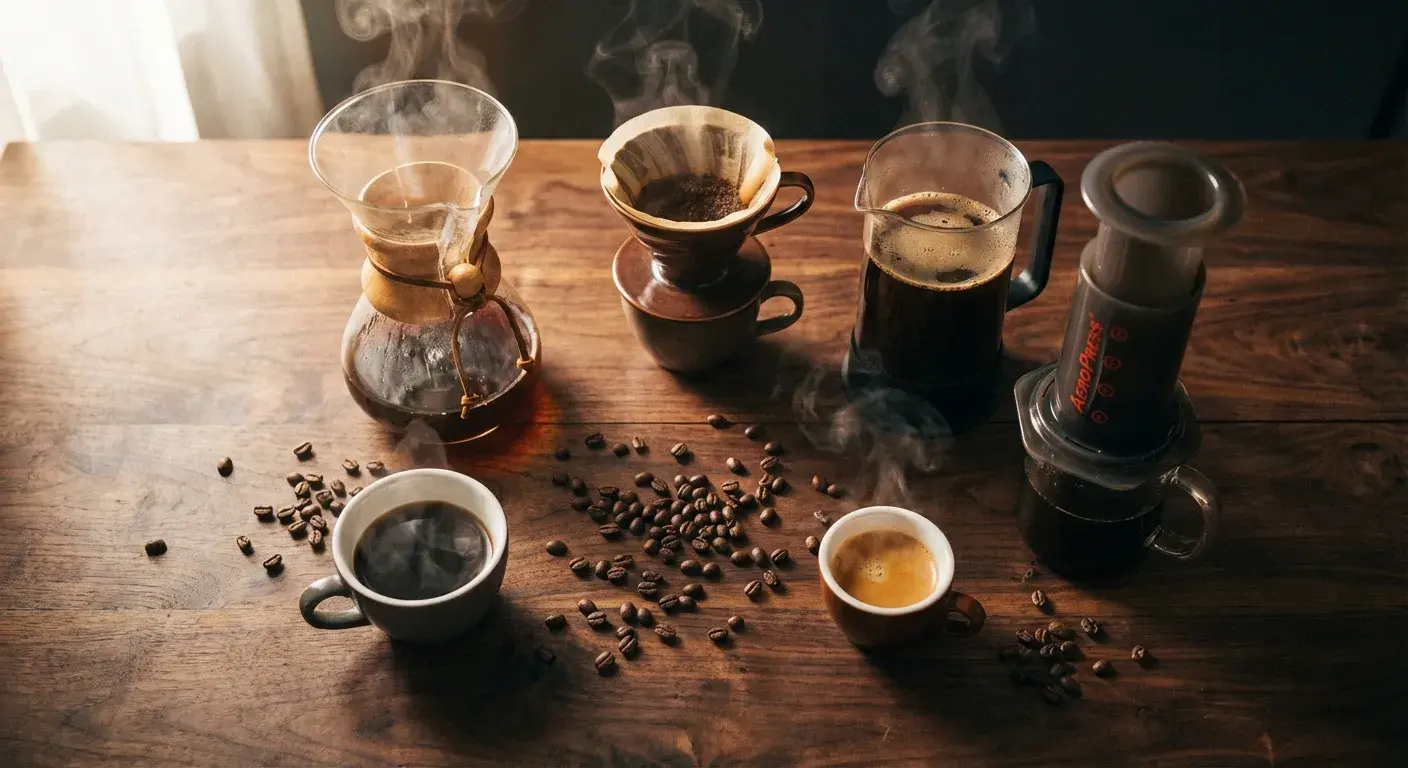
How to Make Espresso Without an Espresso Machine (3 Methods)
 Tommie Chaney·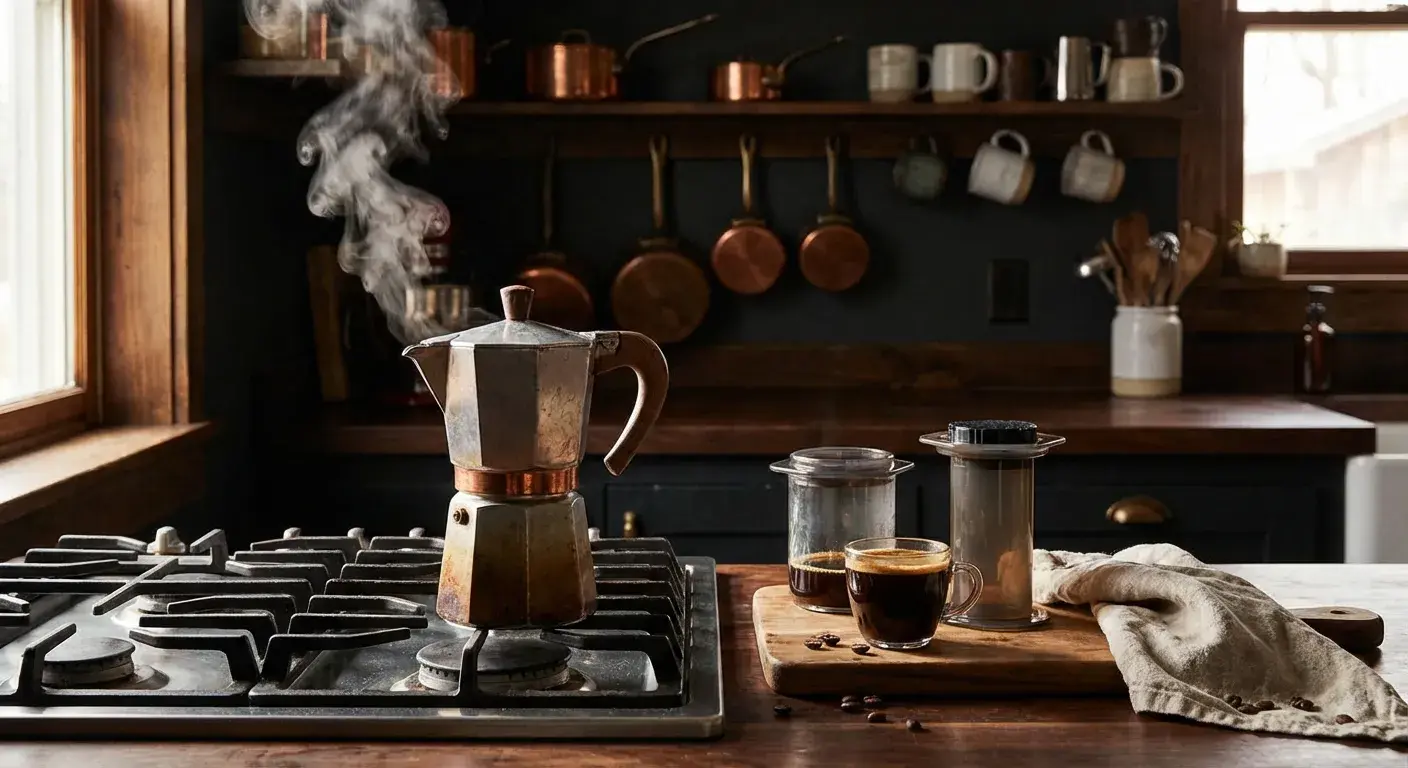
Espresso machines are extraordinary engineering — 9 bars of pressure, precision temperature control, volumetric dosing, forced pre-infusion. They also cost $300 on the low end and $1,500 on the high end, require regular maintenance, and have a learning curve that takes most people months to climb.
You do not need all that to make a strong, concentrated, espresso-style cup of coffee at home.
Three brewing methods can produce coffee that is rich, bold, and concentrated enough to use in lattes, Americanos, and cortados — without a machine, without pressure gauges, and without spending more than $50 on equipment. Each method works differently, produces a slightly different result, and suits different needs.
This article contains affiliate links. We may earn a commission if you make a purchase through our links, at no extra cost to you.
Real espresso requires 9 bars of pressure — none of these methods will produce that. What they produce is highly concentrated coffee strong enough to use anywhere you'd otherwise use a shot.
What Is "Espresso" Anyway?
A definition first. Espresso is coffee brewed by forcing hot water through finely ground, tightly packed coffee at approximately 9 bars of pressure. That pressure is what creates the dense, syrupy texture and the crema — the reddish-brown foam of emulsified oils and CO₂ that sits on top of a real espresso shot.
None of the three methods in this guide can produce 9 bars of pressure. None of them will produce true crema. What they will produce is highly concentrated, full-bodied coffee with a similar strength profile and flavor intensity to espresso — strong enough to use anywhere you would use a shot.
The honest term for what these methods make is espresso-style concentrate. Within that category, the Moka pot comes closest to real espresso. The AeroPress comes next. The French press produces a strong brew that falls short of concentrate territory but still punches above its weight.
Method 1: Moka Pot (Closest to Real Espresso)
The Moka pot — also called a stovetop espresso maker — was invented by Alfonso Bialetti in Italy in 1933. Virtually every Italian household owns one. It uses steam pressure generated in a sealed lower chamber to push water upward through a bed of finely ground coffee and into an upper collection chamber. It does not reach 9 bars, but it generates roughly 1–2 bars of pressure — more than any other consumer brewing method outside a machine.
The result is a strong, concentrated, intensely flavored brew that is closer to espresso in body, strength, and character than anything else you can make without a machine.
What You Need
- A Moka pot (sizes range from 1-cup to 12-cup; a 3-cup or 6-cup is most practical)
- Finely ground coffee, slightly coarser than espresso grind
- A stovetop or any heat source
- Hot water (optional but recommended — see tip below)
Grind and Dose
Grind your coffee to a medium-fine consistency — finer than drip, but slightly coarser than what you would use in an espresso machine. The texture should feel like fine table salt, not flour. Too fine a grind clogs the filter basket and can cause pressure buildup, which is both dangerous and leads to bitter, over-extracted coffee. Too coarse and the pressure drops before the water fully extracts the coffee.
Fill the filter basket completely with ground coffee. Do not tamp — this is a common mistake people make after reading espresso guides. Tamping in a Moka pot restricts flow too aggressively and creates dangerous over-pressure in the sealed lower chamber. Level the grounds with your finger, wipe the rim clean, and that is all.
Dose guide by Moka pot size:
| Size | Coffee Dose | Water Volume | Output |
|---|---|---|---|
| 1-cup | 7g | 60ml | ~30ml (1 shot) |
| 3-cup | 15–17g | 150ml | ~90ml (3 shots) |
| 6-cup | 20–22g | 300ml | ~180ml (6 shots) |
Brewing Technique
Use hot water in the lower chamber. This is the single most impactful tip for Moka pot quality. If you fill the lower chamber with cold water and put the whole pot on high heat, the long pre-heat time cooks the grounds from the outside before any water passes through, producing a burnt, bitter flavor. Pre-boiling the water in a kettle and filling the chamber with hot water eliminates this problem. The brew takes less than 2 minutes and tastes noticeably cleaner.
Fill the lower chamber with hot water to just below the pressure valve — never above it.
Place the assembled Moka pot over medium heat. On a gas stove, keep the flame smaller than the base of the pot so heat does not lick up the sides. On an electric stove, use medium setting.
Keep the lid open and watch the coffee as it rises. When you see coffee flowing steadily into the upper chamber, reduce the heat slightly to slow the brew and prevent scorching. When you hear a hissing or gurgling sound, the lower chamber is nearly empty and pressure is dropping. Remove the pot from the heat immediately. The gurgling sound means steam is starting to enter the grounds, which produces harsh, bitter notes in the last few milliliters of brew.
Run cold water over the bottom chamber to stop the brewing process, then pour.
Result
The Moka pot produces a 2–3 oz serving of strong, concentrated coffee with a dark, glossy appearance and intense flavor. It has more body than drip or pour over, an oil-forward texture, and a bitter edge that many people find authentic and satisfying. It will not have true crema, but the color and concentration make it excellent for:
- Lattes (add steamed milk)
- Americanos (add hot water, dilute to taste)
- Straight shots over ice
- Café de olla (add cinnamon and sugar to the lower chamber water)
Method 2: AeroPress (Smooth Espresso-Style Concentrate)
The AeroPress was not designed to make espresso. But over the 20 years since its invention, the coffee community has developed dozens of techniques for using the AeroPress to produce a concentrated brew that is strong enough to stand in for a shot in milk-based drinks and Americanos.
The AeroPress cannot reach 9 bars of pressure — a hard manual press generates roughly 0.35–0.7 bars. But it compensates with a fine grind, a low water volume, and a short steep that extracts aggressively. The result is a smooth, concentrated coffee that lacks the bitterness of a Moka pot and has a cleaner finish.
For a full breakdown of AeroPress techniques — including the inverted method and championship recipes — see our Best AeroPress Recipes and Techniques guide.
Espresso-Style AeroPress Recipe
Dose: 18g of finely ground coffee Water: 60ml at 200°F (93°C) Steep time: 30 seconds Press: 20–30 seconds of firm, steady pressure Output: ~40ml of espresso-style concentrate
Grind size: Fine — similar to what you would use for espresso, or slightly coarser. You want resistance when you press, but not so much that the plunger won't move.
Method:
- Place a paper filter in the AeroPress cap. Rinse the filter with hot water. Attach the cap to the AeroPress chamber and place it on a sturdy cup or mug.
- Add 18g of finely ground coffee to the chamber.
- Pour 60ml of water at 200°F over the grounds. Stir briefly to ensure all grounds are saturated.
- After 30 seconds, begin pressing the plunger down slowly and firmly. Take 20–30 seconds to fully press. Stop pressing as soon as you hear a hissing sound — that is air passing through, and it adds bitterness to the last few drops.
- The result is roughly 40ml of dense, concentrated coffee.
To use as an Americano base, add 120–150ml of hot water. For a latte, add 100–120ml of steamed or heated milk. The AeroPress concentrate has a slightly lighter body than a Moka pot shot but a noticeably smoother, less bitter character.
Result
Smooth, concentrated coffee — closest to a lungo or Americano. Less intense than a Moka pot shot, significantly stronger than French press. The lower bitterness and cleaner finish make it excellent for:
- Iced Americanos (pour over ice, add water)
- Lattes with cold or hot milk
- Straight, if you enjoy a strong, clean concentrate
Method 3: French Press (Strong Brew Method)
The French press produces strong immersion-brewed coffee, not a concentrate in the same category as the Moka pot or AeroPress. But by doubling the coffee dose, using a coarse grind, and steeping for a full 4 minutes, you can produce a cup that is dramatically bolder and more intense than standard drip or pour over — and strong enough to use as the coffee base in milk drinks when a real shot is not available.
This method is best for people who want a strong, bold cup and do not own an AeroPress or Moka pot. The result is not truly espresso-style — it has no pressure extraction and the concentration tops out well below a real shot — but it is the strongest coffee you can make with a French press.
Strong French Press Recipe
Dose: Double the standard amount — 30g of coffee for a 12oz (350ml) brew (approximately 1:12 ratio) Grind: Coarse — roughly the texture of raw sugar Water: 350ml at 200°F (93°C) Steep time: 4 minutes Output: A bold, full-bodied cup with noticeable strength
Method:
- Preheat your French press with hot water, then discard it.
- Add 30g of coarsely ground coffee to the press.
- Pour in 350ml of water at 200°F. Stir briefly to saturate all grounds.
- Place the lid on the press with the plunger pulled all the way up. Do not press yet.
- Steep for exactly 4 minutes.
- Press the plunger down slowly and steadily over 20–30 seconds.
- Pour immediately — do not let it sit in the press, or it will continue extracting and become bitter.
Result
Bold, oily, full-bodied coffee with pronounced strength. The French press cannot produce the concentration of a Moka pot shot, but doubling the dose produces coffee that is noticeably stronger than standard brewing. It works well for:
- Strong black coffee for people who want something bold without equipment purchases
- A base for café au lait (equal parts coffee and hot milk)
- Adding to recipes that call for strong coffee (tiramisu, chocolate cake)
Comparison: Which Method Is Right for You?
| Method | Equipment Cost | Closest to Espresso | Best For | Result Strength |
|---|---|---|---|---|
| Moka Pot | $15–$40 | Very close | Lattes, Americanos, straight shots | High — espresso-style |
| AeroPress | $30–$45 | Moderately close | Iced Americanos, lattes, clean concentrate | Medium-high |
| French Press | $20–$50 | Least close | Bold black coffee, café au lait | Medium-high |
For lattes and milk drinks: Use the Moka pot. Its higher concentration stands up to milk the best.
For Americanos: Either the Moka pot or AeroPress works well. The AeroPress produces a slightly cleaner result.
For straight strong black coffee: The French press double-dose method is the lowest-effort approach and delivers a consistently bold result.
For espresso-based cocktails: The Moka pot or AeroPress concentrate are both excellent — use whichever you own.
One Tool That Makes All Three Better
No matter which method you choose, grind quality is the single biggest variable. A blade grinder produces uneven particle sizes that lead to simultaneous over-extraction (bitterness) and under-extraction (sourness) in the same cup. A burr grinder produces uniform grounds that extract predictably.
You do not need to spend $200 on a grinder to see a significant improvement. Our Coffee Grinders Under $50 guide covers the best budget burr grinders that work across all three of these brewing methods.
When to Actually Buy an Espresso Machine
If you find yourself making Moka pot or AeroPress concentrate every day, adding steamed milk, and wishing the result was a little closer to what you get at a café — that is when an espresso machine starts making sense.
An entry-level machine with a steam wand, like the De'Longhi Stilosa or the Breville Bambino Plus, gives you actual 9-bar pressure and the ability to make real latte art. The gap between a good Moka pot brew and a good machine shot is real — and noticeable once you have tasted both.
Our Best Espresso Machines for Beginners 2026 guide reviews the best entry-level options, starting at under $100.
Frequently Asked Questions
Is Moka pot coffee actually espresso?
No — not technically. Real espresso requires 9 bars of pressure, which a Moka pot cannot produce. The Moka pot generates roughly 1–2 bars of pressure. The result is a concentrated, strong, full-bodied coffee that is closer to espresso than any other non-machine method, but it lacks the true crema and textural density of a properly pulled shot.
Can I make a latte with a French press?
You can make a latte-style drink using French press coffee, but the result will be weaker than a latte made with a real espresso shot. The coffee will not cut through milk the way a concentrated shot does. For milk drinks, the Moka pot or AeroPress concentrate produces significantly better results. If you only have a French press, use the double-dose recipe above and keep the milk volume modest — no more than 4 oz.
What grind size should I use for Moka pot?
Medium-fine — similar to table salt, but not as fine as espresso powder. This grind is finer than drip but coarser than espresso machine grind. The key is to not tamp the grounds — level them with your finger and let the pressure do the work.
Does the AeroPress make real espresso?
No. The AeroPress generates a fraction of the pressure needed for true espresso (roughly 0.35–0.7 bars vs. the required 9 bars). However, the combination of fine grind, low water volume, short steep, and firm manual pressure produces a concentrated coffee that functions similarly to espresso in terms of strength and flavor intensity. It is best described as espresso-style concentrate.
Where to Go Next
Start with a Moka pot if you don't already own one — $15–$40, decades of service, and results that satisfy most espresso cravings. Pair it with a decent burr grinder and you have an espresso-quality morning routine for under $100 total.
When the gap between this and a real shot starts to matter, our Best Espresso Machines for Beginners 2026 reviews entry-level machines starting under $100. For the broader brewing landscape, see the Complete Guide to Coffee Brewing Methods.