Burr Grinder vs Blade Grinder: Why Your Grinder Matters More Than Your Brewer
 Tommie Chaney·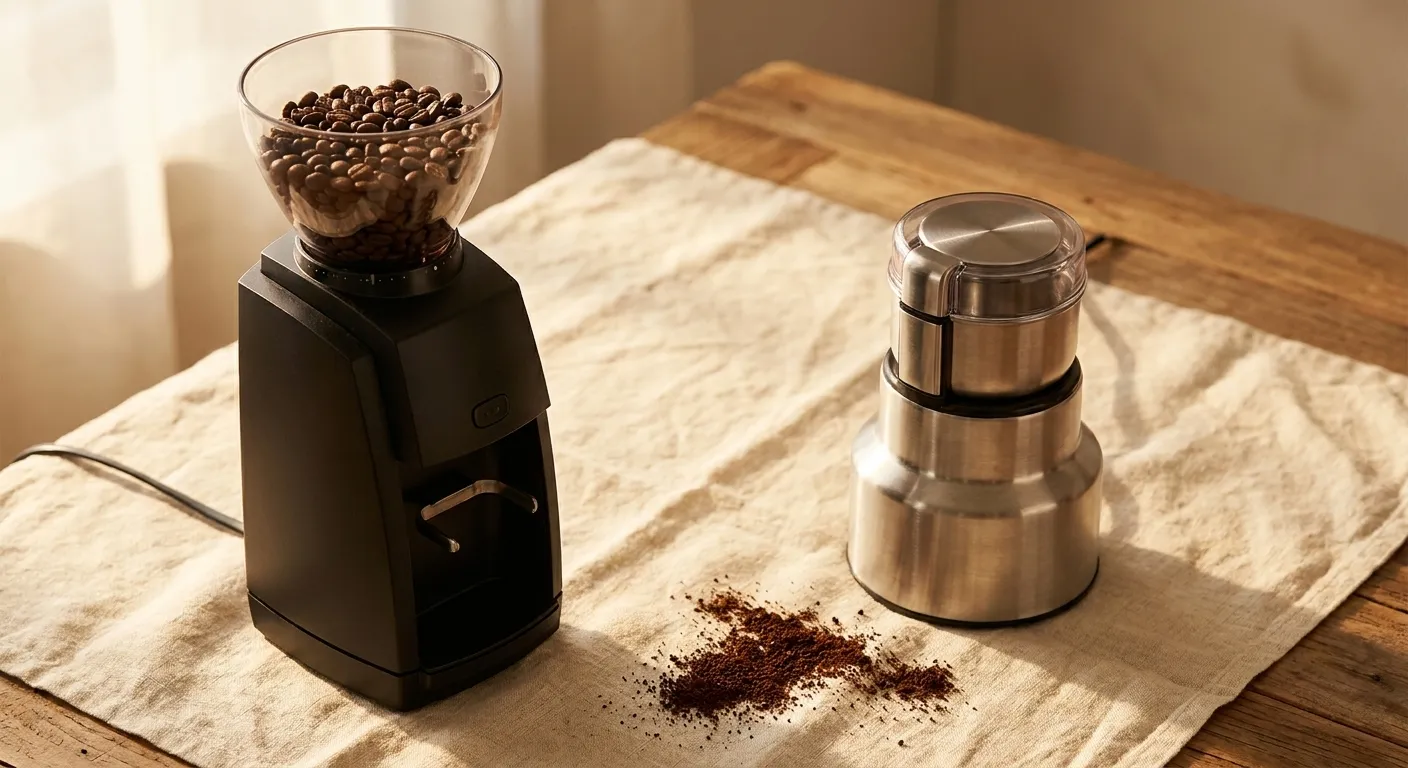
Affiliate disclosure: Sweeter Grind is a participant in the Amazon Services LLC Associates Program. We may earn commissions on qualifying purchases at no extra cost to you.
There is one upgrade that changes home coffee more than any other: switching from a blade grinder to a burr grinder. It is not close. Even an entry-level burr grinder produces coffee that a blade grinder — at any price — cannot match. The difference is not subjective. It is a mechanical limitation baked into how each type works.
What follows is why consistency determines taste, what the price tiers actually get you, and the few narrow cases where a blade grinder is still acceptable.
For how the grinder fits alongside your kettle, brewer, and scale, see our Ultimate Coffee Equipment Guide 2026.
How Each Type Works
Blade Grinder: A Tiny Propeller
A blade grinder — sometimes sold as a "spice grinder" or "coffee grinder" in supermarkets — has a small metal propeller spinning at high RPM inside a closed chamber. When you press the button, the blade chops at whatever beans happen to fall in front of it.
The problem is that there is no mechanism to control particle size. The blade just keeps chopping. Some beans get pulverized into dust on the first pass; others bounce out of the way and stay almost whole. The longer you run the grinder, the more extreme the distribution becomes — more dust AND more boulders — because the already-small fragments keep getting chopped while new chunks stay unground.
Output: a chaotic mix of particle sizes from dust to pea-sized pieces.
Burr Grinder: A Controlled Gap
A burr grinder has two abrasive surfaces — either two flat discs (flat burrs) or a cone inside a ring (conical burrs). Beans pass between them and get crushed at a set distance. You adjust grind size by changing that distance: smaller gap = finer grind, larger gap = coarser grind.
Because every bean has to travel through the same gap, particles come out roughly the same size. The distribution is still not perfect — no grinder produces perfectly uniform particles — but it is dramatically narrower than a blade grinder.
Output: a consistent distribution clustered around the size you set.
Why Consistency Matters in the Cup
Coffee extraction depends on surface area. Water pulls compounds out of grounds at a rate determined by how much surface is exposed. Small particles have proportionally more surface area than large particles. At equal mass, halving the particle diameter roughly doubles the total surface area exposed to water — so a cup with even a handful of fines extracts dramatically differently from a cup with none.
This is why uneven grind wrecks flavor. When you brew a mix of dust and boulders:
- The dust over-extracts. Water pulls compounds out almost instantly, dragging bitter tannins into the cup before the brew is done.
- The boulders under-extract. Water barely touches the interior of large particles. Sour, acidic compounds come out first; the balanced sweet compounds never fully dissolve.
- The cup tastes sour AND bitter simultaneously. This is the signature of a blade grinder. It is the worst of both extraction extremes stacked on top of each other.
A burr grinder, by contrast, produces grounds that all extract at roughly the same rate. Every particle releases its compounds in rough synchronization, and you end up in the balanced zone instead of at both extremes. The same beans, the same brewer, the same technique — the cup is unrecognizably better.
Our article on coffee extraction covers what "balanced extraction" actually tastes like and why it depends on consistent particle size.
Particle Distribution: A Closer Look
If you lay out the grounds from a blade grinder and a burr grinder side by side and measure the particle sizes, you see two very different curves.
A good burr grinder produces a narrow bell curve clustered near your target size. There is always some fines and some coarser particles, but 80%+ of the mass is close to the center.
A blade grinder produces a flat, wide distribution — almost uniformly spread from near-zero up to the largest chunks. There is no meaningful "target" size at all.
This is measurable, reproducible, and visible to the naked eye. Grind a tablespoon each way and look at the piles. The blade grinder output has both dust and visible chunks; the burr grinder output looks like, well, ground coffee.
Price Tiers for Burr Grinders
The good news: burr grinders have come down dramatically in price over the last decade. You no longer need to spend $500 to get a quality grind.
Under $50: Entry Manual Grinders
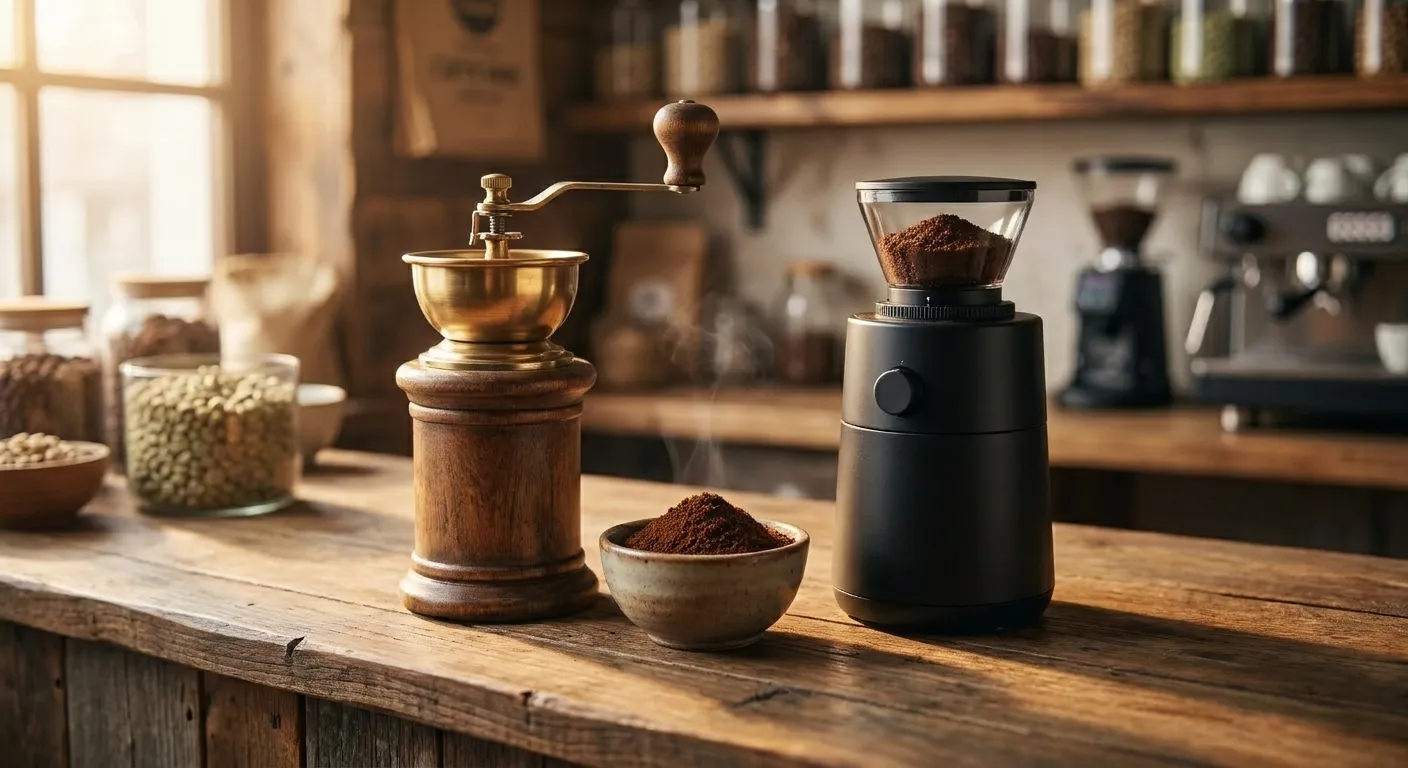
At this price you are looking at manual (hand-cranked) burr grinders with stainless steel or ceramic burrs. Quality varies, but the best options at this tier legitimately outperform $150 electric blade grinders. The tradeoff is effort — you will spend 60–90 seconds cranking for each brew. For one or two cups a day, most people find this easy to live with. See our roundup of coffee grinders under $50.
$50–$150: The Sweet Spot
This is where quality manual grinders and entry-level electric grinders live.
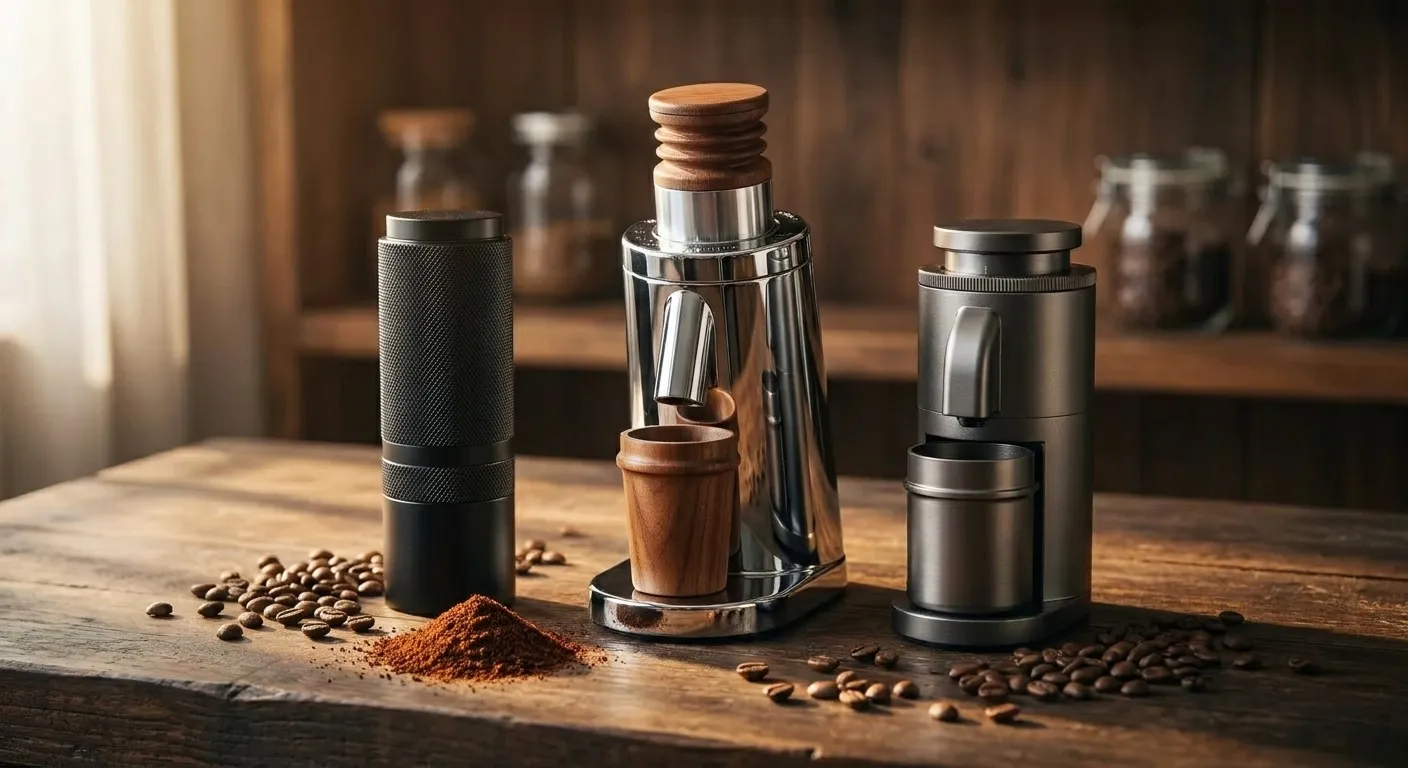
On the manual side, the Timemore Chestnut C2 (~$70) is the entry sweet spot, with its sibling the Chestnut C3 Max (~$100) noticeably more consistent burr-to-burr. The 1Zpresso Q2 (~$100) is the travel-friendly option, and the Kingrinder K6 (~$120) is a solid budget alternative to the pricier 1Zpresso line.
On the electric side, the OXO Brew Conical Burr (~$100) is the reliable budget pick — not the quietest, not the fastest, but dependable. Step up a little and the Baratza Encore (~$170) sits just over the tier line and has been the default entry electric for a decade.
Manual grinders in this range produce grinds competitive with $500 electrics; entry electrics are reliable but may have limited grind range or be noisy. Pick based on whether you value speed or ultimate quality per dollar.
$150–$400: Mid-Range Electric (and Enthusiast Manual)
At this tier, electric grinders become genuinely good: stepped adjustment with 40+ positions, quieter motors, larger hoppers, and burrs good enough for espresso. If you brew for a household or pull espresso shots, this is the minimum practical starting point for an electric.
Named picks at this tier: Baratza Encore ESP (~$200) is the Encore with espresso-range burrs; the Fellow Opus (~$195) is the stylish all-purpose option; and the Baratza Virtuoso+ (~$250) is a real step up from the Encore in burr quality and build. The Fellow Ode Gen 2 (~$345) is a dedicated brewed-coffee specialist (no espresso range, but excellent for filter).
Enthusiast manuals also live in this range — the 1Zpresso JX (~$160) is a well-regarded pour-over workhorse, and the 1Zpresso K-Pro, J-Pro, and J-Max (~$180–$230) are the favorites of serious hand-grinder users. The Comandante C40 MK4 (~$295) is the legendary (and pricey) end of the manual category.
$400+: Enthusiast and Above
Above $400 you are buying into marginal gains — slightly better burr geometry, more consistent particle distribution at very fine settings (for espresso), better static control, commercial-grade motors. For dedicated espresso at home, the Eureka Mignon Specialita (~$650) is a common starting point. Worth it for espresso enthusiasts; overkill for filter-only home brewing.
Our detailed look at manual vs electric coffee grinder covers the full tradeoff between these two camps.
When Is a Blade Grinder Acceptable?
Almost never for daily coffee. But there are a few narrow cases:
Spices. Blade grinders work fine for grinding whole spices — cinnamon sticks, cloves, peppercorns, dried chilies. The coarse-to-fine inconsistency matters less when the spice is being blended into a dish. Many households keep a blade grinder for this purpose alone.
Dedicated batch grinding before a move or trip. If you are traveling without your grinder for a few days, grinding beans ahead on a blade grinder in one big batch is slightly better than buying pre-ground supermarket coffee — but only slightly, and the freshness drops fast once ground.
Backup only. If your electric burr grinder breaks and you have a blade grinder in the cupboard, it is better than nothing until the replacement arrives.
That is it. For daily brewed coffee, the blade grinder has no role. The first upgrade in a home coffee setup is always: replace the blade grinder with any burr grinder you can afford.
What to Look For When Buying a Burr Grinder
- Burr type — conical or flat; both work for filter coffee. Flat burrs tend to be more consistent at fine settings, conical at coarse
- Burr material — hardened steel or ceramic; both are fine for home use. Ceramic is slightly harder; steel is slightly more tolerant of the occasional bad bean (rocks)
- Adjustment mechanism — stepless (infinite positions) is ideal; 30+ stepped positions is plenty
- Grind range — make sure it covers every method you plan to brew. Some cheaper grinders cannot go fine enough for espresso or coarse enough for French press
- Retention — how much coffee gets stuck inside between uses. Low retention matters when changing beans; for single-bean daily use, it matters less
- Static — some grinders spray coffee grounds everywhere due to static electricity. Look for reviews that mention it
Conical vs Flat Burrs
Within burr grinders, there is a second design question: conical or flat burrs.
Conical burrs are shaped like a cone fitting inside a ring. Beans fall in, get crushed between the cone and ring, and exit through the bottom. Conical burrs tend to be quieter, slower to heat up, and produce grinds with slightly more fines (very small particles) plus slightly more boulders (larger particles) than flat burrs. Many enthusiasts believe this bimodal distribution produces more complex, full-bodied coffee.
Flat burrs are two parallel discs facing each other, with beans crushed between them as they pass from center to edge. Flat burrs produce narrower particle distributions — closer to uniform — which many say results in cleaner, clearer cup clarity. Flat burrs can run hotter under long grind sessions, though for home use this is rarely noticeable.
Both designs can produce excellent coffee. For home brewers, the distinction matters less than the overall grinder quality. Most manual grinders use conical burrs; electric grinders come in both. Do not agonize over this choice — pick based on budget, size, and reviews of the specific model, not on burr geometry alone.
Blade Grinders: The Bigger Problem You Might Not See
A blade grinder's worst quality is not just its inconsistent output — it is the heat it generates. Spinning a blade at high RPM against hard beans produces friction, and friction produces heat. Over a 20-second grind, a blade grinder can warm the grounds noticeably, which:
- Starts extraction before brewing. Heat triggers some of the same reactions that brewing does. Your "fresh" grind is already losing aromatic compounds.
- Accelerates staling. Warm coffee stales faster than room-temperature coffee, meaning your ground coffee goes downhill in minutes instead of hours.
- Partially melts oils. Dark roasts in particular have surface oils that blade friction can smear rather than grind cleanly, coating particles and interfering with extraction.
Burr grinders, by contrast, crush beans at a lower relative speed and generate almost no heat. Your grind comes out at essentially room temperature. This is yet another reason the difference between blade and burr is larger than it appears — the heat damage is invisible but real.
What "Grind Consistency" Feels Like in the Cup
If you have never brewed with a quality burr grinder, the difference can be hard to imagine. Here is what changes when you switch:
The sour notes disappear. That edge of thin sourness that blade-grinder coffee almost always has — gone. Your cup is cleaner.
The bitter finish disappears. The harsh, drying aftertaste from over-extracted fines — gone. Your cup is smoother.
Sweetness appears. Most people have never tasted genuinely well-extracted coffee. Once you do, you realize coffee is naturally sweet when brewed properly. It does not need sugar; it already has it, waiting to come through.
Complexity appears. Single-origin beans develop their origin character. You start tasting "like blueberry" in Ethiopian or "like dark chocolate" in Brazilian the way the coffee bag's description promises. This is not marketing — it is what coffee actually tastes like when extraction is even.
Consistency appears. The same recipe produces the same cup every day. You can dial in small improvements and repeat them tomorrow.
None of this happens with a blade grinder, regardless of how good the beans are. The chaotic particle distribution actively prevents it.
Frequently Asked Questions
Can I get decent coffee from a blade grinder if I shake it while grinding?
Shaking helps a little by redistributing beans in front of the blade, but it does not solve the fundamental problem: you still cannot control particle size, and you still end up with fines and chunks. The improvement is marginal — enough to notice, not enough to matter.
Is a cheap burr grinder really better than an expensive blade grinder?
Yes. The cheapest functional burr grinder ($30–$40 manual) produces more consistent grounds than any blade grinder ever made. Burr vs blade is a mechanism difference, not a price difference.
How do I know if my electric grinder is burr or blade?
Blade grinders have a small propeller visible inside the chamber when you open the lid. Burr grinders have a hopper on top that funnels beans down into a grinding chamber you cannot easily see; the adjustment is usually a dial or twist on the hopper or base.
Do I need to clean a burr grinder?
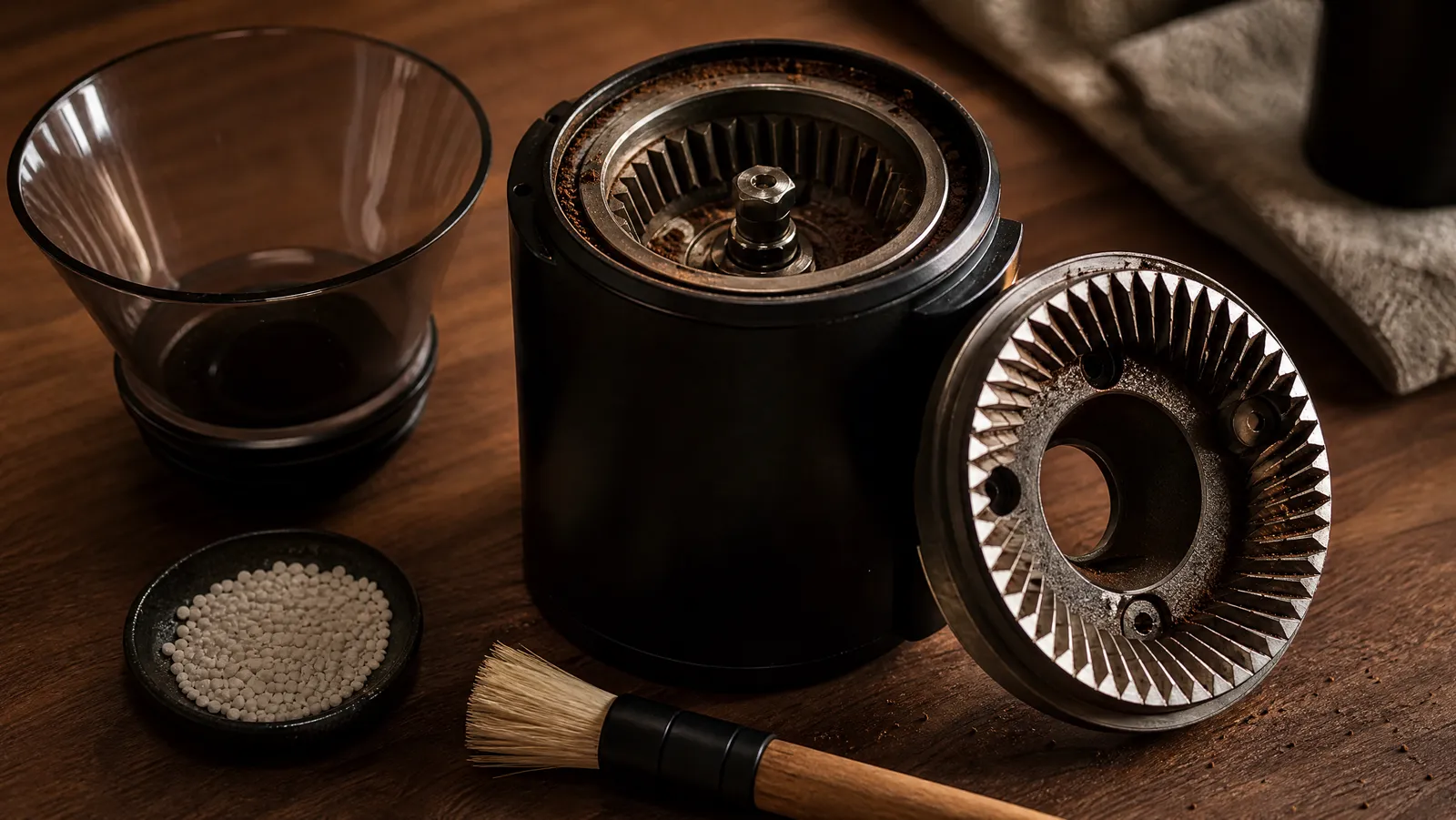
Yes, occasionally. Oils from beans (especially dark roasts) build up on burrs over time and can go rancid. A monthly grind of uncooked rice or specialty grinder cleaner pellets (like Grindz) clears the buildup. Deeper cleaning — disassembling and brushing the burrs — every 6 months keeps the grinder performing like new.
Related reading
- The Ultimate Coffee Equipment Guide 2026
- Manual vs Electric Coffee Grinder
- Do You Need a Coffee Scale?
- Coffee Extraction 101
- Coffee Grinders Under $50
- Brew Ratio Calculator
The Short Version
If you're still using a blade grinder, replace it before you upgrade anything else. Even the cheapest burr grinder transforms the cup more than doubling your brewer budget ever would. Start there — the rest of your equipment suddenly has room to do its job.