Stovetop vs Electric Kettle for Coffee: Which Should You Buy?
 Tommie Chaney·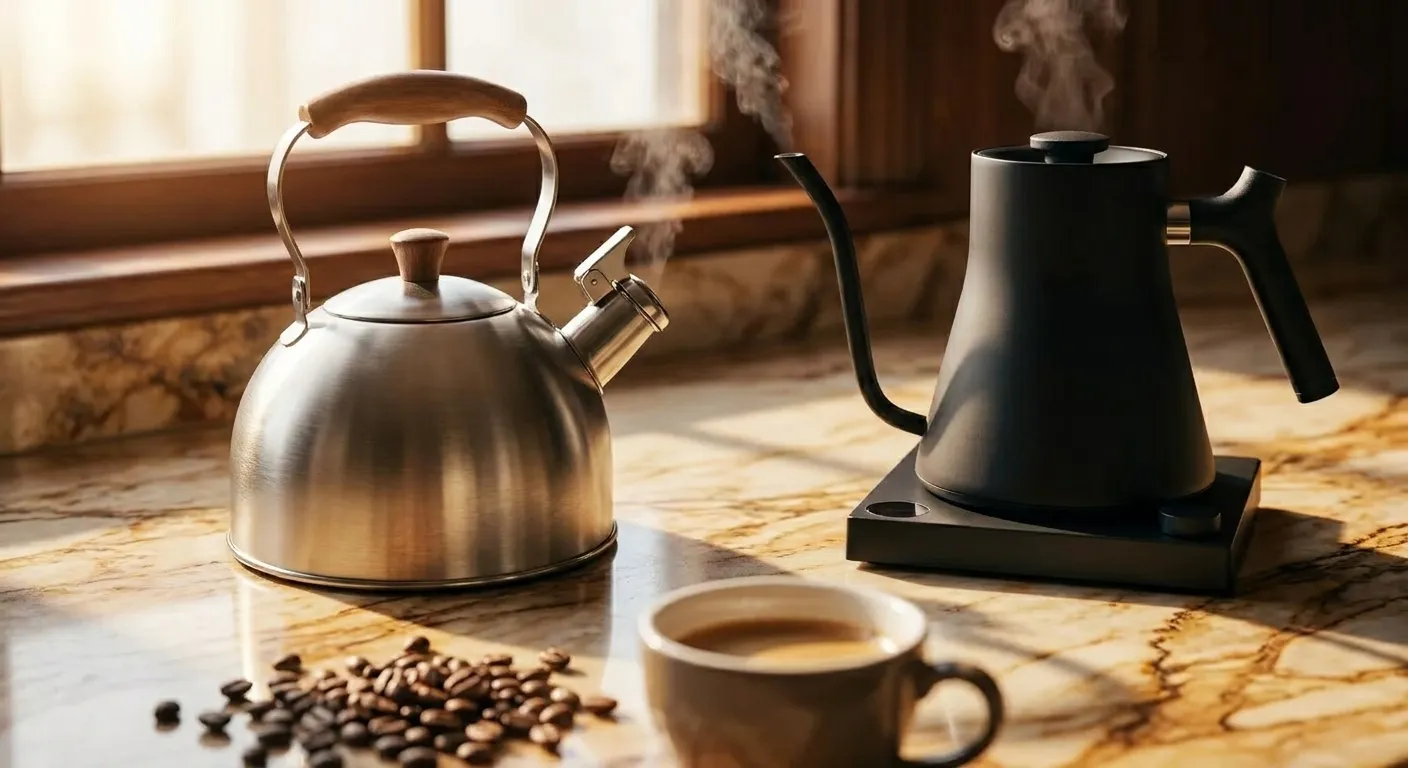
Affiliate disclosure: Sweeter Grind is a participant in the Amazon Services LLC Associates Program. We may earn commissions on qualifying purchases at no extra cost to you.
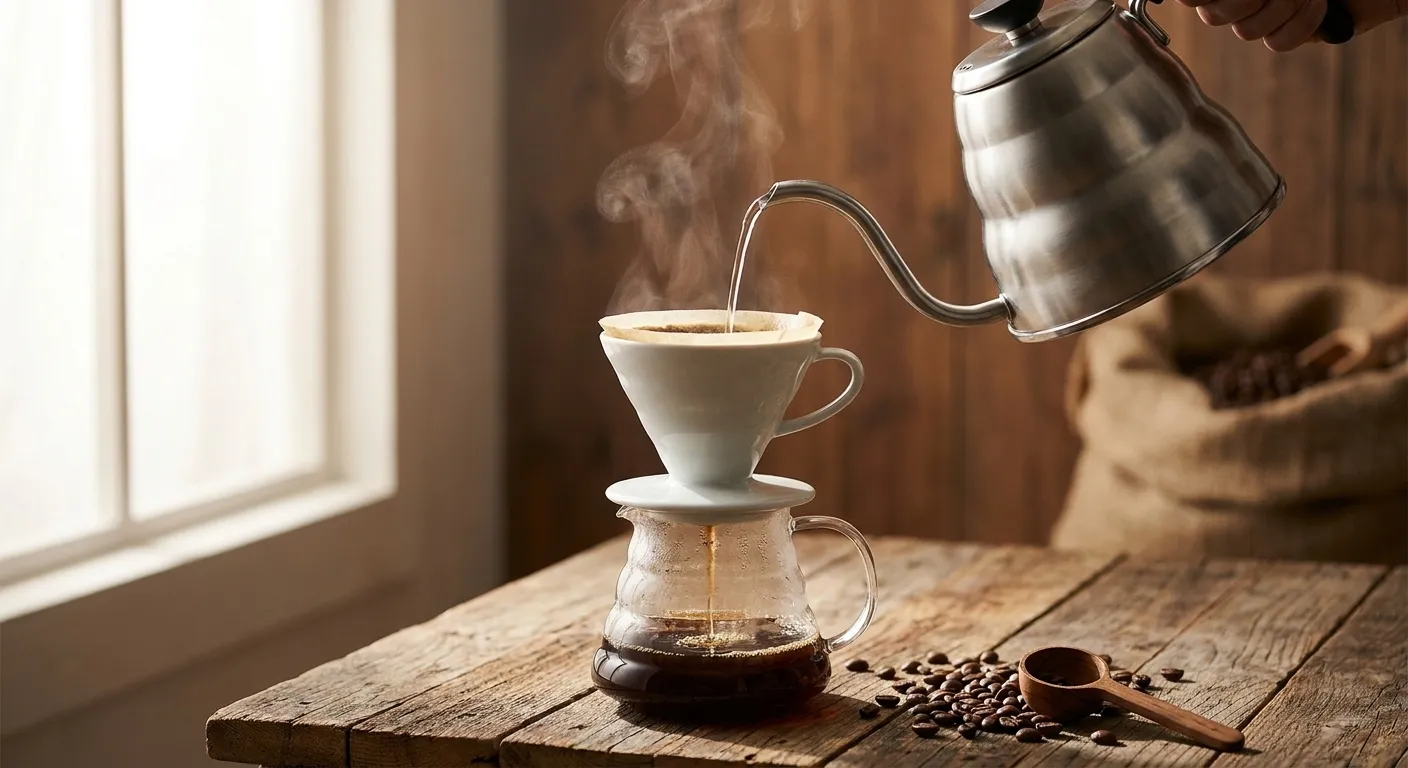
There are two broad camps when it comes to boiling water for coffee: stovetop kettles and electric kettles. Both work. Both have fans. But for coffee specifically, the decision usually comes down to three factors — speed, temperature control, and whether you care about a specific aesthetic — and the answer surprises some people.
Below: what each type is good at, where safety matters, what temperature control actually buys you, and why a hot plate can undo half the work you put into the brew.
For the bigger picture of how your kettle fits alongside the rest of your coffee gear, see our Ultimate Coffee Equipment Guide 2026.
Speed: Electric Wins Almost Every Time
An electric kettle pulls 1200–1500 watts directly into a heating element submerged in water. A stovetop kettle gets its heat secondhand — burner heats the kettle bottom, kettle bottom heats the water. The result: electric kettles boil 1 liter in roughly 3–4 minutes; stovetop kettles typically take 5–8 minutes on a standard gas or electric burner, and longer on slower coils.
The gap widens on electric stovetops with coil burners, where heat transfer is inefficient. It narrows on powerful gas burners and on induction cooktops (which heat the kettle bottom directly, similar to an electric kettle's mechanism).
If you value speed — and many people do, especially on weekday mornings — electric wins. If your mornings are unhurried, it probably does not matter.
Temperature Control: The Big One
This is where the decision really lives. For coffee, water temperature is a brewing variable. The SCA-recommended range is 195–205°F (90–96°C), not "boiling." Water off a rolling boil is 212°F, which is above the ideal for most methods, especially lighter roasts.
Electric Kettles with Temperature Control
A variable-temperature electric kettle lets you set a target temperature — anywhere from 140°F to 212°F in 1-degree increments on premium models — and the kettle heats to that temperature and stops. A "hold" function keeps it there for 30–60 minutes while you prep.
This is transformative for coffee. You tell the kettle "200°F," it beeps when ready, you pour. No guessing, no thermometer fiddling, no watching for bubble patterns. Temperature control is why most enthusiast home brewers use electric kettles — not because electric is inherently better, but because temperature-controlled electric is dramatically better than no control at all.
Stovetop Kettles: Heat-and-Guess
Most stovetop kettles have no temperature control. You boil water, turn off the burner, and wait. Water cools at roughly 1°F per second in an open kettle at kitchen temperature, so after 30 seconds of waiting, you are somewhere around 195°F–200°F — assuming a standard ambient environment and kettle geometry. It works, but you are estimating, not measuring.
You can buy stovetop kettles with built-in thermometers (the dial sits on the lid), which helps. But even with a thermometer, you cannot ask the kettle to stop at a specific temperature — you are still watching and pulling it off the heat manually.
The Exception: Induction + Precise Burner
On an induction cooktop with precise low-heat settings, a stovetop kettle can hold water at a specific temperature by matching the burner setting. This requires an induction-compatible kettle and a stovetop that lets you dial in a specific low temperature — not common in home kitchens, but doable.
Hot Plate Risks (and Why Your Drip Machine Is Cheating You)
A tangent that matters: many drip coffee machines include a "warming plate" that keeps brewed coffee hot after brewing. This is not a coffee kettle, but it is relevant here because it shows what happens when hot plates meet coffee.
A heating element continuously applied to already-brewed coffee continues cooking it. Bitter compounds develop. Volatile aromatics evaporate. After 30 minutes on a hot plate, coffee that started fresh tastes stale, burnt, and harsh.
The same logic applies to any prolonged heating situation. If you leave a stovetop kettle on low heat "to keep the water hot," you are slowly evaporating water (changing your effective ratio) and burning off any volatile compounds in whatever water mineral content is present. Boil, pour, brew. Do not keep water "warm" on the burner.
Electric kettles with proper hold functions maintain the target temperature in insulated kettles with minimal evaporation — this is safe and useful. Stovetop kettles on low heat over long periods are not the same thing.
Safety
Electric Kettles
- Auto-shutoff on boil — standard on all modern electric kettles
- Boil-dry protection — shuts off if you accidentally start the kettle empty
- Cordless base — kettle lifts off the base, no dangling cord while pouring
- Stable base — wider than the kettle body on most models
Risks: rare malfunctions can leave a kettle heating without shutoff; old frayed cords are a fire risk. Buy from known brands, replace kettles after 5–10 years of daily use.
Stovetop Kettles
- Whistle alert — classic stovetop kettles whistle to signal boiling
- No electrical components — nothing to short out
Risks:
- Forgetting the burner is on. No auto-shutoff means a forgotten stovetop kettle can boil dry and start a fire. This is the biggest safety gap compared to electric.
- Hot handle. Stovetop kettle handles get hot — either from the burner's heat plume or via conduction. Always use a towel or oven mitt.
- Whistling reliability varies. Some whistle quietly or not at all, depending on design.
If you are forgetful or live with small children, electric kettles are meaningfully safer.
Durability and Longevity
Stovetop kettles are usually stainless steel or enameled cast iron with no electronics. A well-made one lasts a lifetime. No wearing-out components, no failed sensors, no battery compartments to corrode. The aesthetic (especially enameled models) holds up well too.
Electric kettles have heating elements, circuit boards, and displays. Most last 5–10 years of daily use before something fails — usually the heating element wearing out or the base plate contacts corroding. Buying from quality brands (Fellow, Bonavita, OXO, Breville, Cuisinart) extends lifespan; cheap no-name kettles often fail in 2–3 years.
If longevity and repairability matter to you, stovetop wins. If replacement cost every 5–10 years is acceptable, electric's convenience wins.
Cost
| Type | Price range | What you get |
|---|---|---|
| Basic stovetop kettle | $20–$60 | Stainless steel, whistle, no temperature features |
| Stovetop with thermometer | $40–$80 | Built-in dial thermometer, still manual heat control |
| Basic electric kettle | $25–$50 | Boil and auto-off, no temperature control |
| Temperature-controlled electric | $60–$120 | Presets or variable target temperature |
| Gooseneck electric with temp control | $70–$200 | Pour control + temperature — the enthusiast default |
| Premium electric (Fellow Stagg EKG, etc.) | $150–$200 | All features, refined design, premium build |
For coffee specifically, a temperature-controlled electric at $70–$120 hits the sweet spot. Going cheaper means losing temperature control. Going much more expensive adds incremental refinement, not fundamental capability.
Which Should You Buy?
Buy an Electric Kettle If...
- You want temperature control without fiddling
- You brew pour over or any method where temperature matters (which is nearly all of them)
- Your mornings are time-constrained
- You share a kitchen with people who might forget burners
- You live in a place with reliable electricity
Buy a Stovetop Kettle If...
- You specifically want no electronics (aesthetic, principle, or simplicity)
- You are on an off-grid setup where electric kettles are impractical
- You are on a tight budget and already have a good burner thermometer workflow
- You only brew methods where temperature precision matters less (French press, cold brew)
The Hybrid Setup
Some people keep both: an electric kettle for daily coffee and a beautiful stovetop kettle for tea or company. Nothing wrong with this, if counter space allows.
For the separate question of gooseneck vs standard spout — which matters regardless of stovetop vs electric — see our gooseneck kettle vs regular kettle comparison.
Power Outage Scenarios
An underdiscussed practical point: stovetop kettles work during power outages (if you have a gas stove or camp stove). Electric kettles do not. For emergency preparedness, a basic stovetop kettle is a genuinely useful backup even if you use electric daily.
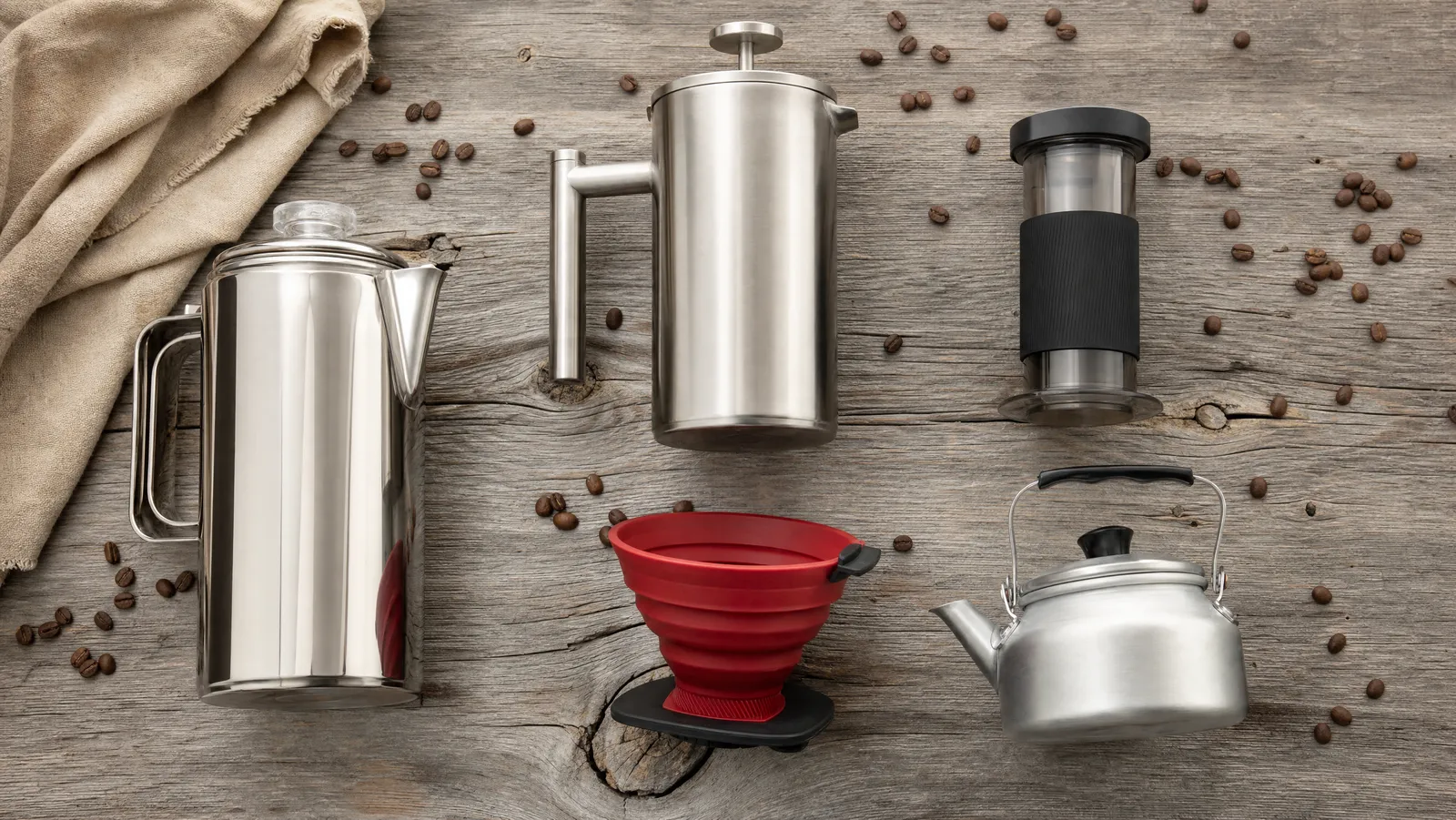
If you live in a place with frequent outages, a stovetop kettle stored as a backup is a cheap insurance policy. Stovetop Moka pots have the same advantage for full coffee brewing without electricity.
Frequently Asked Questions
Can I use a stovetop kettle on an induction cooktop?
Only if the kettle is induction-compatible — it needs a magnetic base (stainless steel or enameled cast iron usually works; aluminum and copper do not). Check the kettle's product description or test with a fridge magnet on the base.
Is an electric kettle really that much faster?
For 1 liter, yes — roughly 3–4 minutes electric vs 5–8 minutes stovetop. For a small 250ml cup's worth of water, the gap is smaller (maybe 1.5 vs 2.5 minutes), but electric is still faster.
Does the kettle material affect coffee flavor?
Only indirectly. Stainless steel is neutral. Copper and aluminum can leach minimally into water over time (usually not enough to taste, but worth considering). Avoid kettles with plastic contacting hot water, especially older models, due to both flavor and health concerns.
Can I use the water from a tea kettle for coffee?
Absolutely. Coffee and tea kettles do the same job. Just make sure the kettle does not have lingering tea flavors, which can happen with aggressive herbal or flavored teas.
Do I need a separate kettle just for coffee?
No. One kettle that handles tea, coffee, oatmeal, and instant soup is perfectly fine. You just want one with good temperature control if coffee is a priority.
Related reading
- The Ultimate Coffee Equipment Guide 2026
- Gooseneck Kettle vs Regular Kettle
- Coffee Brewer Buying Guide: What to Look For
- Best Electric Kettle for Pour Over Coffee
- Why Water Quality Matters for Coffee
- Brew Ratio Calculator
The Short Version
For coffee, a temperature-controlled electric kettle is the default. Faster, safer, and it lets you hit a specific brewing temperature without thermometer gymnastics. Stovetop kettles are still valid — beautiful, durable, and they work without electricity — but for pour over and most precision brewing, they're the harder path. Keep one around as an outage backup if you like the aesthetic.