How to Backflush and Maintain an Espresso Machine
 Tommie Chaney·
Affiliate disclosure: Sweeter Grind is a participant in the Amazon Services LLC Associates Program. We may earn commissions on qualifying purchases at no extra cost to you.
A dirty group head ruins more coffee than a mediocre grinder does. Backflushing forces water — and periodically a measured detergent dose — backwards through the group head and out the three-way solenoid valve, clearing coffee oils from parts a brush can't reach. It is not descaling, and it only works on machines that have that valve.
That last sentence is the whole article. Get it wrong and you can damage a machine while believing you're maintaining it. Get it right and backflushing takes ninety seconds and is the highest-leverage habit in how to clean and descale coffee equipment. If you're still assembling the setup around it, our complete home espresso guide covers the rest.
One rule first: check your machine's manual. Manufacturers disagree on chemicals, doses, and intervals, and the manual in front of you outranks every guide on the internet, this one included.
Backflushing Is Not Descaling
These two jobs get conflated constantly, and the confusion is where damage starts.
Backflushing removes coffee oils from the brew path — group head, shower screen, dispersion block, and the three-way valve behind it. Organic, fatty residue; comes off with an alkaline detergent.
Descaling removes mineral scale from the water path — boiler, heating element, and the tubing carrying water before it meets coffee. Calcium and magnesium carbonate; comes off with an acid.
Different problem, different chemical, different schedule. According to Papel Espresso, backflushing cleans coffee oils from the brew path and solenoid valve while descaling removes mineral scale from the boiler and water lines — and the detergent used for backflushing is formulated specifically to dissolve coffee oils. An acid descaler is aimed at a different problem, and an alkaline powder does nothing to limescale. You need both, and our guide to descaling a coffee maker covers the acid side.
The taste cost is real: per Papel Espresso's write-up on dirty equipment, oils left on the screen, gasket, and basket oxidise and turn rancid, producing a bitter, stale character that overwrites whatever the beans were doing.
Does Your Machine Even Have a Three-Way Valve?
The three-way solenoid valve is what makes backflushing mechanically possible. As La Marzocco describes it, the valve removes water from the top of the group head and depressurises it once the shot ends. Papel Espresso's account of the same valve adds the visible consequence: releasing that pressure pulls excess water out of the portafilter, which is why the puck comes out firm and mostly dry. That vent path is also where backflush water escapes when a blind basket blocks the normal exit. Three ways to tell:
- Listen after the shot. Per Seattle Coffee Gear, if you hear a brief hiss and see a little water drain into the drip tray after the pump stops, your machine has a solenoid valve.
- Check the accessories box. Same guide: if your machine shipped with a blind basket, it was designed to be backflushed.
- Read the manual. If it never mentions backflushing or a cleaning cycle, assume the machine isn't built for one.
Seattle Coffee Gear lists E61 group head machines (Rocket, ECM, Profitec, Bezzera, Quick Mill), the Rancilio Silvia, the La Marzocco Linea Mini, mid-range Brevilles such as the Barista Express and Barista Pro, and higher-end De'Longhi units like the La Specialista Arte and Maestro as machines that generally support backflushing. It lists the Breville Bambino line, entry-level De'Longhi Dedica models, most entry-level Saecos, superautomatics, and manual lever machines as ones that generally do not.
If your machine is on the second list, do not put a blind basket in it. Seattle Coffee Gear states plainly that forcing a backflush on a machine without the valve can damage the machine — with the basket sealed and no vent path, the pump pushes against a closed system.
Those owners aren't stuck. Seattle Coffee Gear's alternative is to remove the shower screen monthly, soak it in Cafiza solution about 20 minutes, scrub and reinstall — soaking the baskets in the same solution and flushing the group with clean water.
Some machines automate the job. Breville's tutorial for the Barista Express notes a self-monitoring cleaning cycle that tells you when the next clean is due, and the BES870 instruction book gives the loading order: the 1 CUP filter basket, then the supplied cleaning disc, then one cleaning tablet. Use a built-in program rather than improvising.
What You'll Need
- A blind basket (also sold as a backflush disc) sized to your portafilter — 58 mm, 54 mm, or 51 mm.
- An espresso machine detergent. Urnex Cafiza and Puly Caff are the two widely stocked options, both sold as powders and tablets. Follow one product's printed directions, not a blended recipe.
- A group brush with a curved handle, so you can reach the gasket without burning your knuckles.
- A microfibre cloth kept for the machine only, and a measuring spoon so the dose is a number.
Cheap, and that's the whole kit. We cover what else earns counter space in espresso accessories you actually need. Never mix cleaning products — one chemical, one job, rinse between.
How to Backflush an Espresso Machine, Step by Step
The doses and timings below are the manufacturers' own, quoted separately because they genuinely differ.
Step 1: Confirm your machine has a three-way valve
Run the hiss test, check for a blind basket in the box, read the manual. If any two say no, stop and use the soak-and-scrub routine above instead. Then bring the machine to full operating temperature — cold water and hardened oil are a bad pairing.
Step 2: Knock out the puck and clean the portafilter
Empty the basket, rinse the portafilter under hot water, wipe it dry. Take thirty seconds with the group brush on the underside of the shower screen and around the gasket while the group is hot, flushing briefly to carry the grounds away. Do this first and the detergent works on the film you can't see, not the grounds you can.
Step 3: Run a water-only backflush first
Drop the blind basket in with no powder, lock it into the group, and run the brew cycle in short bursts — roughly ten seconds on, ten seconds off. You'll hear the valve dump into the drip tray each time. This is also the entire routine on days you're not doing a detergent clean.
Step 4: Add the measured detergent dose
Urnex's directions for Cafiza Powder specify up to 1/2 teaspoon (3 g) in the blind basket. The instructions published for Puly Caff by the Espresso Machine Company call for more — 3–5 g (1 teaspoon) of powder detergent in the blind filter or on top of the backflushing membrane. La Marzocco's walkthrough sits between them at about half a teaspoon of espresso machine cleaner in the backflush disc. One more reason to read the tub in your own cupboard.
More is not better. Excess powder foams heavily, takes far more cycles to clear, and leaves residue that tastes soapy in the next shot.
Step 5: Run the cycle in short bursts with pauses
Urnex's Cafiza instructions are explicit: brew cycle on for 10 seconds, stop for 10 seconds, repeat five times. La Marzocco describes the same rhythm for manual machines — 10 seconds on, off, wait for the pump to fall silent, repeat five times. The Espresso Machine Company's Puly Caff procedure also runs 10 seconds on and 10 seconds off, five times with detergent in the basket.
The three agree, which is unusual and worth taking seriously: bursts with pauses rather than one long run, so the valve cycles repeatedly.
Step 6: Rinse with the blind basket until there are no suds
Remove the portafilter, rinse it and the blind basket in the stream from the group, then reinsert with no powder and repeat the 10-on, 10-off sequence five more times. That second rinse cycle is Urnex's published instruction, not an optional extra. Keep going until the water runs clear and produces no foam.
Step 7: Remove the blind basket and flush the group
Swap the blind basket for a normal one, lock it in, and run the group several seconds to clear detergent from the dispersion screen and the spouts. Wipe the gasket, and empty the drip tray while you're down there.
Step 8: Pull a shot and throw it away
Urnex and the Espresso Machine Company both end the same way: pull a shot and discard it. The Espresso Machine Company frames it as seasoning the grouphead. Urnex is blunter — make a cup of espresso to remove any traces of cleaner, discard it, do not drink.
La Marzocco's five-step guide stops at the rinse instead, and its Field Test manager is openly sceptical of the seasoning idea: "The espresso machine is not a cast iron pan." Fair enough — but the first shot after a detergent clean still isn't one you want to drink.
Cleaning the Group Head, Screen, and Gasket
Backflushing handles the plumbing. The visible surfaces still need hands.
After every session, brush the group head while it's hot and flush for a couple of seconds. Thirty seconds of brushing prevents the buildup a detergent backflush later has to fight.
Monthly, take the shower screen off — one central screw or a snap fit on most machines, a screw plus a dispersion plate on E61 groups. Soak the screen and your baskets in detergent solution: Urnex specifies 6 g of Cafiza powder per litre of hot water with a 30-minute soak, then a fresh-water rinse. Seattle Coffee Gear suggests around 20 minutes for a screen.
Nothing abrasive touches the screen — no steel wool, no scouring pad, no wire brush. The holes are precision-drilled, and enlarging them changes how water spreads.
Gaskets, Screens, and Wear Parts
The group gasket is a rubber ring compressed and heat-cycled every single shot. It hardens, shrinks, and eventually stops sealing. Two tells:
- The portafilter creeps. Espresso Parts Online notes that as the gasket flattens, the portafilter travels further before it seals — drifting past 6 o'clock toward 4 o'clock, which they call a decent indicator that replacement is due.
- It leaks or hisses during the shot. Water escaping around the rim instead of through the puck means pressure isn't being contained, and that changes what lands in the cup. If your shots have gone unpredictable, work through pulling a perfect espresso shot — but check the gasket before blaming the grinder.
Intervals vary and nobody agrees on a universal number. 1st-line.com suggests replacing every 6 months if the machine is used more than once every 3 days, or every 12 months if used less often; other retailers quote roughly six months to a year at home. Brackets, not deadlines. Screens are cheap and worth replacing annually if the mesh has gone dull.
The Espresso Maintenance Calendar
Our recommended espresso machine maintenance schedule for a home setup pulling a few shots a day.
| Frequency | Task | Why |
|---|---|---|
| After every shot | Knock the puck, rinse and dry the basket, flush the group 2–3 seconds | Stops oils setting on screen and gasket |
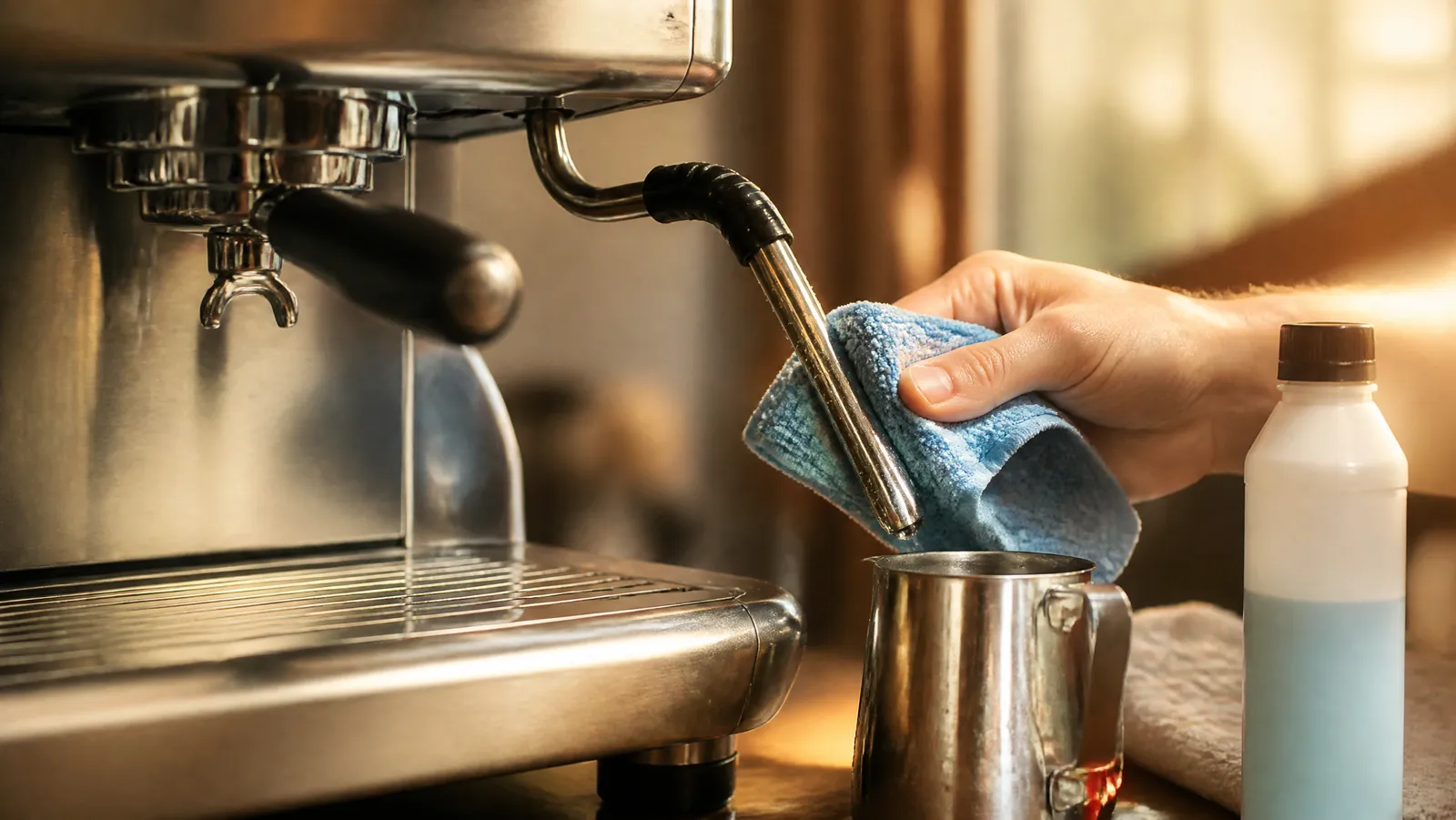
| After every milk drink | Purge the steam wand, then wipe it immediately | Milk proteins bake on once the wand cools |
| Daily (days you use it) | Water-only backflush, brush the group, rinse the drip tray | Clears loose oil before it hardens |
| Weekly to monthly | Detergent backflush; soak portafilter and baskets | Removes film water alone won't shift |
| Monthly | Soak the shower screen; deep-clean the steam wand; inspect the gasket | Screen holes clog invisibly |
| Every 1–6 months | Descale, on an interval set by your water hardness | Scale runs on its own timetable |
| Annually | Replace group gasket and shower screen; service prosumer machines | Rubber hardens whether you use it or not |
Manufacturers vary and yours wins. Seattle Coffee Gear recommends a water-only backflush weekly and a detergent backflush monthly at home; the Espresso Machine Company publishes a Puly Caff procedure but no fixed interval, saying only that regular backflushing prolongs a machine's life; La Marzocco's commercial guidance is every two to four hours of service plus end of day. Pick your spot by how many shots you pull.
The descale row can't be generalised — it depends on your water more than your habits. Our guide on how often you should descale turns hardness and volume into a number.
The steam wand rows are the bare minimum. Cleaning a steam wand properly, including the internal channels and the residue you can't see, deserves its own guide; meanwhile steaming milk like a barista covers technique.
Mistakes That Damage Machines
- Backflushing a machine with no three-way valve. Seattle Coffee Gear warns it can damage the machine, and no amount of care makes it safe.
- Using vinegar as a backflush agent. According to Papel Espresso, manufacturers explicitly warn against acetic acid, its use can void warranties, and it attacks aluminium as well as rubber and silicone seals.
- Overdosing the detergent. Half a teaspoon means half a teaspoon. Extra powder doesn't clean better; it just survives the rinse.
- Skipping the rinse cycles. Urnex builds a second five-cycle rinse and a discarded shot into the procedure for a reason.
- Scrubbing the screen with anything abrasive. Soak it, brush it softly, replace it when worn.
- Backflushing a cold machine. Hardened oil needs heat and pressure to move.
Frequently Asked Questions
Can I backflush with vinegar?
No. According to Papel Espresso, manufacturers warn against acetic acid in their manuals and its use can void a warranty, because it corrodes aluminium and degrades rubber and silicone seals. It's also an acid aimed at mineral scale, not the alkaline detergent coffee oils need.
How often should I backflush my espresso machine?
Seattle Coffee Gear recommends a water-only backflush weekly and a detergent backflush monthly at home. La Marzocco's guidance for cafés is far heavier — every two to four hours of service plus end of day — but that is commercial volume, not yours. We'd run water-only on any day you use the machine, and detergent between weekly and monthly depending on volume.
Can I backflush a Breville Bambino or a De'Longhi Dedica?
Seattle Coffee Gear lists both the Bambino line and entry-level Dedica models among machines that generally do not support backflushing. For those, soak the shower screen and baskets in detergent solution monthly and flush the group with clean water. Check your model's manual to confirm.
When should I replace the group gasket?
When it stops sealing. Espresso Parts Online describes the portafilter creeping past 6 o'clock toward 4 o'clock as a decent indicator; leaking or hissing around the rim during a shot is the other. 1st-line.com suggests every 6 months for machines used more than once every 3 days, every 12 months for lighter use.
Does backflushing descale my machine too?
No, and this is the most common misunderstanding. Backflushing cleans the brew path with an alkaline detergent; descaling clears the water path with an acid. Doing one does nothing for the other, and both belong on the calendar.
Keep It Boring
The machines that last belong to people whose maintenance is dull and automatic: brush the group, water backflush, purge the wand, detergent backflush on a fixed day, descale on a schedule set by the water. None of it is difficult. The only genuinely important decision is the first one — whether your machine has the three-way valve that makes backflushing possible at all.
Check the manual, run the hiss test, pick the matching routine. For how this fits alongside grinders, brewers, and kettles, see the complete coffee equipment cleaning guide.
Related reading
- How to Descale a Coffee Maker — the acid half of the job
- How Often Should You Descale Your Coffee Maker? — hardness into an interval
- The Complete Home Espresso Guide (2026) — machine, grinder, workflow
- How to Pull a Perfect Espresso Shot — dialling in a clean machine
- Espresso Accessories You Actually Need — what earns counter space