DIY Descaling Solution: Citric Acid vs Vinegar Recipes
 Tommie Chaney·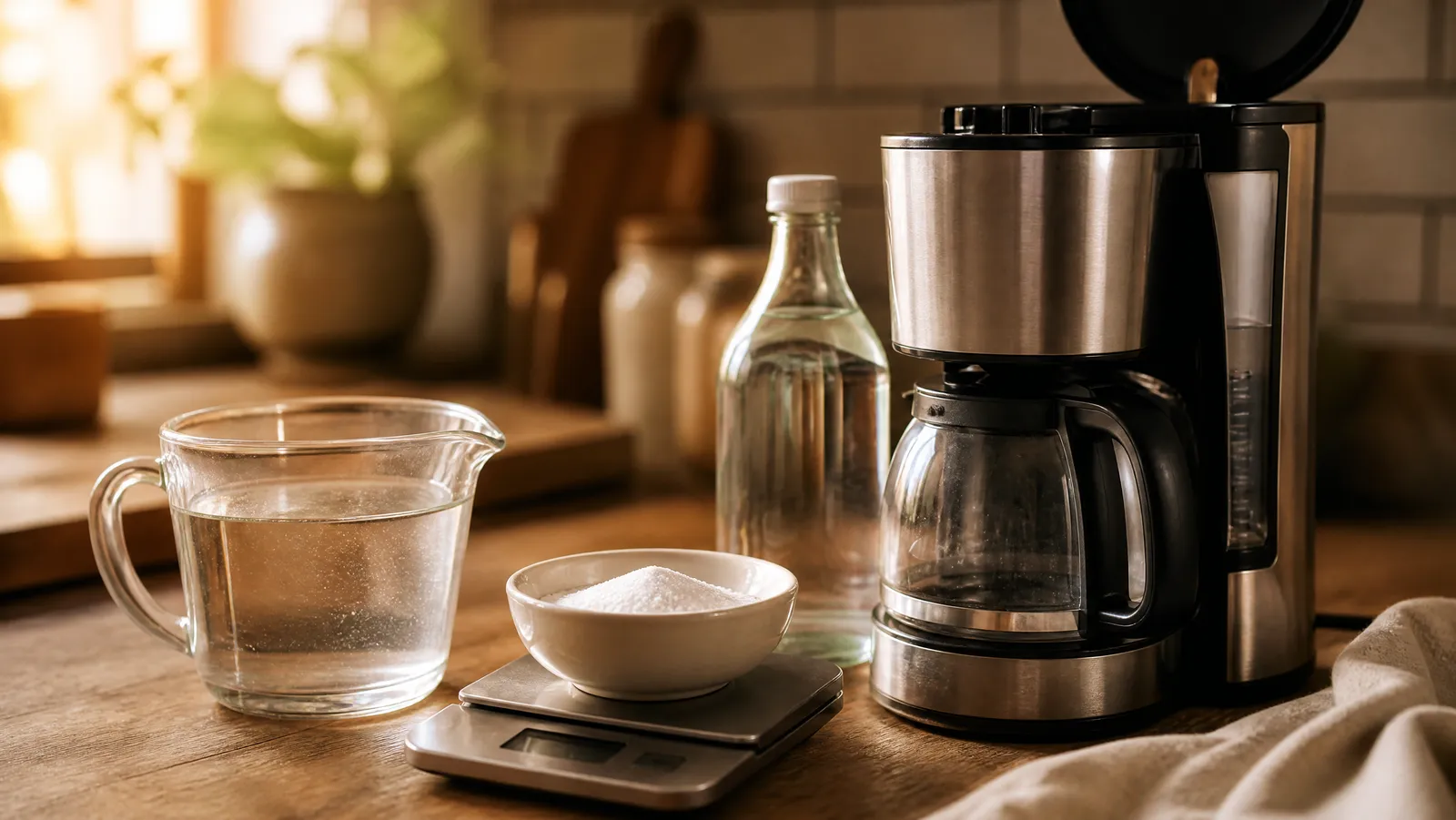
Affiliate disclosure: Sweeter Grind is a participant in the Amazon Services LLC Associates Program. We may earn commissions on qualifying purchases at no extra cost to you.
The recipe is two ingredients and about ninety seconds of work.
A homemade descaling solution for a coffee maker is food-grade citric acid powder dissolved in water — start at 10 g of powder per litre, dissolve it completely before it touches the tank, and rinse harder than you think you need to. That's the whole thing. The complication isn't chemistry, it's paperwork: several manufacturers name an approved descaler in writing, and mixing your own puts you outside what they'll cover. Read the warranty section before you read the recipe. This piece sits inside our broader guide to cleaning and descaling coffee equipment.
The Short Answer: The Citric Acid Recipe
Dissolve 8–12 g of food-grade citric acid powder in every 1 litre of water, and start at 10 g/L. That's the ratio published in Mikael Jasin's Breville descaling guide, which puts 8–12 g per litre — "roughly 1–2 tablespoons" — as the working range for a home machine.
Note how wide that spoon conversion is: 8 to 12 grams mapping onto "1 to 2 tablespoons" is a 50% swing, because granular citric acid packs differently depending on grind and scoop. Weigh it. You already own a scale for coffee.
For heavier deposits the numbers climb. Alliance Chemical's citric acid descaling guide starts its calculator at 20 g/L, adds 5 g/L for hard water above 180 ppm, subtracts 5 g/L for soft water, and caps the dose at 15 g/L for aluminium boilers, on the grounds that citric acid pits aluminium at higher concentrations. If you don't know what your boiler is made of, stay low.
| Tank size | Routine descale (10 g/L) | Heavy scale (20 g/L) |
|---|---|---|
| 0.5 L | 5 g | 10 g |
| 1.0 L | 10 g | 20 g |
| 1.5 L | 15 g | 30 g |
| 1.8 L | 18 g | 36 g |
| 2.0 L | 20 g | 40 g |
Mix only what the tank holds — there's no reason to store a batch, and an unlabelled jug of acid on a kitchen shelf is a bad idea.
Why Citric Acid and Not Vinegar
Three reasons. Citric acid is odourless and rinses out without leaving a taste. It's the same acid family that shows up as the primary ingredient in several commercial descaling powders. And it's a powder, so you control the concentration precisely instead of guessing at a jug.
Vinegar works — it's an acid, scale is a carbonate, the reaction happens. It's just weaker for the job, it smells for days, and some manufacturers name it specifically as something not to use. We've argued the full case in vinegar vs descaling solution for coffee makers. If you're still deciding, read that first.
The Vinegar Recipe (If You're Going To Anyway)
Sources genuinely disagree here, so here's the spread rather than a number pretending to be settled.
- 1:1, equal parts white vinegar and water. Breville's own published coffee-maker cleaning guide tells drip owners to fill the tank with "equal parts distilled white vinegar and equal parts plain water," and Mikael Jasin's Breville guide lists the same 1:1 dilution for the vinegar route.
- 1:3, one part vinegar to three parts water. Cuisinart's own coffee maker cleaning instructions tell owners of models with a Clean button to fill the carafe with three parts water and one part vinegar.
A threefold difference in strength between two reasonable sources tells you how imprecise this method is. If your manual prints a ratio, that ratio wins. If it doesn't, start weak — you can run a second cycle, but you cannot un-run a strong one.
Vinegar handles light scale fine and struggles with a machine untouched for two years. It also needs more rinsing than citric acid, because the smell is the last thing to leave. Use plain white vinegar — never apple cider, never a cleaning vinegar sold at higher concentration.
Before You Mix Anything: The Warranty Question
This is the part that actually matters, and manufacturers do not agree with each other.
De'Longhi is the most direct, and it argues against citric acid specifically. De'Longhi's published maintenance guidance tells owners to use its own EcoDecalk descaler "and never vinegar," and dismisses DIY methods including lemon juice and vinegar as things that "can incur corrosion and leave behind a lingering aftertaste and residue." Its objection to citric acid is chelating power: De'Longhi says the lower chelating power means limescale won't fully detach, instead flowing into the water circuit and causing further internal issues. That's a vendor argument for a vendor product — but it's their published position on their own machines.
Breville's position depends on which machine you own. For espresso machines, Mikael Jasin's Breville descaling guide marks both citric acid and vinegar as not officially approved by Breville, and notes that only Breville's own solution keeps the warranty intact. For drip coffee makers, though, Breville's own published cleaning guide tells you to fill the tank with "equal parts distilled white vinegar and equal parts plain water." Same brand, opposite advice, different product line — which is exactly why the instruction that matters is the one for your model, not for the badge on the front.
Keurig's instructions are written entirely around its own bottle — pour the whole bottle of Keurig Descaling Solution into an emptied reservoir, refill the bottle with water and add that too, then run at least 12 rinsing brews. There's no DIY substitution point in the procedure.
Cuisinart, by contrast, prints a vinegar ratio on its own website. Same category of appliance, opposite instruction.
So the rule is simple, and it isn't about chemistry:
- Machine in warranty, or a manual that names a specific approved product → buy that product. The few dollars you save are not worth handing the manufacturer a reason to decline a claim.
- Machine out of warranty, and the manual doesn't restrict what you use → DIY is fine. Mix carefully, rinse thoroughly.
That's what makers state, not a prediction about your machine. Plenty of people descale with citric acid for years without incident — which is not the same as being covered.
One hard safety rule, no exceptions: never combine a descaler with any other cleaning product. The Washington State Department of Health states that "when chlorine bleach is mixed with an acid, chlorine gas is given off," and lists vinegar, rust-removal products, toilet bowl cleaners and drain cleaners among the acid-containing household products involved. Citric acid, vinegar, and commercial descalers are all acids. None of them belong in the same vessel as bleach, an ammonia cleaner, or each other.
How to Mix and Run a DIY Descale, Step by Step
This section covers mixing and dosing. The machine-by-machine procedure — reservoir positions, cycle buttons, what to do with a pod brewer — lives in how to descale a coffee maker.
Step 1: Check your manual first
Find the descaling or maintenance section. If it names a product, stop here and buy that product. If it prints a vinegar ratio, use that ratio. If it says nothing about descaling agents at all, you're free to mix your own.
Step 2: Weigh the acid
Put a bowl on your coffee scale, tare, and weigh out the grams from the table above for your tank capacity. Tablespoons are an approximation of an approximation.
Step 3: Dissolve it fully in warm water — before it goes in the tank
Stir the powder into warm (not boiling) water in a jug until it runs completely clear. Undissolved granules are a risk worth taking seriously — loose crystals may settle in valves, screens, and pump inlets, where they can sit against metal at a far higher local concentration than you intended. Never tip dry powder into the reservoir and top it with water.
Step 4: Fill the tank and start the cycle
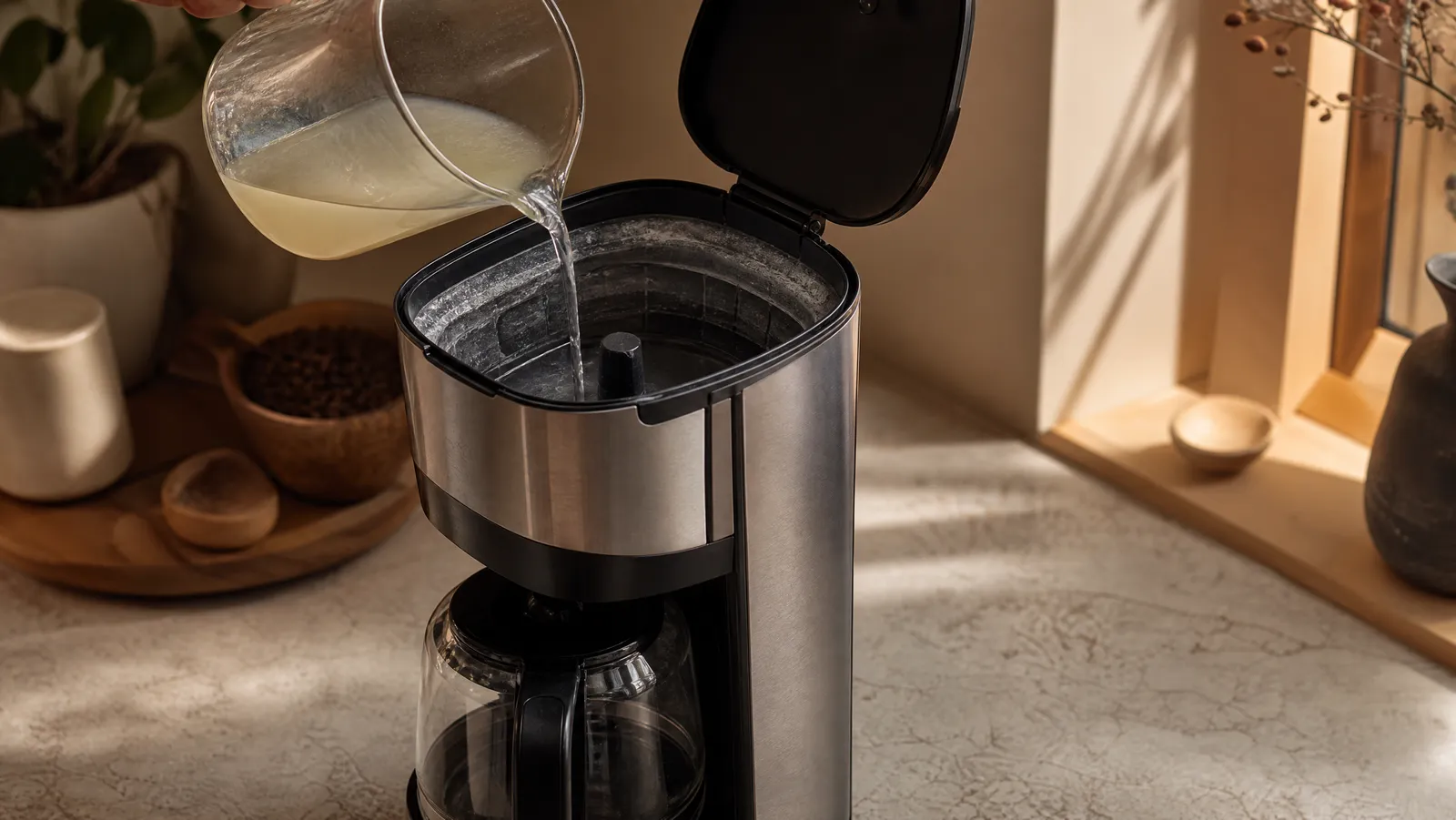
Pour the solution into an empty reservoir. If your machine has a descale program, run it and let it manage the timings. If not, run roughly half the tank through — including the hot water spout and steam wand, separate paths that scale up too — then stop.
Step 5: Let it dwell
Leave the rest sitting in the machine for 15 to 20 minutes — Alliance Chemical's guide recommends letting the machine sit with solution in the boiler for 15 minutes between outlets. Descaling is a soak, not a flush, and contact time matters at least as much as concentration. It's also why a second cycle is usually the safer move than a stronger dose.
Step 6: Run the rest through
Push the remainder out through every outlet the machine has, and discard all of it. On a heavily scaled machine, expect the flow to change as it clears.
Step 7: Rinse with at least three full tanks of fresh water
This is where most home descales fall short. Alliance Chemical's guide calls for a minimum of three full reservoirs of plain water through every outlet, and four if your water is hard. Vinegar users should plan on more, and keep going until the smell is gone.
Step 8: Brew one cycle and throw it away
Make one full brew with coffee, then pour it out. If it tastes sharp or sour, there's acid left in the system — run another rinse tank.
What DIY Descaler Will Not Do
Descaling is one job. It is not cleaning.
It doesn't touch coffee oils. Scale is mineral; oils are fat. Acid dissolves one and does nothing useful to the other. Rancid oils in a group head or brew basket are a detergent problem — see how to backflush and maintain an espresso machine for the right chemistry. It won't clean a grinder either, where the residue is oil and fines and the burrs should never meet liquid, and it isn't a milk-line cleaner — milk systems need their own alkaline product.
It also doesn't stop scale coming back. The mineral content of your water is what creates it, which is why water quality matters for coffee beyond taste — the harder your water, the more often you'll be doing this.
Cost: Is It Actually Worth It?
Less than you'd expect. Working from a 1.8 L reservoir at 10 g/L — 18 g of powder per descale — here's the arithmetic, with all prices as of August 2026:
| Option | Price | Uses per package | Cost per descale |
|---|---|---|---|
| Food-grade citric acid powder, 1 lb (454 g) | $8.99 (Fermentaholics) | ~25 | ~$0.36 |
| Urnex Dezcal descaling liquid, 32 oz | $15.00 (Voltage Coffee Supply) | ~17 | ~$0.85 |
| Urnex Dezcal single-use packets, 3-pack | $5.99 (Seattle Coffee Gear) | 3 | ~$2.00 |
The liquid figure uses Prima Coffee's stated Dezcal dosing of 1 oz per litre of tank capacity, so a 1.8 L tank draws about 1.8 oz.
DIY wins, but the margin is small. Against pre-portioned sachets you save roughly $1.60 a descale — call it $10 to $20 a year, depending on how hard your water is and how often it makes you do this. Against a bulk bottle of commercial descaler it's about fifty cents. Mix your own for control over the concentration, not to save money. If you'd rather buy something pre-formulated, our roundup of the best coffee machine cleaners and descalers covers what's worth it.
Frequently Asked Questions
Is citric acid safe for coffee machines?
At the doses above, for most machines, yes — it's the primary active ingredient in several commercial descaling powders. Two caveats: Alliance Chemical caps the concentration at 15 g/L for aluminium boilers because citric acid pits aluminium at higher strengths, and De'Longhi publishes the opposite view for its own machines. Safe is not the same as approved.
Does it have to be food-grade citric acid?
Yes. Alliance Chemical states that USP food-grade citric acid monohydrate is the only citric acid suitable for espresso machines, and that industrial grade carries impurities that leave residue. The gap is real: published grade specifications put technical/industrial citric acid at roughly 96–97% assay, and Alliance Chemical notes that technical grades carry allowable trace impurities including heavy metals; food-grade USP citric acid monohydrate runs about 99.5% and must meet a recognised compendium. Look for FCC or USP on the bag.
Can I descale a Keurig or Nespresso machine with a homemade solution?
We wouldn't. Pod machines are sealed systems you can't inspect, and Keurig's own instructions are built around its branded Descaling Solution — a whole bottle into an emptied reservoir, then at least 12 rinsing brews. There's no dilution figure to substitute into.
How often should I be descaling?
It depends far more on your water than your machine. Keurig's guidance is every three to six months; Mikael Jasin's Breville guide suggests every three to four weeks on hard tap water with heavy use — six to eight weeks if you use the machine lightly — stretching to two or three months on soft water with heavy use, and four to six months on soft water with light use. We've broken the intervals down in how often you should descale your coffee maker.
Does lemon juice work instead of citric acid powder?
Same acid family, but no. Lemon juice carries sugars and pulp that don't belong in a water path, and its acid concentration varies bottle to bottle, so you can't hit a target dose. De'Longhi lists lemon juice alongside vinegar among DIY methods that can leave a lingering aftertaste and residue. Powder is the disciplined version of the same idea.
Can I mix citric acid and vinegar for a stronger descaler?
No — don't combine cleaning products, full stop. Two acids buy you nothing a longer soak wouldn't, and freelance mixing is how people end up putting an acid together with bleach and generating chlorine gas, which the Washington State Department of Health specifically warns against. One acid, correctly dosed, dwelt properly, rinsed thoroughly.
The Bottom Line
Weigh 10 g of food-grade citric acid per litre. Dissolve it completely before it goes near the tank. Let it soak. Rinse three tanks. Throw away the first brew.
And before any of that, open the manual — because on this question the manufacturers contradict each other, and the only one that matters is yours. If it names a product, buy the product; the recipe above is for machines out of warranty and unrestricted. For everything descaling doesn't fix — oils, grinders, milk lines, the parts you can actually see — our complete coffee equipment cleaning guide covers the rest of the job.
Related reading
- Vinegar vs Descaling Solution: Which Should You Use? — the full argument behind the acid you choose
- How to Descale a Coffee Maker (Step by Step) — the machine-by-machine procedure
- How Often Should You Descale Your Coffee Maker? — intervals by machine type and water hardness
- The Best Coffee Machine Cleaners and Descalers — if you'd rather just buy one
- Why Water Quality Matters for Coffee — the mineral content that creates scale in the first place