How to Clean a Steam Wand and Milk System
 Tommie Chaney·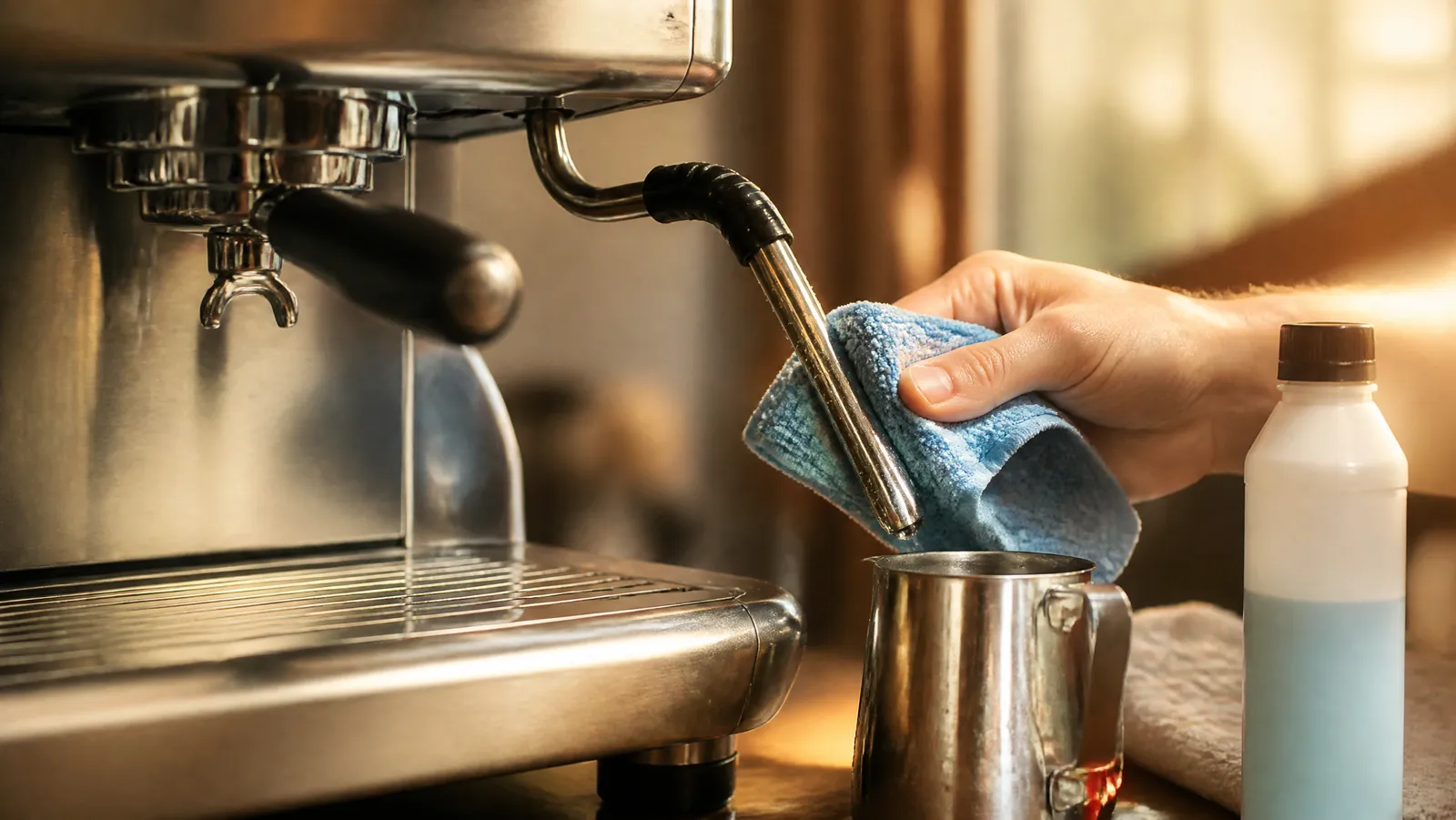
Affiliate disclosure: Sweeter Grind is a participant in the Amazon Services LLC Associates Program. We may earn commissions on qualifying purchases at no extra cost to you.
Purge, wipe, purge — immediately, before you pour the drink. That is how to clean a steam wand, and doing it in the ten seconds after every milk drink prevents almost everything else in this article. On top of that habit you add a periodic deep clean with a cleaner formulated to dissolve milk protein, plus a soak of the removable tip.
The part nobody says clearly enough: a wiped wand is not a clean wand. The cloth cleans the outside of a tube. Milk gets pulled back inside the tip when the steam shuts off, and no cloth reaches that. This article covers the milk side of the machine — wand, tip, pitchers, and the automatic milk systems on super-automatics. The rest of the counter lives in how to clean and descale coffee equipment; if you're still building the setup, our complete home espresso guide covers what goes on it.
Why Wiping Isn't Cleaning
Milk is protein, fat and sugar meeting metal at steam temperature. Heat sets that residue onto the metal, which is why the word doing the work in every instruction below is immediately.
The mechanism people miss is suction. According to Whole Latte Love's guide to common milk frothing mistakes, when you shut off the steam with the tip still in the pitcher, "as the wand quickly cools a bit of milk gets sucked up into the wand." Seattle Coffee Gear's steam wand guide gives the consequence in a line: "The wipe cleans the outside; the purge clears the inside."
How badly this goes when people are confident they've cleaned is documented. Lancaster City Council's guidance for baristas reports that its food and safety team visited 21 local businesses in 2024 and asked each to prepare its coffee machine to serve an allergy-free coffee. The result: "Tests showed that 19 out of the 21 businesses failed; that is allergens were still detected on the steam irons after cleaning!" The same document names the error behind much of it: "Sanitiser wipes kill microorganisms, they do not destroy allergen proteins."
That was an inspection of businesses, not home kitchens. But the residue is identical, and the lesson transfers: killing bacteria and removing protein are different jobs.
The 15-Second Routine After Every Drink
Three moves, in this order, while the wand is still hot and before you pour.
- Purge for a second into the drip tray. This pushes out the milk drawn back into the tip as the steam died. Breville's instruction is the same: "Immediately after texturing milk, turn steam on to purge out any residual milk from the steam wand then wipe the wand with a damp cloth."
- Wipe with a damp cloth used only for milk. Start where the wand meets the machine and pull down to the tip in one pass, using a clean section of cloth.
- Purge again. This clears whatever the wipe pushed toward the holes, and clears the tip once more now that the wand has cooled and pulled again.
Seattle Coffee Gear puts the daily routine at "about ten seconds." Lancaster wipes first then purges; Breville purges first then wipes. We do both purges — five seconds, argument settled.
Do this every time and the deep clean stays maintenance rather than rescue. Technique is a separate skill, covered in how to steam milk like a barista.
The Deep Clean, Step by Step
The most rigorous published procedure we've found sits in that same Lancaster City Council document. The timings are the council's, not ours.
Step 1: Wipe off the visible residue
"Wipe the stream iron with disposable paper cloth (e.g. blue roll) to remove any visual contamination." Disposable, not your milk cloth — at this stage a reusable cloth relocates residue rather than removing it.
Step 2: Purge the wand
Next: "Purge the steam iron. To remove any remaining milk from the head of the lance." One to two seconds into the drip tray.
Step 3: Wash the wand in hot soapy water
The council's fourth step is to "wash the steam lance in hot soapy water using a clean cloth. This with help remove protein residue." A small jug works well — keep the joint where the wand meets the machine body out of the water.
Step 4: Leave the solution on for at least 20 seconds
The step everyone skips, and the one doing chemical work. Lancaster instructs staff to leave the steam iron with soapy water "for at least 20 seconds. This will allow the chemicals to lift stubborn proteins remaining on the exterior of the iron." Dwell time isn't waiting around; it is the cleaning.
Step 5: Purge into the solution
Then: "Purge the iron into the soapy water. This cleans the inner tip of the iron." This uses the physics that caused the problem — the purge pushes solution out through the holes, and as the wand cools it draws solution back in, reaching the surface no cloth touches. Wash the steam control too — the council's step 7 is to "wash the button used to operate the steam iron with hot soapy water."
Step 6: Rinse in clean water and purge again
"Rinse the steam iron in clean water, purge the iron to remove any soapy residue in the tip." Twice, if you used a dedicated cleaner. Anything left inside the tip ends up in the next drink.
Step 7: Wipe dry with a fresh cloth
The last wand step: "wipe the steam iron with fresh disposable paper cloth (e.g. blue roll)." Fresh — not the one from Step 1.
Step 8: Unscrew and soak the tip if it's crusted
If residue survived Steps 1–7, dish soap is the wrong chemical for it. Breville's manual directs owners to "remove the tip using the integrated spanner in the cleaning tool and soak in hot water." An alkaline milk-system cleaner is the right product class for that soak: Urnex describes Rinza Alkaline as breaking down "milk protein and fat buildup on auto frothers, steam wands and frothing pitchers," with directions calling for 30 mL per 500 mL of water and a 15-to-30-minute soak, then a clean-water rinse. Follow one product's printed instructions rather than averaging several — our roundup of the best coffee machine cleaners and descalers covers which does which job.
Unclogging a Blocked Steam Tip
The symptoms are unmistakable: pressure drops, the wand spits instead of hissing, and milk that used to spin into a vortex just churns. One or more holes are blocked with dried milk.
Breville's fix, in its manual's words: "Use the pin on the end of the provided cleaning tool to unblock the hole(s)." If that fails, remove the tip with the integrated spanner, soak it, and clear the holes again before reattaching. Its safety instruction comes first: put the steam dial in standby, power the machine off and let it cool. Seattle Coffee Gear notes that tips typically have one to four holes and every one needs clearing, and suggests a soak of at least an hour for a heavy clog — overnight, with the tip detached, for severe buildup.
Don't enlarge the holes. Hole size and count are part of how a tip is designed to steam, and a hole reamed out with a drill bit can't be undone. Don't force anything metal that isn't the supplied tool. A replacement tip is cheap next to a damaged wand.
Automatic Milk Systems and Milk Fridges
Super-automatics with a milk carafe or fridge line are the worst case here: the milk sits in opaque tubing you cannot inspect. You won't see the problem develop — you'll taste it weeks later.
The pattern across manufacturers is three tiers — a rinse after every milk session, a detergent clean on the maker's schedule, and a periodic disassembly and soak. The intervals are model-dependent, so your manual outranks this article.
De'Longhi's published guidance for its Rivelia LatteCrema carafes shows the shape of it: "After each preparation use the 'Auto clean' function, by turning the froth dial to the Clean position"; then, after use, "disassemble the components as described in the User manual and wash them accurately (all carafe components are dishwasher-safe)." The same guidance caps fridge storage of milk in the carafe at two days for the hot carafe, one for the cold. JURA states that its milk system cleaner "effectively removes milk fats and proteins" when used together with the automatic cleaning programme.
The chemical class you want is an alkaline milk-line cleaner, run through the circuit rather than wiped on. Dose and dwell come from the bottle, not from us.
Milk Pitchers, Cloths, and Cross-Contamination
The cloth is where careful people undo their own work. Lancaster's guidance advises "a separate dedicated cloth for dairy so that both steam lances do not get contaminated with diary protein" — and warns against over-engineering it: colour-coding a cloth for every milk "is not recommended as staff often become confused, use the wrong cloth." At home: one cloth, milk only, never touching the group head, drip tray or counter.
Pitchers get washed, not rinsed — a rinse just moves the film around. Residue survives a casual wash in two places: the crease inside the spout, and the seam where the handle joins the body. Check both with a finger rather than your eyes.
The Milk Cleaning Schedule
Our recommended baseline, not a universal standard.
| Interval | Task | Why |
|---|---|---|
| After every milk drink | Purge, wipe with the milk cloth, purge again | Clears milk drawn into the tip before it bakes |
| Daily | Wash pitchers in hot soapy water; run the built-in milk rinse | Removes the film a rinse leaves behind |
| Weekly | Full wash-and-dwell deep clean of the wand | Lifts protein the daily wipe never removed |
| Monthly | Soak the tip in an alkaline milk cleaner, clear each hole | Restores steam pressure before you notice it dropping |
| Per the manual | Disassemble and soak an automatic milk system | The tubing you can't see is the part that fails |
Machines with automated cleaning programmes set intervals that override this table. The wand is also one line on a longer maintenance calendar; group heads, gaskets and shower screens run on their own schedule in our guide to how to backflush and maintain an espresso machine.
Mistakes That Cost You a Steam Wand
- Reaching for a sanitiser wipe. It feels like cleaning and isn't. Lancaster's guidance is explicit that sanitiser wipes kill microorganisms but do not destroy allergen proteins, and tells businesses not to use them for removing allergens.
- Leaving milk to dry. Dried milk is a solvent problem; wet milk is a wipe.
- Scouring the wand. Abrasives leave scratches in stainless steel, and scratches can trap residue and make a surface harder to clean than a smooth one.
- Soaking the whole wand assembly. On most home machines, only the tip is designed to come off; check your manual before immersing anything else. Water forced into the joint or steam valve is a repair, not a clean.
- Using descaler as a milk cleaner. Wrong chemistry. Per ORAPI's explainer on cleaning chemistry, alkaline cleaners break down "fats, oils, grease, and other protein-based deposits" through saponification and emulsification; the general principle in food-industry cleaning is that acids are the class used for the opposite soil — mineral deposits such as scale. Descaler is an acid built for scale in the water path, a different job covered in how to descale a coffee maker. Never mix cleaning products; follow one label at a time.
Frequently Asked Questions
Can I use dish soap on a steam wand?
Yes — Lancaster City Council's procedure has staff wash the lance in hot soapy water with a clean cloth to remove protein residue. What dish soap may not shift is protein already baked onto the tip — that's the job an alkaline milk-system cleaner is formulated for.
How long should I soak a steam wand tip?
Follow the product's directions rather than combining advice. Urnex specifies 15–30 minutes at 30 mL of Rinza Alkaline per 500 mL of warm water; Seattle Coffee Gear suggests a routine soak of 15 to 20 minutes, and at least an hour for a heavy clog.
Why is my steam wand spitting instead of steaming?
Almost always a partially blocked tip. Power down, let the wand cool, and clear each hole with the pin from the machine's cleaning tool, as Breville's manual specifies. If the holes won't clear, unscrew the tip and soak it.
Can I put my milk pitcher in the dishwasher?
Usually, if it's stainless steel — but note the council's caution that "some dishwashers are not effective in the removal of allergen proteins." In an allergy household, hand wash in warm soapy water and inspect the spout.
Is a milk-system cleaner the same as espresso machine detergent?
No, and swapping them wastes both. Seattle Coffee Gear notes that Cafiza "is designed for coffee residue and is not the right product for steam wand cleaning," while Rinza is formulated for milk.
The One Habit That Replaces All of This
Take the second purge. The wipe is the part everyone already does; the purge reaches where the milk actually went. Ten seconds after every drink beats any monthly ritual you'll eventually skip.
When you're ready to put the rest of the counter on the same footing, work through the complete guide to cleaning coffee equipment.
Related reading
- How to Backflush and Maintain an Espresso Machine — the coffee half of the machine
- Best Coffee Machine Cleaners and Descalers 2026 — which chemical, which soil
- How to Descale a Coffee Maker — the acid side of maintenance
- How to Steam Milk Like a Barista — the technique, not the cleaning
- The Complete Home Espresso Guide 2026 — the setup it all sits on