Greek Frappé and Freddo Espresso, Explained
 Tommie Chaney·
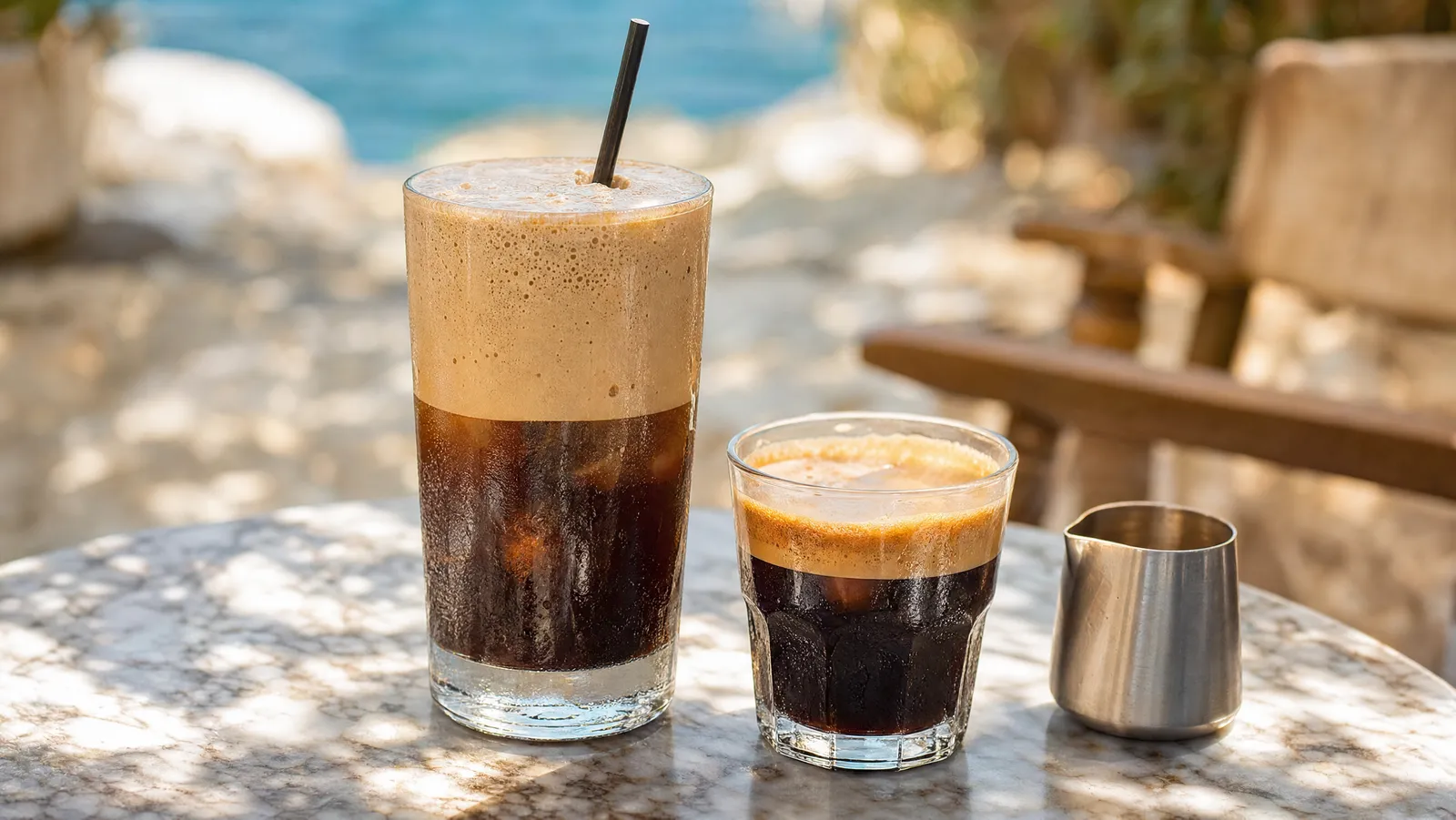
The classic Greek frappé recipe is 2 teaspoons of spray-dried instant coffee, up to 2 teaspoons of sugar and 2 tablespoons of cold water, whipped for about 30 seconds into a stiff tan foam, then poured over ice and topped with cold water. Milk is optional. A freddo espresso is a different drink: real espresso shots shaken with ice.
Sweeter Grind is reader-supported. We may earn a commission on purchases made through links on this site, at no extra cost to you.
Americans tend to collapse the two into one thing called "iced Greek coffee," which is how people end up disappointed by both. One is built from instant coffee, the other from espresso. This guide teaches both, and it sits inside our wider look at coffee traditions across the world.
Frappé vs Freddo Espresso: What Actually Differs
| Drink | Coffee base | How the foam is made | Milk | When sugar goes in |
|---|---|---|---|---|
| Frappé | 1-2 tsp spray-dried instant | Instant, sugar and a splash of cold water whipped 15-30 seconds | Optional, traditionally evaporated | Before whipping — it is part of the foam |
| Freddo espresso | 1-2 real espresso shots | The shot itself shaken or frothed with ice | None | Into the warm shot, before the ice |
| Freddo cappuccino | 1-2 real espresso shots | Shot shaken with ice, then cold-frothed milk floated on top | Yes — a cap of cold foam, afrogala | Into the warm shot, before the ice |
The practical difference is the barrier to entry. A frappé needs instant coffee, sugar, water, ice and something that spins — a battery wand at around $6 as of November 2026, or a jam jar with a lid, will do. A freddo needs real espresso. Our espresso drink recipes guide shows where the two freddo drinks sit against the rest of the espresso menu.
Where the Greek Frappé Came From, and Where the Story Wobbles
The standard account is unusually specific. Wikipedia's frappé coffee entry dates the drink to September 1957 in Thessaloniki and credits experimentation by Dimitris Vakondios, a Nescafé representative who, in the common version, worked for Nestlé's Greek representative Giannis Dritsas, could not get hot water for his instant coffee at the Thessaloniki International Fair, and mixed it with cold water and ice in a shaker instead.
People who went looking for documents have challenged that. The same entry records that Nikos Bakounakis first questioned the story in 2006, that the magazine Gastronomos presented further evidence in 2013, and that Nestlé newspaper advertisements from before the fair appear to promote the product as "Nescafé frappé" already. The sources genuinely disagree, and we are not going to pick a winner.
The freddo is younger. To Vima reports that its most widely accepted account credits Yiannis Iosifides of the distributor Kafea Terra, and that the drink was created to counter falling hot espresso sales over the Greek summer.
Which one dominates now deserves care. To Vima quotes Panagiotis Konstantinopoulos, managing director of the chain Coffee Island, estimating that freddo espresso and freddo cappuccino together account for 70-80% of all cold coffee drinks consumed in Greece — an industry estimate, not published market research. Greek Reporter separately noted that TasteAtlas placed freddo espresso third in its 2025 ranking of the world's best coffees, a measure of reputation rather than consumption.
Why the Instant Coffee Matters More Than the Shaker
Here is the most useful technical point in the article: not all instant coffee foams, and the drying method is why. Wikipedia's frappé entry explains that spray-dried instant contains almost no oil, which is what lets a thick foam form, one it describes as resembling espresso crema but thicker. Freshly brewed coffee and freeze-dried instant carry more oil and produce only a short-lived foam.
Patent literature on foaming coffee compositions adds a second mechanism: spray drying traps gas inside the particles, and that gas is released when the powder meets water. One such patent, Kraft Foods' US 9,591,863, notes that the same gas-injection trick cannot be used on freeze-dried coffee because the spray-drying step is what retains the bubbles; freeze-drying research on instant coffee attributes that structure's pores to ice crystals subliming away instead. Young & Foodish offers a third explanation — a solution concentrated enough that its proteins act as surfactants and line the bubble walls — which several other recipe writers repeat. Treat the chemistry as unsettled and the practical rule as reliable.
The rule is a 30-second test. Put 2 teaspoons of instant and 2 tablespoons of cold water in a jar and whip. If you get a stiff, pale tan foam that holds a peak, you have the right jar. Brown water with a rim of bubbles means freeze-dried crystals, and no amount of shaking fixes that.
Greek-market Nescafé Classic is the canonical base, and recipes name it for a reason. US jars are another matter. The Greek Frappe Classic instant coffee sold as a frappé base is the closest thing on Amazon at roughly $30 for 200 g as of November 2026. The pragmatic substitute is a supermarket jar like NESCAFÉ Clásico, about $13 as of November 2026, understanding that it is a US-market blend rather than the Greek one. Neither listing states its drying method, so run the test.
Whipping sugar and coffee into a foam before the drink is built is also the trick behind the espuma behind a Cuban cafecito, where sugar is beaten with the first drops of espresso and the rest of the shot poured through it. Same principle, opposite drink: the cafecito is hot, tiny and intensely sweet, the frappé long, cold and diluted.
How to Make a Greek Frappé
Step 1: Measure the coffee and sugar into your mixing vessel
Put 2 teaspoons of spray-dried instant coffee into a cocktail shaker, a jam jar with a tight lid, or the tall cup of a frappé mixer, then add sugar to taste. Wikipedia's frappé entry gives the Greek café convention against a 2-spoonful dose of coffee: 2 spoonfuls of sugar for a metrios, 4 for a glykos, none for a sketos.
Step 2: Add only a splash of cold water
Add 2 tablespoons of cold water and no more. Young & Foodish's frappé recipe uses 2 teaspoons of instant, 2 teaspoons of sugar and 2 tablespoons of cold water, roughly one part coffee to four parts water, because the foam depends on a concentrated solution. Several recipe sources also say fridge-cold water foams better than room-temperature water.
Step 3: Whip for 15 to 30 seconds
Shake the sealed jar hard for 30 seconds, or run a handheld frother, drink mixer or blender for about 15 seconds — those are the times Young & Foodish gives, and the maker of the YUSWKO wand likewise states that drinks blend in 15-20 seconds. Stop when the foam is pale tan, stiff and glossy, and holds its shape when you tilt the jar.
Step 4: Fill a tall glass with ice
Fill a tall, straight-sided glass about two-thirds with ice cubes before the foam goes near it. Young & Foodish's assembly order is ice first, then foam, then water, so the foam lands on top instead of being churned through the drink.
Step 5: Pour the foam over the ice
Pour the foam slowly over the ice so it settles as a distinct layer rather than breaking up, then scrape the jar out with a spoon — that clinging foam is the densest part of what you made.
Step 6: Top up with cold water, then milk if you want it
Top the glass with cold water, poured gently down the side so it slides under the foam instead of through it. Milk is not part of the default drink — Wikipedia notes it is requested separately, me gala with milk or choris gala without, and that evaporated milk is traditional, sometimes condensed. Young & Foodish lists 2 tablespoons of evaporated or regular milk as optional.
Step 7: Serve it immediately with a straw
Serve the frappé the moment it is built, with a straw and a glass of cold water alongside in the Greek café style. The straw is not decoration: Wikipedia notes the drink is usually served with one because many people find the foam itself bitter, and says water drains out of the foam over roughly 2 to 10 minutes depending on bubble size and sugar content.
Glykos, Metrios, Sketos: How to Order and How Much Sugar
The vocabulary is worth learning, because it is how the drink is specified in Greece and it tells you the sugar amounts.
- Sketos — no sugar at all. With Robusta-heavy instant, this is a bracing drink.
- Metrios — medium. Wikipedia gives 2 spoonfuls of sugar against 2 spoonfuls of coffee for a frappé, and To Vima describes a metrios freddo as about 1-2 teaspoons.
- Glykos — sweet. Wikipedia gives 4 spoonfuls against 2 of coffee, and To Vima puts a glykos freddo at 2 or more teaspoons.
- Me gala / choris gala — with milk, or without. Not included unless you ask.
For a frappé the sugar is structural: it goes in before the whipping and it changes how long the foam survives. For a freddo, To Vima and Greek recipe sources both note that baristas add sweetener while the espresso is still warm so it dissolves, because granulated sugar stirred into an iced drink mostly becomes grit at the bottom. Our guide to sweetening iced coffee covers the syrups and alternatives that dissolve cold.
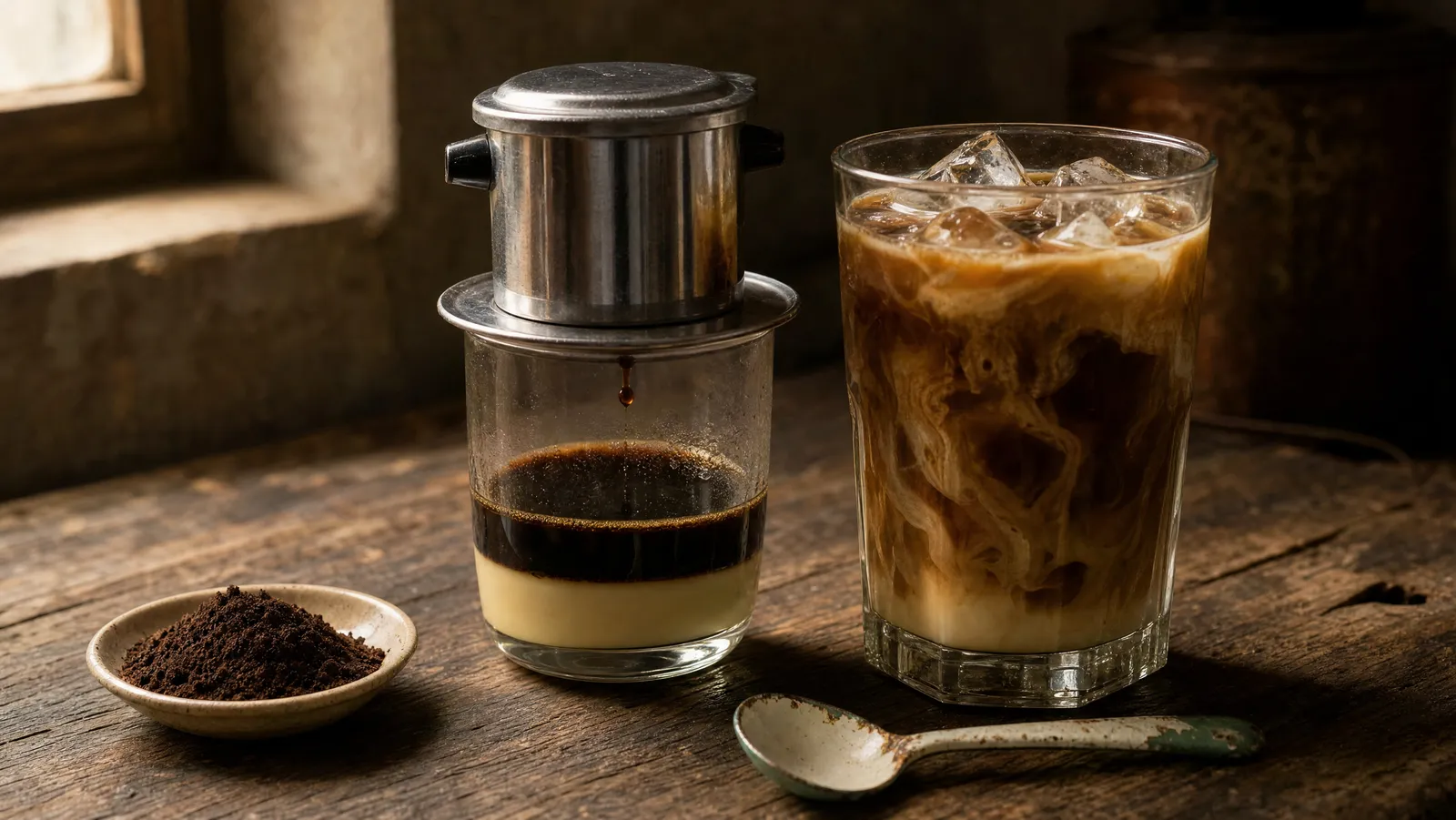
Sweet-and-iced recurs across the cold-coffee world. Vietnamese coffee with a phin builds the same contrast with sweetened condensed milk over a strong Robusta brew instead of sugar over instant.
Freddo Espresso and Freddo Cappuccino
A freddo espresso is not espresso poured over ice. To Vima's account of the standard build starts with two espresso shots, adds sugar at that point if you want it, shakes the shots violently with ice in a metal mixer, then pours the chilled coffee over fresh ice. The shaking is the technique: it chills the coffee and whips a light crema-like head onto it in one move.
For numbers, the Hungry Bites' Greek freddo recipe calls for two shots totalling 60 ml — a shot there meaning about 10 g of ground coffee and 30-35 ml of water — and allocates 6 ice cubes, two for shaking or frothing the espresso and the rest for the glass. It treats frothing the espresso as optional. Everything downstream is dilution, so the shot is the ceiling — our guide to pulling a perfect espresso shot is where to fix that.
A freddo cappuccino is a freddo espresso with afrogala on top: cold-frothed milk, not steamed. The Hungry Bites recipe whips 3 tablespoons (45 ml) of very cold skimmed milk into a thick cold foam with a handheld frother. It prefers UHT skimmed, says 2% works if very cold, and does not recommend whole milk because it froths poorly. Cold evaporated milk works too. That source is blunt that an iced cappuccino is not made with steamed milk, and that you must never froth the coffee once the milk is in.
Proportion is where home versions go wrong. The milk is a cap, not the body of the drink — that recipe's FAQ describes the espresso as topped with equal parts cold milk and foam, and on our own arithmetic 60 ml of espresso against 45 ml of milk whipped to roughly double its volume leaves the milk in about the top third of a tall glass. Build it like an iced latte and you have made an iced latte. Our guide to making cold foam at home goes deeper on pulling dense foam out of a handheld wand.
Troubleshooting
The foam never forms. Usually this is the coffee, not the technique: freeze-dried crystals look glassy and sharp rather than powdery and will not build a stable head. The other cause is water — 2 tablespoons, not a quarter cup.
The foam collapses in under a minute. Some drainage is normal, and Wikipedia notes that a handheld shaker produces finer, longer-lasting bubbles than other methods. A sketos with no sugar and coarse bubbles falls apart fastest.
It tastes harsh and bitter. The foam is the bitter part, which is why the drink is served with a straw so you drink from under it. Beyond that, add more cold water or step up from sketos to metrios.
It tastes like dishwater. Too much top-up water, or ice that melted while you whipped. Use fewer, larger cubes and top up to taste rather than to the rim.
The milk will not froth for a freddo cappuccino. Use very cold skimmed or UHT milk, and froth it separately in its own glass. Once milk and coffee are combined, the window is gone.
What We Would Use to Make the Foam
You do not need equipment to start. A jam jar with a tight lid and 30 seconds of honest shaking makes a real frappé, and it is how we would test a new jar of instant.
If you want a tool, the question is how often you make the drink. A battery wand like the Zulay Kitchen handheld frother costs around $6 as of November 2026 and is plenty of motor for two teaspoons of instant, at the cost of AA batteries that fade quietly and take your foam quality with them. The YUSWKO rechargeable wand, about $21 as of November 2026, trades that for a USB battery with a charge indicator plus separate heads for coffee powder and milk foam.
The café answer is a stand mixer. The Difora stand frother and frappé maker runs about $52 as of November 2026, and the maker names Greek frappé from instant coffee as a primary intended use, with a 100 W two-speed motor and a 500 ml stainless cup. What you give up is counter space and flexibility: the maker explicitly states the unit will not crush ice, and it is a 120 V US-plug appliance that does one job.
FAQ
Can I make a Greek frappé with freeze-dried instant coffee?
Not well. Wikipedia's frappé entry explains that spray-dried instant contains almost no oil, which is what allows a thick, long-lasting foam, while freeze-dried instant and freshly brewed coffee carry more oil and give only a short-lived foam. You can drink the result, but it will not be a frappé.
Do I need an espresso machine to make a freddo espresso?
You need espresso from somewhere. To Vima's description of the standard build is two espresso shots shaken violently with ice in a metal mixer, then poured over fresh ice, and nothing in that method substitutes for the shots. If espresso is not an option, make the frappé — it is the drink designed around instant coffee.
Can I make a freddo cappuccino with oat milk?
Yes, with a caveat about frothing. The Hungry Bites' Greek freddo recipe lists cold oat or almond milk as the vegan options and notes that almond milk froths less well, recommending you froth the espresso with the ice first in that case. Temperature matters more than the carton: cold milk froths, cool milk does not.
How much caffeine is in a Greek frappé?
We did not find a published measurement for a standard frappé, so treat any single number with suspicion. What you can reason from is the dose: a frappé uses 1-2 teaspoons of instant, and Nescafé's stated preparation for its instant is 1 teaspoon per 6 fluid ounces, so a frappé is roughly one to two cups' worth of instant in a tall glass.
Where to Go Next
Two drinks, one glass of ice, and a clean split between them: the frappé is instant coffee whipped into foam, the freddo is espresso shaken with ice. Make the frappé first — it costs almost nothing to try and it teaches you what a coffee foam should look like. Then make a freddo espresso with the best shot you can pull, and a freddo cappuccino with 45 ml of very cold milk frothed separately and floated on top.
If this is the part of coffee you enjoy — the same few ingredients arranged differently in every country — carry on with our guide to the world's coffee cultures, which maps the cezve, the phin and the cafecito against each other.

Greek Frappe Classic Instant Coffee, Robusta Blend, 200 g (7.05 oz)
A 200 g jar of instant coffee sold specifically as a frappé base, which is the category of product Greek cafés reach for. The listing describes it as made from selected Robusta beans, roasted, ground and naturally filtered into the blend, with quick-dissolving granules. It is for the reader who wants the drink to taste the way it tastes in Greece and is willing to pay import prices for that.

NESCAFE Clasico Dark Roast Instant Coffee, 10.5 oz Jar
The jar most American readers can actually buy without waiting for a parcel. Nescafé's stated preparation is 1 teaspoon to 6 fluid ounces of hot water, and the maker says the 10.5 oz jar makes up to 150 cups when prepared as directed — so a frappé habit costs pennies per glass. Treat it as the practical default, not the authentic one.

Difora Stand Milk Frother and Frappe Maker, 100 W, 2 Speeds
A countertop stand mixer of the type Greek cafés use for frappé and for the cold-frothed milk on a freddo cappuccino. The maker names Greek frappé from instant coffee as a primary intended use, and the unit pairs a 100 W two-speed motor with a 500 ml stainless cup that can be mounted on the base or lifted up to the whisk. Buy it if frappé or freddo is a daily drink in your house.

Zulay Kitchen Handheld Milk Frother and Drink Mixer Wand
A battery-powered wand that does the one job a frappé needs: spin a small volume of concentrated coffee into stiff foam in about 15 seconds. Zulay states a 13,000 RPM motor and 26 spiral rings, and it runs on two AA batteries that are included. This is the cheapest honest way to find out whether you like the drink.

YUSWKO Rechargeable Handheld Milk Frother, 3 Heads, 3 Speeds
The middle option: a USB-rechargeable wand with a 1500 mAh battery, a three-level battery indicator and three speeds, plus three detachable stainless heads. The maker assigns them separate jobs — a hook stirrer for powders, a spring stirrer for milk foam and a balloon whisk for eggs and cream — which maps neatly onto a frappé foam and a freddo cappuccino's cold milk.