South Indian Filter Coffee and the Davara Tumbler
 Tommie Chaney·
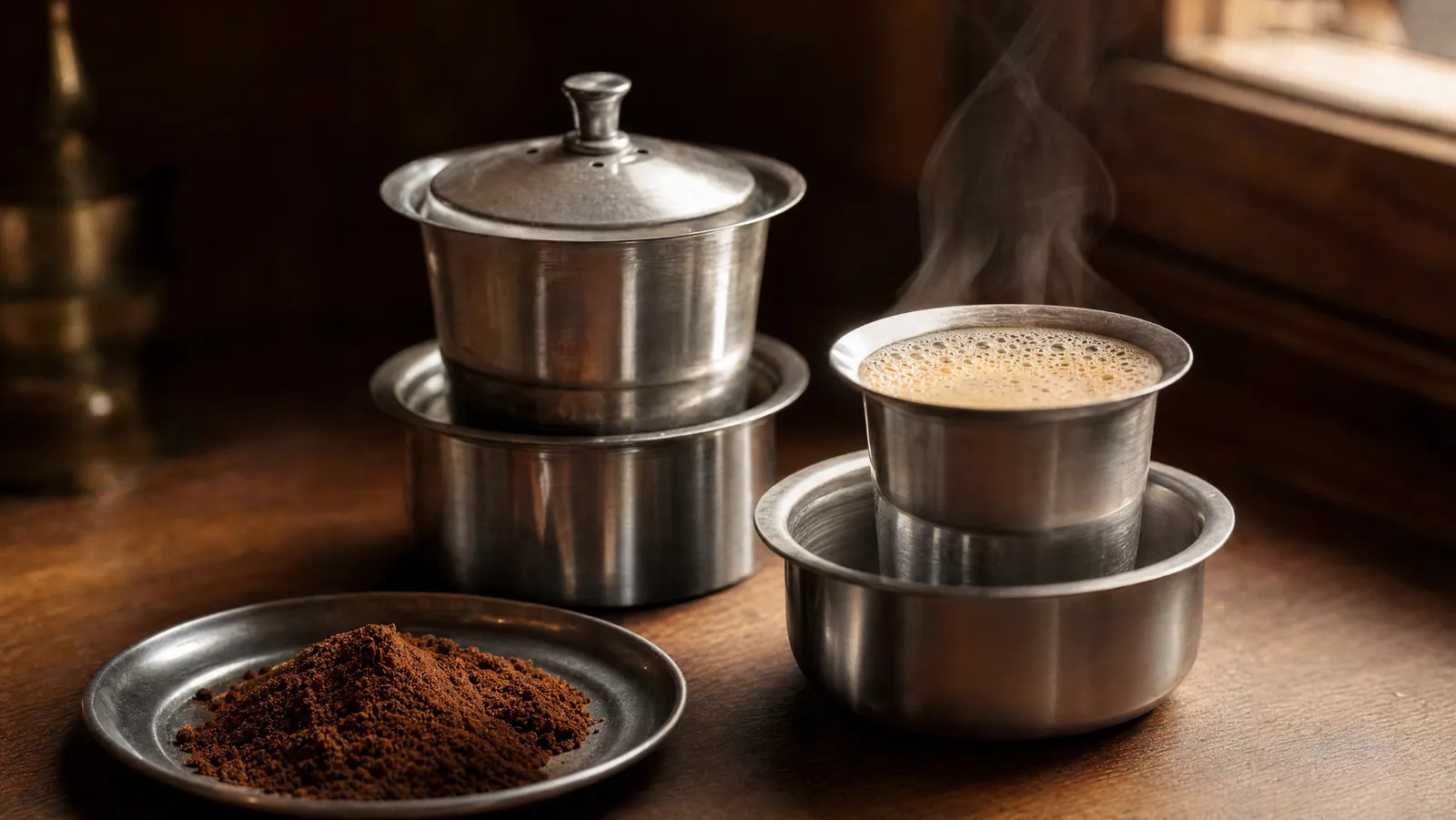
South Indian filter coffee is a thick coffee decoction brewed by gravity in a two-chamber stainless steel filter, then mixed with hot boiled milk and sugar at roughly one part decoction to three or four parts milk, and finished by pouring it between a tall tumbler and its wide-bottomed davara until it comes up frothy. No paper, no pressure, no pour technique to master.
Sweeter Grind is reader-supported. We may earn a commission on purchases made through links on this site, at no extra cost to you.
Wikipedia's entry on Indian filter coffee defines the drink as hot milk and sugar mixed with "the infusion obtained by percolation brewing of finely ground coffee powder with chicory in a traditional Indian filter." It is one of the few traditional coffee methods around the world where the serveware is part of the method, not a garnish.
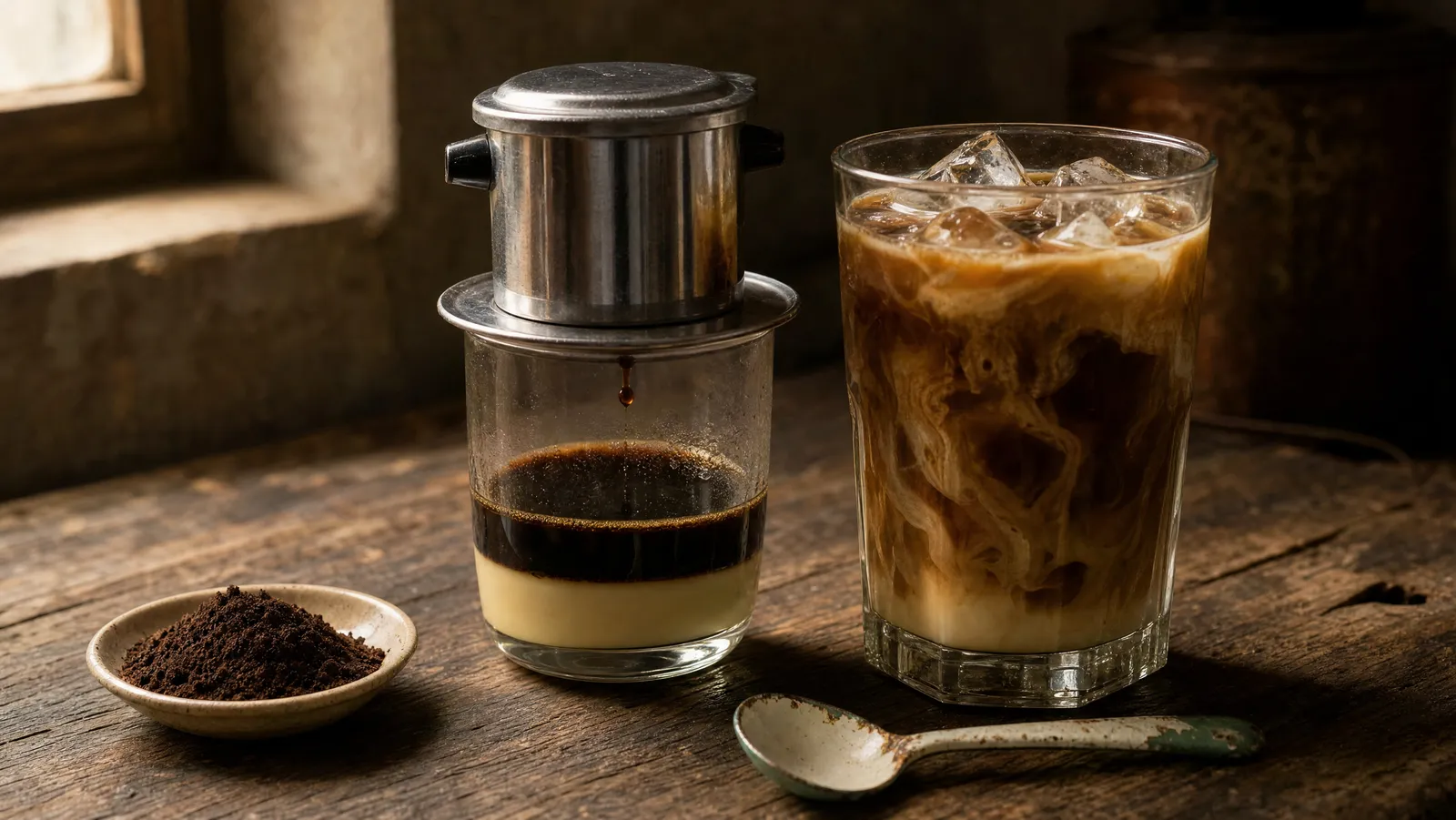
The closest cousin is making Vietnamese coffee with a phin: a small steel gravity filter, a dark robusta-leaning blend, a slow drip, sweetened milk underneath. Kaapi differs in four ways — the filter is slower, the dose is bigger, the milk is boiled rather than condensed, and the drink is aerated in the pour instead of layered in the glass.
What Makes the South Indian Coffee Filter Different
Two stainless steel cylinders stack. The upper chamber holds the coffee and has a perforated plate for a floor; the lower one catches what comes through. Between them is nothing — no gasket, no valve, no pump. You also get a lid and a pressing disc that holds the bed flat. That is the whole machine, and it helps to say what it is not:
- Not a pour-over. You do not pour continuously or control flow rate. You charge the chamber once and walk away.
- Not espresso. There is no pressure at all, which is why a fine grind does not choke it the way it would choke a drip cone.
- Closest to a percolation concentrate. The grounds sit wet a long time and the liquid works down slowly, so what lands below is dark and syrupy.
Every filter in this format works the same way, so the only decisions are capacity and price. The PAJAKA South Indian Filter Coffee Maker is a 250 ml unit PAJAKA lists at 4-6 cups — right for a household, about $12 as of November 2026. The Kitchen Mart stainless steel filter is the same two chambers and disc for about $10 as of November 2026, but publishes no capacity, so you will have to measure the chamber yourself before you can plan a dose.
The Coffee: Fine Grind, Dark Roast, and Chicory
The grind is fine. Wikipedia specifies "finely ground coffee powder" — in practice, finer than drip and a little coarser than espresso. Powdery between your fingers, but not so fine it packs into a brick. Start one step finer than a flat-bottom drip basket and adjust from the drip rate; our grind size guide places it against everything else you brew.
The roast is dark. Wikipedia describes Indian filter coffee as dark-roasted coffee mixed with chicory, which is part of why kaapi reads as bittersweet rather than bright, and why it does not disappear under boiled milk.
The chicory is not a filler to apologise for. Chicory is the roasted root of Cichorium intybus — Tasting Table identifies it as the subspecies sativum and a relative of endive, and Holland and Barrett calls the plant a member of the dandelion family, noting the root is roasted before use because it is not pleasant raw. It carries no caffeine: GoodRx states that pure chicory coffee is naturally caffeine free, and that a half-chicory, half-coffee cup has about half the caffeine of all-coffee. In the cup it adds body and a dark bittersweet edge — what you want in a drink about to be cut three-to-one with milk.
How much? Wikipedia puts coffee at 80-90% and chicory at 10-20% of the mixture. The ceiling is legal rather than cultural: as reported by Agro and Food Processing, India's regulator FSSAI requires coffee to be no less than 51% of a coffee-chicory mixture by mass and chicory no more than 49%, with both percentages on the pack. That gap is a live argument — The News Minute reported Karnataka growers demanding chicory be cut back, on the grounds that high-chicory blends suppress demand for coffee itself.
The shortcut is a pre-ground blend. The Cothas 454 g filter coffee powder states an 85% coffee to 15% chicory split at filter fineness, about $14 as of November 2026; Cothas describes its chicory as adding smoothness and gentle caramel notes, which is the maker's language, not a measurement. Because chicory is a real flavour decision, start with the 7 oz bag of the same blend at about $5 as of November 2026. Either way, pre-ground coffee stales fast and neither pack publishes a roast date.
For contrast, café de olla also puts something besides coffee in the cup, but it does it in the pot. Chicory is milled into the blend before you see it, so the percentage on the bag matters more than anything you do at the brewer.
Where Indian Coffee Comes From
A November 2025 Press Information Bureau document states that Karnataka, Kerala and Tamil Nadu together account for 96% of India's coffee production. The species split matters more for taste. Coffee Board figures reported by Kodagu First project India's 2025-26 crop at 4.03 lakh tonnes — 2.85 lakh tonnes robusta against 1.18 lakh tonnes arabica, so robusta is roughly 70% of the harvest. That is much of why kaapi tastes as it does, and why it survives being cut with milk. See arabica vs robusta explained and coffee growing regions and flavor profiles.
Brewing the Coffee Decoction
People get the decoction wrong by treating it like a brew. Four variables matter.
Dose and water. Samson Coffee House's South Indian filter brew guide uses 50 g of coffee to 250 ml of water and says that yields roughly 160 ml of decoction — 1:5 coffee to water by weight.
Press pressure. Firm, not packed. Whisk Affair's filter coffee recipe warns not to press too hard, because coffee powder then falls through the pores into the lower chamber, and a compacted bed can stall or channel around the edge.
Water temperature. Sources disagree here. Wikipedia and the INTACH heritage archive both describe boiling water being poured over the disc, while Whisk Affair's recipe calls for warm water rather than boiling and the Spicy Mango Kitchen filter coffee guide says boiling water scorches the grounds and makes the decoction bitter. We would pour just off the boil.
Time. Sources genuinely disagree, so we will not pick a number for you. Samson's guide allows about 15 minutes; Whisk Affair says 3-4 hours produces a properly thick decoction and notes you can pour at 15-20 minutes but it will not be very thick.
Good decoction is opaque, close to black, and heavy enough to coat the lower chamber as you swirl it.
The Milk: Boiled, Not Steamed
Kaapi milk is not steamed to a temperature. It is boiled — brought to a full rolling boil, 212°F / 100°C at sea level — then poured hot into the decoction.
Café technique does the opposite. Roughly 140°F / 60°C is the target in our guide to how to steam milk like a barista, because past that you cook the proteins and lose sweetness. Boiled milk crosses that line on purpose: it thickens slightly, takes on a faintly cooked sweetness, and stands up to a decoction that would flatten gently steamed milk. Use full-fat and use it hot — Whisk Affair's recipe calls for two cups of boiling hot milk poured onto the decoction, and we would treat lukewarm milk as the most likely reason a home kaapi tastes flat.
Published ratios run from 1:2 to 1:5 decoction to milk: Samson's guide serves 40 ml to 80 ml, Amyra Farms suggests 30 ml to 150 ml for a medium cup. Start at 1:3. Sugar goes in hot so it dissolves into the drink — a teaspoon per tumbler, because the chicory bitterness does work unsweetened drinkers may not expect.
The Davara Tumbler Pour
A davara — also spelled dabara or dabarah — is a wide, shallow, straight-sided dish, traditionally brass and now usually stainless steel, and the tumbler is the tall cup that sits in it. Pouring the coffee between the two, repeatedly and from a height, does three things at once: it aerates the drink into a light head of foam, cools it to drinkable, and mixes decoction, milk and sugar better than stirring. The INTACH heritage archive's entry on the coffee filter and davara set describes the pair as making it "possible for the patrons to aerate and froth the beverage, at the same time maintaining its warmth." Wikipedia likewise describes a metal tumbler inside the dabarah saucer, in which the coffee is cooled.
So the metalware is method, not decoration. Steel dumps heat fast, which is the point. A traditional steel davara tumbler set runs about $29 as of November 2026 for four pairs at 140 ml per tumbler. The downside: steel conducts both ways, so a fresh tumbler is too hot to hold by the body until you have poured it a few times.
How to Make South Indian Filter Coffee at Home
The sequence for two small tumblers, scaled from the ratios cited above.
Step 1: Load the upper chamber with fine-ground coffee
Measure 20-25 g of fine-ground coffee-and-chicory blend onto the perforated plate in the upper chamber — the dose for two 140 ml tumblers, scaled from the 50 g to 250 ml ratio in Samson Coffee House's brew guide. Shake the chamber so the bed sits level.
Step 2: Set the pressing disc firm but not packed
Place the pressing disc flat on the coffee and press until the grounds stop moving, then stop. Whisk Affair's recipe warns not to press too hard, because coffee powder then falls through the pores into the lower chamber, so flatten the bed rather than compact it — a level bed stops water finding one fast channel.
Step 3: Wet the grounds with a small first pour
Pour just enough hot water through the disc to darken and settle the whole bed, about 30 ml for this dose, then wait a minute. Water should be hot but off the boil — Whisk Affair's recipe calls for warm rather than boiling water, though Wikipedia's account of the method has boiled water poured straight over the disc. This swells them evenly so the main charge cannot punch through dry coffee.
Step 4: Fill the chamber and put the lid on
Top the upper chamber up with the rest of your hot water, 100-120 ml in total including the first pour, and fit the lid. Heat retention is most of what you still control. Do not stir, do not press again, do not lift the disc to look.
Step 5: Let the decoction drip undisturbed
Leave the filter somewhere warm and do not touch it for at least 20 minutes. Timing is where sources diverge: Samson's brew guide allows about 15 minutes, while Whisk Affair says 3-4 hours gives a properly thick decoction and pouring at 15-20 minutes gives something thinner.
Step 6: Boil the milk
Bring about 210 ml of full-fat milk to a full rolling boil, 212°F / 100°C at sea level, stirring so it does not catch, and pull it off the heat as it climbs the sides. Whisk Affair's recipe calls for boiling hot milk, so this milk reaches the tumbler hot.
Step 7: Mix decoction, milk and sugar
Combine roughly 35 ml of decoction with 105 ml of boiled milk per tumbler — a 1:3 ratio — and stir in a teaspoon of sugar while everything is hot. Published ratios run from 1:2 in Samson's guide to 1:5 at Amyra Farms, so 1:3 is a starting point.
Step 8: Pour between the tumbler and the davara
Pour the mixed coffee from the tumbler into the davara and back again, four to six times, from about 6 to 12 inches (15 to 30 cm) of height, keeping the receiving vessel tilted. This builds a light head of foam and brings the drink down to drinking temperature.
Troubleshooting Your Filter Kaapi
| Problem | Likely cause | Fix |
|---|---|---|
| Decoction weak and pale | Low dose, coarse grind, or pulled early | Move toward 1:5, grind finer, wait 20-30 minutes |
| Decoction harsh and bitter | Boiling water on the grounds, or high chicory | Let the kettle stop rolling; try a lower-chicory blend |
| Nothing dripping | Disc compacted the bed, or grind is espresso-fine | Lift the disc, break the surface, re-press lightly |
| Drains in two minutes | Grind too coarse, or bed not levelled | Grind finer; level the bed |
| Skin on the milk, or a scalded taste | Milk standing before it is poured, or catching on the pan | Heavy pan, stir continuously, pull it as it climbs, pour while hot |
| Too hot to drink | Not enough passes between tumbler and davara | Keep pouring — the cooling is the point |
Kaapi, Degree Coffee, and Madras Filter Coffee
Wikipedia gives only filter kaapi as the Indian name for the drink. Whisk Affair's recipe lists degree coffee, filter kapi, Mylapore filter coffee, Madras filter coffee, Madras kaapi, Mysore filter coffee and Kumbakonam degree coffee for the same thing, and most Indian filter coffee recipes online use several interchangeably.
The "degree" part is contested, and we will not adjudicate it. One widely repeated account, told by Deccan Herald, is that milk certified as pure with a lactometer was called degree milk, and coffee prepared with it became degree coffee. A second account, from the food historian Rakesh Raghunathan in The Better India, holds that degree is simply a measure of the quality and purity of the milk being used. Deccan Herald's piece notes that nobody has established how Kumbakonam got attached to the name, and that there is no original degree coffee shop in Kumbakonam itself.
The institutional history is better documented. Wikipedia's entry on the Indian Coffee House chain records that it began in 1957, when the Coffee Board's outlets were handed to its former workers after a campaign encouraged by the communist leader A. K. Gopalan; the workers formed Indian Coffee Workers' Co-operative societies, the earliest of them beginning in Bangalore on 19 August 1957. Around 400 outlets run today under 13 cooperative societies. The Culture Trip reports an earlier root — a first outlet called India Coffee House, opened by the Coffee Board in Churchgate, Mumbai, in 1936.
FAQ
Do I have to use chicory?
No, and plenty of Indian roasters sell unblended filter coffee. But chicory is doing real work: body and a bittersweet depth that survives being cut three-to-one with boiled milk. A pure decoction tastes thinner. Wikipedia's range for traditional blends is 10-20% chicory; FSSAI caps it at 49%.
Can I make this in a pour-over cone or a French press instead?
You can make a strong concentrate that way, but it is a different drink. A cone packed with coffee this fine will clog or channel, and it gives you a brew rather than a decoction — the Indian filter's character comes from a fine bed sitting wet for 20 minutes or more under gravity alone. A heavy French press dose gets closer on strength, not texture.
How fine should the grind be, exactly?
Finer than drip, coarser than espresso. Wikipedia only says finely ground coffee powder and we found no published micron range, so dial it by drip rate: if the chamber drains in two minutes, go finer; if nothing moves after ten, go coarser.
How long does decoction keep, and can I refrigerate it?
Decoction is a concentrate, and the method is built around a lower chamber holding more than one serving, so a morning batch drawn on through the day is normal practice. Refrigerate what you are not drinking soon, use it the same day, and reheat the milk rather than the decoction. We found no published shelf-life figure, so treat it as kitchen judgement.
Does the davara actually change the coffee, or is it just tradition?
It changes it. The INTACH heritage archive describes the filter-and-davara pair as letting drinkers aerate and froth the beverage while keeping it warm — foam, mixing and cooling in one motion. A ceramic mug gives you none of the three.
Where to Take This Next
Filter kaapi is one of the cheapest good coffee methods there is: a steel filter for about $10-12 as of November 2026, a bag of pre-ground blend for about $5, whatever milk is in the fridge. What matters is not the gear but the restraint — press lightly, pour water that is hot rather than boiling, then leave it alone.
If you would rather zoom out, our tour of the world's coffee traditions maps how different cultures solved the same problem — strong coffee, cheap gear, milk or sugar to carry it — and the Indian filter is one of the most elegant answers anyone reached.

PAJAKA South Indian Filter Coffee Maker, 250 ml (4-6 Cup)
A traditional two-chamber Indian coffee filter in stainless steel with a perforated metal filter plate, so there is no paper to buy and nothing to throw away. At 250 ml, listed as 4-6 cups, it makes enough decoction for a household rather than a single tumbler. This is the size we would buy if more than one person in the house drinks kaapi.

Kitchen Mart Stainless Steel South Indian Filter Coffee Drip Maker
The cheapest honest way to find out whether you like brewing kaapi at home: a 100% stainless steel filter in the traditional South Indian drip format, with the same two chambers and pressing disc as every other version of this brewer. Buy it, make decoction for a month, and upgrade only if you decide you want more capacity.

Traditional Steel Davara Tumbler Set, Set of 4 (140 ml)
Four tumbler-and-dabara pairs in stainless steel, 140 ml per tumbler. The davara is not decoration: the wide, shallow dish is what you pour into and out of to aerate the coffee and bring it down to drinking temperature. If you want to make kaapi the way it is actually served, this is the piece most Western kitchens are missing.

Cothas Traditional South Indian Speciality Blend Filter Coffee Powder, 454 g (85% Coffee / 15% Chicory)
A 454 g pack of pre-ground coffee and chicory at a stated 85/15 split, already milled to filter-coffee fineness. Buying the blend pre-ground is the shortcut around the hardest part of making kaapi in a Western kitchen, which is sourcing chicory and getting the grind right. Cothas sells it as a South Indian heritage blend.

Cothas Coffee Speciality Blend of Coffee and Chicory, 7 oz
The same Cothas coffee-and-chicory speciality blend in a 7 oz bag. This is the one to buy first. Chicory is a real flavour decision, not a technicality, and a small bag lets you find out whether you like it before you commit to a 454 g pack of pre-ground coffee.