How to Make Cuban Coffee: Cafecito, Colada and Espuma
 Tommie Chaney·
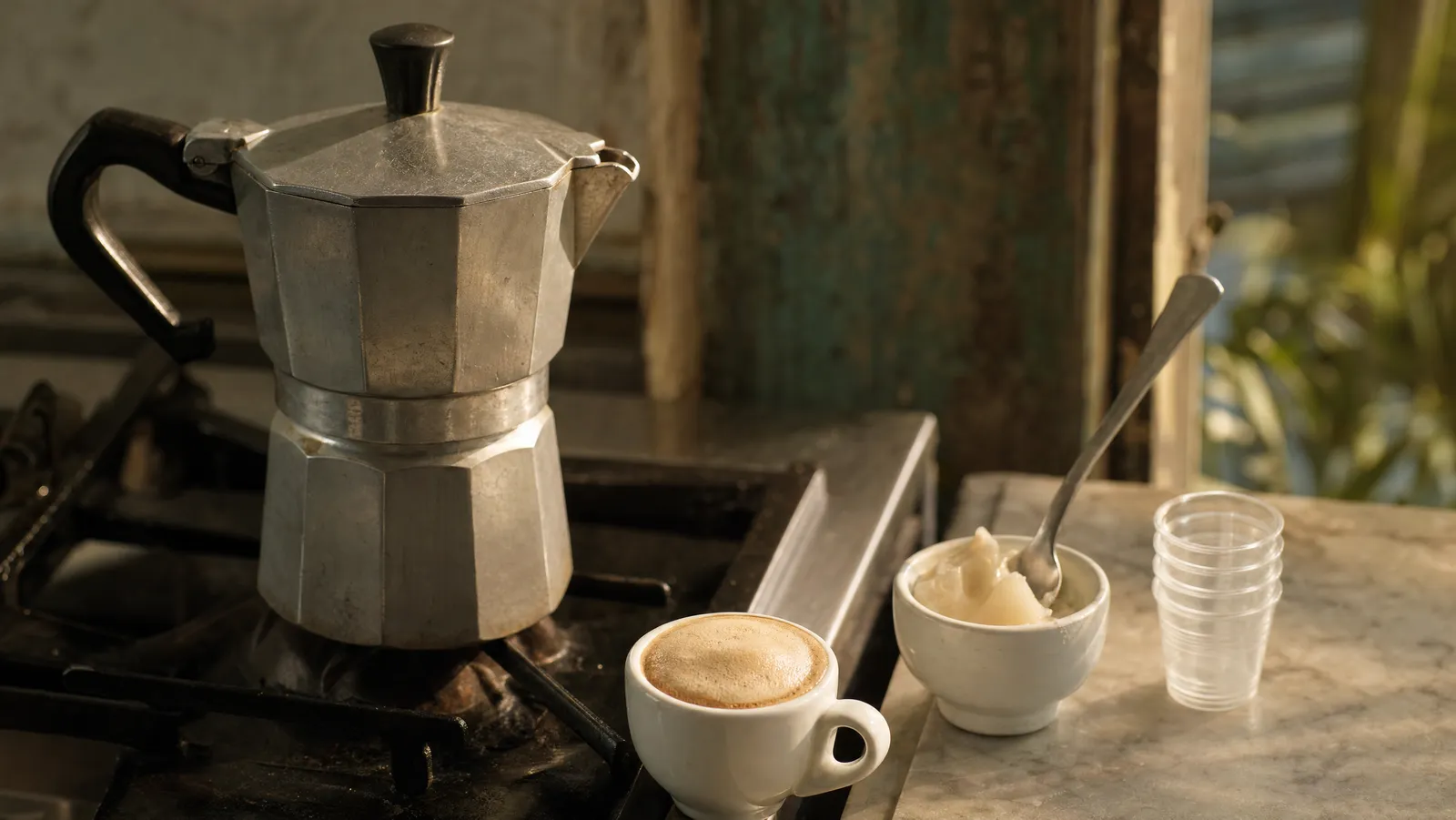
To make Cuban coffee: brew fine-ground dark roast in a stovetop cafetera, put 1 heaping teaspoon of sugar per ounce of finished coffee into a cup, catch about a teaspoon of the first coffee out of the pot, and whip the two into a pale, spoonable paste. Pour the rest of the coffee into it. That paste is the espuma, and it is the entire trick.
Sweeter Grind is reader-supported. We may earn a commission on purchases made through links on this site, at no extra cost to you.
Everything else — cafecito, colada, cortadito, the stack of thimble-size cups — is detail layered on that one move. It is also one of the few corners of how coffee is made around the world where sugar is structure rather than seasoning: beaten with hot coffee, it becomes the drink's crema. If a moka pot is new to you, read how to make moka pot coffee first — this recipe assumes that technique and changes only what happens in the cup.
What Cuban Coffee Is, and What Cafecito Means
A cafecito — also called café cubano — is a small sweetened shot of moka-brewed dark roast topped with espuma. Wikipedia's entry describes Cuban espresso as an espresso shot which is sweetened, traditionally with natural brown sugar whipped with the first and strongest drops; Barista Magazine calls it strong and especially sweet, dark Italian-style roasts brewed stovetop in a moka pot. Serving size is not standardized: the University of Miami's cafecito guide allows two to three fluid ounces in a demitasse, while a cafecito from a walk-up window is often closer to an ounce.
It is not espresso in the technical sense: a moka pot builds a fraction of the pressure an espresso machine does, so what you get is a concentrated, syrupy brew rather than a true shot — closer to how to make espresso without an espresso machine.
Barista Magazine's history credits José Antonio Gelabert with bringing coffee plants to Cuba in 1748 — the account usually given, though sources disagree over whether the first seeds came from Santo Domingo or Haiti, and Cuban historians say the details cannot be pinned down precisely. The espuma technique is harder to date — none of our sources names an inventor, or even a decade — so treat confident origin stories with suspicion.
Espuma: The Sugar Is the Crema
This is the only genuinely difficult part, so it gets the paragraphs.
You whip the first liquid out of the pot, not the finished coffee. The first dark drops to climb the center post are the most concentrated thing the brew will produce — the first pass of water through dry grounds. Both Barista Magazine and Wikipedia specify those first drops rather than the finished pot, and recipe guides stress catching them before the brew runs pale. Later coffee is thinner and cooler, and whips into a slack puddle.
The whipping does two jobs. It dissolves far more sugar than cool coffee would hold, giving you syrup instead of grit, and it beats air in so the result holds its shape. Barista Magazine adds a chemical note — the high temperature of the espresso hydrolyzes the sucrose — which is why whipped sugar tastes different, not merely sweeter.
You are looking for something specific: pale caramel rather than brown, thick enough to hold a soft peak when the spoon lifts, closer to wet frosting than to syrup.
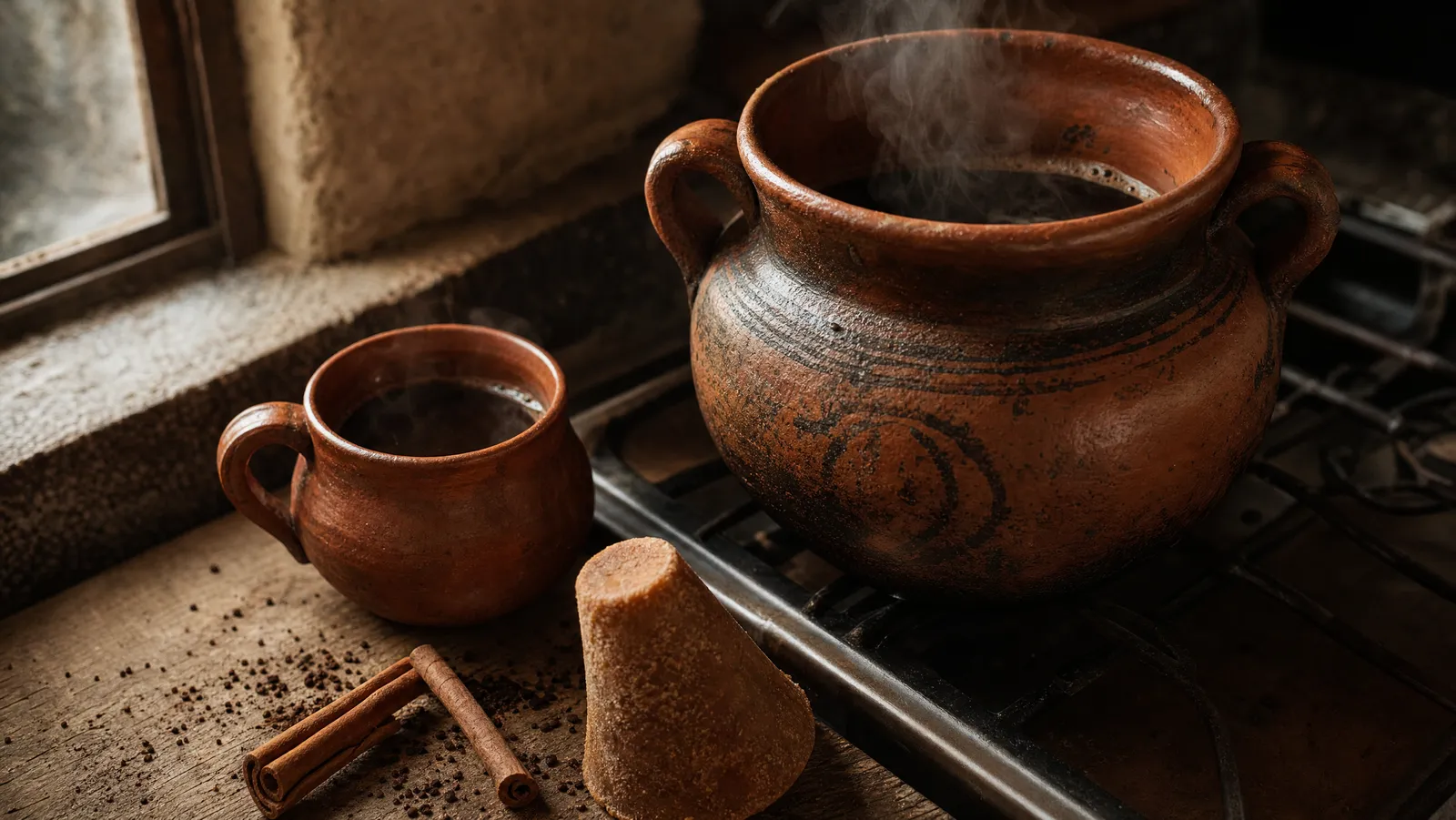
The physics are the ones behind Greek frappé and freddo espresso — sugar, coffee and air beaten until the mix holds structure — run hot instead of cold. Compare café de olla too: there the piloncillo is simmered into the water before the coffee goes in, so the sugar flavors the brew instead of sitting on top as foam. Same two ingredients, opposite order of operations.
How much sugar. Published amounts vary enormously: about half a tablespoon per serving in the University of Miami guide, a couple of tablespoons in Barista Magazine, 2 tablespoons for a two-serving batch in KitchenAid's espresso-machine recipe, and, by some accounts, as little as 3 to 4 teaspoons for a whole six-cup pot — while other published six-cup recipes call for four tablespoons or a quarter cup. We sit in the middle, at roughly 1 heaping teaspoon per ounce of finished coffee:
| Cafetera | Rough yield | Sugar for the espuma | Serves |
|---|---|---|---|
| 1 cup | 1 to 2 oz | 2 tsp | 1 |
| 3 cups | about 6 oz | 2 tbsp | 2 to 3 |
| 6 cups | about 9 to 11 oz | 3 to 4 tbsp | 4 to 6, or one colada |
Those yields are estimates, because an espresso cup is not a standard unit: Bialetti's Moka Express guide lists its 1-cup pot at 60 ml and its 6-cup at 340 ml, while IMUSA specifies 1.5 oz per cup on its electric model. Measure your own pot once with water.
Demerara or another natural brown sugar is traditional, and Wikipedia's entry lists demerara among the main ingredients. White sugar whips fine and tastes cleaner. Halve the sugar and you get good coffee with a thinner foam — a fair trade, but no longer quite a cafecito.
The Cuban Coffee Family, in One Table
Most confusion here is really confusion about names. All four drinks start from the same sweetened moka brew.
| Drink | What it is | Typical serving | Usual moment |
|---|---|---|---|
| Cafecito / café cubano | The sweetened shot with espuma | 1 to 3 oz demitasse | After lunch or dinner |
| Colada | 3 to 6 shots to share, with a stack of tiny cups | Takeaway cup, 4 to 12 oz | Mid-afternoon, office or job site |
| Cortadito | Cafecito cut with scalded or steamed milk | Small cup, roughly half and half | Morning or afternoon |
| Café con leche | Mostly hot milk with a cafecito stirred in | Mug or glass | Breakfast, with buttered Cuban toast |
Cortadito means little cortado: Barista Magazine describes an equal balance of milk and espresso, and it is the cafecito's sweetness and whipped espumita — which Barista Magazine says set these Miami drinks apart from cortados elsewhere — that carry into it. Wikipedia adds that a cortadito is pre-sweetened. The University of Miami guide treats the ratio as personal — 50/50 or 75/25 — says many people prefer evaporated milk, and to order it oscuro for more coffee than milk.
Café con leche inverts the proportions: espresso poured into hot milk to the darkness you want. The University of Miami guide pairs it with tostadas — buttered toasted Cuban bread, for dunking.
Colada: The Order That Comes With a Stack of Cups
A colada is not a large coffee for one person. It is a batch built to be split, and the etiquette is the point.
Wikipedia describes 3 to 6 shots of Cuban-style espresso in a Styrofoam cup with small plastic demitasses, customary at workplace breaks. Barista Magazine calls the colada the mother of Miami Cuban coffee, served in a 12-ounce styrofoam cup with about six tiny cups — enough for six people. The University of Miami guide is blunt: coladas are meant to be shared among a group.
So here is the social contract. You buy the colada, carry it back, and pour for everyone: a thimble each, handed round, drunk standing up. Keeping the big cup to yourself reads the way draining a shared office pot does, only worse, because the little cups were handed to you on the assumption you would use them. Want coffee for yourself? Order a cafecito.
Most Americans meet these drinks at a ventanita, the walk-up window. Barista Magazine translates it as little window and credits Felipe Valls Sr. with installing the first ones at his restaurants after moving to Miami in the 1960s.
At home a colada is a full six-cup cafetera poured into one vessel with the espuma whipped in. To scale a batch and hold the strength steady, use our brew ratio calculator rather than eyeballing it.
The Grounds: Dark, Fine, and Usually Not From Cuba
Buy a brick labelled Cuban-style, read the back, and you will notice it does not say Cuba anywhere.
Wikipedia names Café Bustelo, Café La Llave and Café Pilón as the popular brands for the dark roasts used in this coffee, and Barista Magazine names the same three. Reporting by Emily Williams for The Miami Herald's In Cuba Today, republished in The Miami Student in September 2016, explains why they are a style rather than an origin: the embargo begun under President John F. Kennedy restricts trade with Cuban state-owned and operated businesses, and Café Bustelo is advertised as a Cuban-style espresso since its beans, too, are not harvested on the island. The same reporting describes the narrow opening — on April 22, 2016 the State Department added coffee to the list of products Cuban entrepreneurs may export to the US, after which Nespresso USA received a licence from the Office of Foreign Assets Control and sold Cafecito de Cuba as a limited edition — and quotes Havana professor Karell Acosta Gonzalez on the catch: all exports must go through state-owned companies.
Grind fine, but not espresso-fine. Bialetti's Moka Express guide warns against coffee ground too fine, which it says will taste burnt. The bricks arrive pre-ground fine — Café Bustelo's own FAQ says its espresso-style coffee is ground very finely and names both espresso machines and the stovetop moka pot — so the grind is the one variable you cannot adjust, only the heat.
These dark Latin-style blends are widely said to carry some robusta for body and heavier foam, though the bricks rarely disclose the species split — arabica vs robusta explained covers what each brings. The Café Bustelo 6 oz brick runs about $8 as of November 2026 and is the sensible first purchase; the Café La Llave four-pack is about $20 as of November 2026 and cheaper per ounce, but pre-ground coffee fades once the seal is broken, so 40 oz is a commitment, not a bargain.
Which Cafetera to Buy
The pot is not where the skill lives: any stovetop moka pot makes this coffee.
For most people the IMUSA 6-cup stovetop cafetera at about $13 as of November 2026 is the whole answer: six espresso-size cups is a round of cafecitos or one colada, and the burner knob gives you full control over the end of the brew, when scorching happens. The trade-off is the material — IMUSA names gas, ceramic and electric coil stovetops, and does not claim induction.
Brewing for one, the 1-cup IMUSA pot is about $6 as of November 2026, but it makes the espuma harder: a pot yielding an ounce or two gives you a very short window to catch the first drops. If the stovetop is the problem, the IMUSA electric maker is about $40 as of November 2026 and states 1.5 oz per cup, so you know your yield — but you give up heat control, which is the one control that matters.
How to Make Cuban Coffee in a Cafetera
This is the cafecito method, scaled to a 3-cup or 6-cup pot.
Step 1: Fill the boiler with cold water up to the valve
Unscrew the pot and fill the lower chamber with cold water to just below the safety valve, never above it. Bialetti's Moka Express guide and the University of Miami's cafecito guide agree: water just to the valve.
Step 2: Fill the basket level and do not tamp it
Drop in the funnel basket, spoon in fine-ground dark roast until it is level with the rim, brush the edge clean so the pot seals, and leave the bed loose. Bialetti's own instructions say to fill the funnel and not to tamp it: a tamped bed raises the pressure the boiler must overcome, which makes for a bitter cup and strains a pressure vessel.
Step 3: Assemble the pot and set it over medium heat
Screw the top onto the base firmly, holding the body rather than levering on the handle, and set the pot over medium heat with the flame no wider than its base. Bialetti's guide warns that if the heat is too high, coffee may have a burnt taste — an unrecoverable mistake.
Step 4: Put the sugar in a cup while the pot heats
Measure the sugar into a small cup or metal pitcher now, before any coffee appears — about 1 heaping teaspoon per ounce of expected yield, so 2 tablespoons for a 3-cup pot, 3 to 4 for a 6-cup pot. You get seconds to catch the first drops, so it has to be waiting.
Step 5: Catch the first teaspoon of coffee
The moment the first dark coffee rises up the center post, lift the pot off the burner, spoon about a teaspoon of that coffee onto the sugar — a little more if you measured out several tablespoons, since too little liquid will not whip — and set the pot straight back on the heat. Those drops are the most concentrated the brew will give you.
Step 6: Beat the sugar and coffee into espuma
Beat the mixture hard against the side of the cup with a teaspoon for 30 to 60 seconds — some published recipes call for up to two minutes — until the grit is gone and you have a pale caramel paste thick enough to hold a soft peak. If it still pours like syrup, keep going.
Step 7: Pull the pot off the heat at the gurgle
Take the pot off the burner as soon as the upper chamber is full and you hear the gurgle — that is steam, not water, coming through the grounds. Bialetti's guide notes that a hazel brown foam appears seconds before the coffee is done, and says to remove the pot then.
Step 8: Pour the coffee into the espuma and serve immediately
Pour the brewed coffee slowly into the cup holding the espuma, stir once gently to lift the foam, then divide it among warmed demitasse cups. The espuma should rise and sit on top as a tan crema. Serve it now — it neither keeps nor reheats.
Troubleshooting
| Problem | Likely cause | Fix |
|---|---|---|
| Espuma stays runny | Coffee taken too late, or too little sugar | Catch the very first drops; 1 heaping tsp sugar per oz of yield |
| Burnt or metallic taste | Heat too high, or grind too fine | Medium heat, flame no wider than the base, grind a step coarser |
| Bitter and harsh | Tamped basket, or pot left on past the gurgle | Fill the basket loose and level; pull the pot when it gurgles |
| Sputtering and spitting | Pot left on the heat after the water ran out | Remove at the gurgle — spitting is steam, not coffee |
FAQ
Can I make Cuban coffee with an espresso machine instead of a cafetera?
Yes, and that is how most ventanitas do it. Barista Magazine describes the colada as usually made on an espresso machine at the window, with the first few drops whipped into sugar, often in a small pitcher. The technique is identical.
Why does my espuma stay runny no matter how hard I whip?
Almost always the coffee, not the whipping. Coffee spooned out after the pot has run a while is too dilute and too cool to carry that much sugar. Lift the pot at the very first drops, use a small cup so the mixture is not spread thin, and start from about 1 heaping teaspoon of sugar per ounce of yield.
Is a colada just a big cafecito?
Not in practice. Wikipedia describes a colada as 3 to 6 shots in a Styrofoam cup with small plastic demitasses, customary at workplace breaks. The coffee is the same as a cafecito; the order is a round for the group, and the little cups are the instruction.
Is Cuban coffee actually grown in Cuba?
Usually not, and the brands do not claim it is. Emily Williams's report for The Miami Herald's In Cuba Today, republished in The Miami Student, notes that Café Bustelo is advertised as Cuban-style espresso because its beans are not harvested on the island, and that the embargo begun under President Kennedy restricts trade with Cuban state-owned businesses. The same reporting says coffee was added to the State Department's list of permitted exports from independent Cuban entrepreneurs on April 22, 2016, which let Nespresso USA obtain an OFAC licence for a limited-edition Cuban coffee.
Where to Take This Next
What is worth carrying away from a cafecito is not the recipe, which is four ingredients and a spoon. It is that sugar can be a brewing variable rather than an afterthought — whipped into foam here, simmered into the water in a Mexican clay olla, beaten cold in a frappé.
If that is the thread you want to pull, our guide to coffee culture around the world maps the rest of it. Tonight, do the simple thing: fill the boiler to the valve, leave the grounds loose, and have the sugar waiting before the first drop lands.

IMUSA Aluminum Stovetop 6-Cup Espresso Maker (B120-43V)
The plain aluminum cafetera you see on Cuban-American stovetops, in the six-espresso-cup size that matches how this coffee is actually drunk. IMUSA lists it as brewing six espresso-size cups by the stovetop moka method, which is enough for a round of cafecitos or one shared colada. Buy this if you want the traditional pot and nothing else, and you are brewing for more than yourself.

IMUSA 6 or 3 Cup Electric Espresso Maker with Cool-Touch Handle, Black
A countertop version of the same moka mechanism, with a detachable base instead of a burner. IMUSA builds it for 6 or 3 espresso cups and specifies 1.5 oz per cup, so a full pot is about 9 oz, which is colada territory. The listing names Cuban coffee directly among its intended uses alongside Italian coffee and moka, and it is the pick for anyone without a cooperative stovetop.

IMUSA USA B120-41V Aluminum Stovetop Espresso Coffeemaker, 1 Cup
The single-cup cafetera, for one person making one cafecito. It is cast aluminum with a polished exterior, a cool-touch handle, a flip-top lid and a pour spout, and it needs no electricity. The listing names Cuban coffee among its intended uses. At this price it is less an appliance than a utensil, and it is the cheapest honest way into this drink.

Cafe Bustelo Espresso Coffee, 6 Ounce Brick
The vacuum-packed yellow brick that introduced most Americans to this style of coffee. Wikipedia names Bustelo, along with Cafe La Llave and Cafe Pilon, among the popular brands for the dark roasts used in Cuban espresso, so this is the default rather than a discovery. The 6 oz size is the right first purchase: enough for a couple of weeks of cafecitos without committing to four bricks.

Cafe La Llave Espresso Ground Coffee, Dark Roast, 10 oz (Pack of 4)
Four vacuum-sealed 10 oz bricks, which is the buy for a household that makes cafecito daily rather than occasionally. The listing names espresso machine, moka pot and drip among supported brewing styles and describes a full-bodied Cuban-style espresso flavor, and the coffee is roasted in Los Angeles by the Gavina family, whose listing states over 140 years of family coffee history. Per ounce it is the cheapest coffee on this page.