How to Sweeten Iced Coffee (Why Granulated Sugar Never Dissolves)
 Tommie Chaney·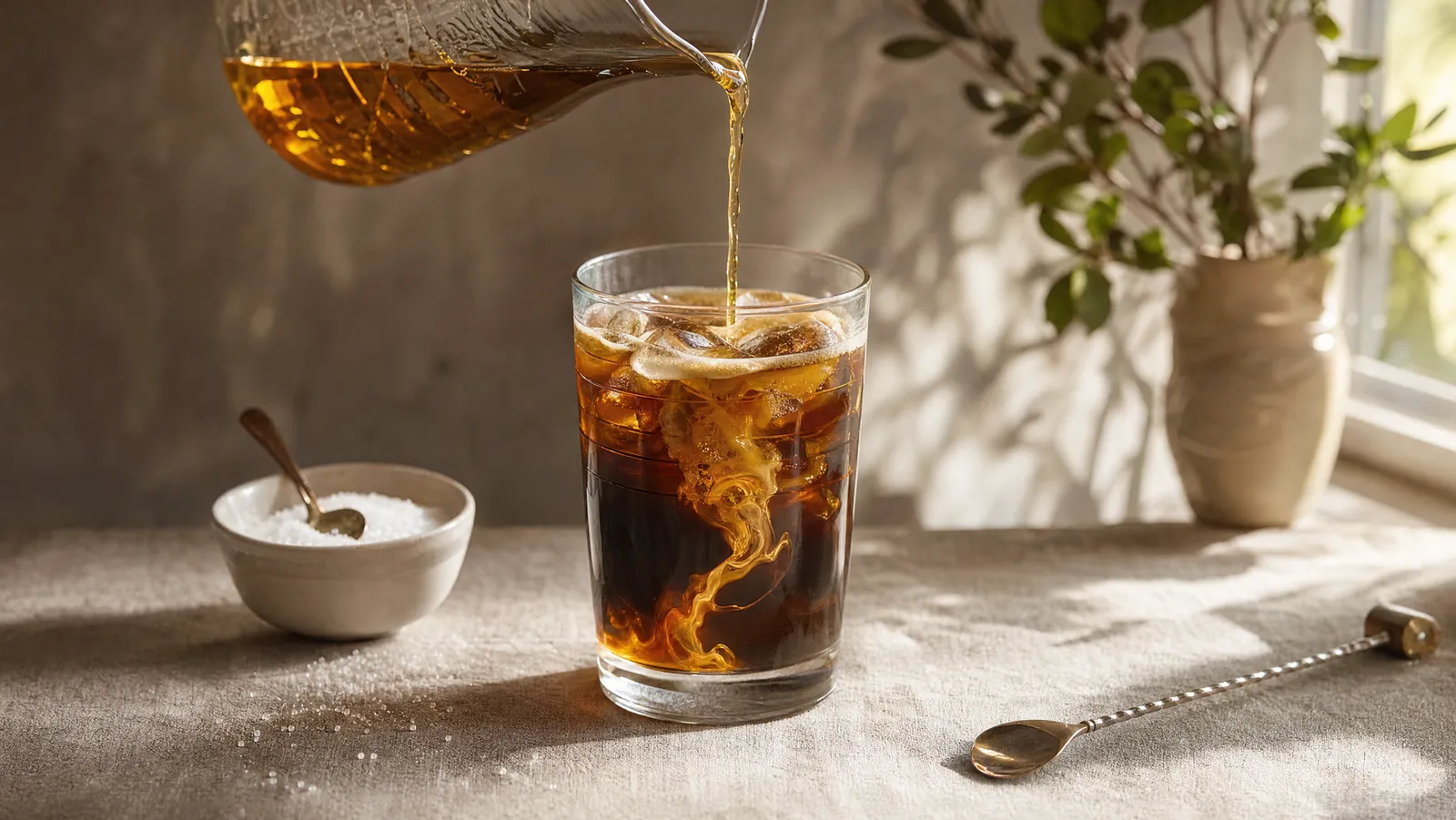
Affiliate disclosure: Sweeter Grind is a participant in the Amazon Services LLC Associates Program. We may earn commissions on qualifying purchases at no extra cost to you.
You stirred for a full minute and there is still a sand dune at the bottom of the glass.
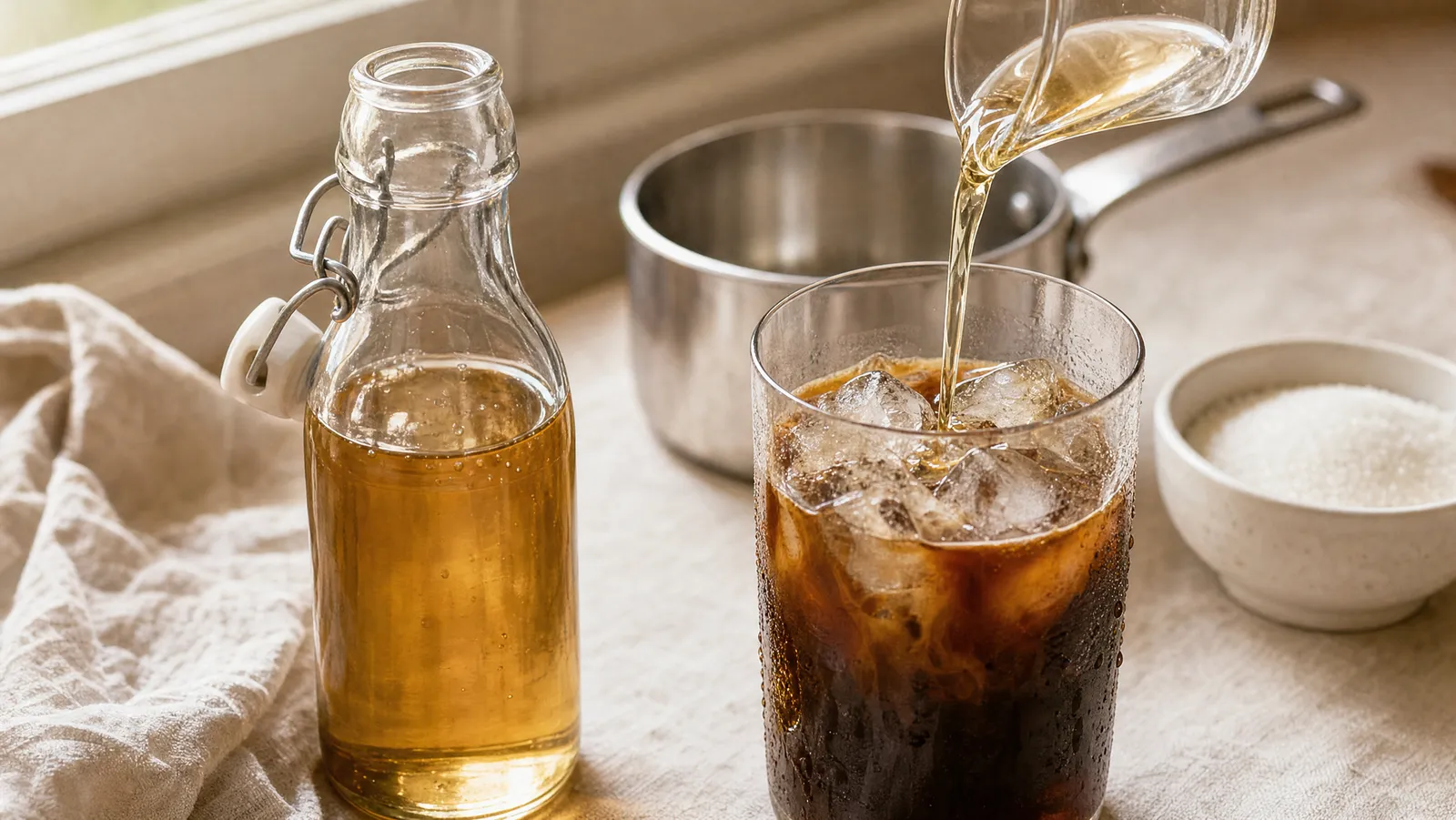
The way to sweeten iced coffee is to add sugar that is already dissolved. Pour 1 to 2 tablespoons of 1:1 simple syrup into a 12 oz glass, stir it into the coffee before the ice goes in, and you are done. Dry granulated sugar spooned into a cold drink will not get there, no matter how long you work the spoon.
That one swap is the move behind nearly every sweet drink on a cafe menu. If you are rebuilding a whole drink rather than just fixing the sugar, our guide to coffee shop drinks at home covers the rest of the structure. This piece is only about the sweetener: what dissolves cold, how much to use, and what each option does to the coffee underneath.
Why granulated sugar won't dissolve in iced coffee
Two things are going on, and the one people blame is the wrong one.
The first is capacity, and it barely matters. Standard chemistry solubility tables put cane sugar at about 179 grams per 100 grams of water at 0°C, roughly 204 grams at 20°C, and nearly 487 grams at 100°C. Solubility clearly falls as water cools, and it falls a lot. But 179 grams per 100 grams of cold water is still a ludicrous quantity of sugar. The teaspoon or two in your glass is nowhere near that ceiling.
The second factor is rate, and that is the real answer. The American Chemical Society's middle school chemistry lesson on temperature and dissolving puts it this way: heating adds energy, that energy increases molecular motion, and the extra motion brings more water molecules into contact with the solute and lets them pull on it with more force — so dissolving speeds up. Chill the water and that process slows down hard. The sugar in your iced coffee would dissolve eventually. It will not dissolve in the thirty seconds you are willing to stand there stirring, and while it waits it settles into a layer next to the ice that is chilling it further.
So the fix is not more stirring or finer sugar. It is dissolving the sugar somewhere hot and pouring the result into the glass.
Simple syrup: the default fix
Simple syrup is sugar that has already done the hard part. The standard is 1:1 by weight, so 100 g of sugar to 100 g of water, heated until clear or shaken cold until the crystals vanish. A rich syrup is 2:1, which works out at roughly 1.35 times as sweet gram for gram — not twice — and dilutes your coffee less.
Our full walkthrough on simple syrup for coffee covers both ratios, the no-cook method, and how to stop it crystallizing in the bottle. The short version:
- 1:1 syrup, 1 to 2 tablespoons per 12 oz. Half of what you pour is water, so you need more volume than you would use of dry sugar.
- 2:1 rich syrup, 2 to 3 teaspoons per 12 oz. Better for iced drinks, because you add less liquid to a glass that ice will water down anyway.
- Keep it in a clean sealed bottle in the fridge. A swing-top bottle with a narrow neck pours a cleaner stream than a mason jar.
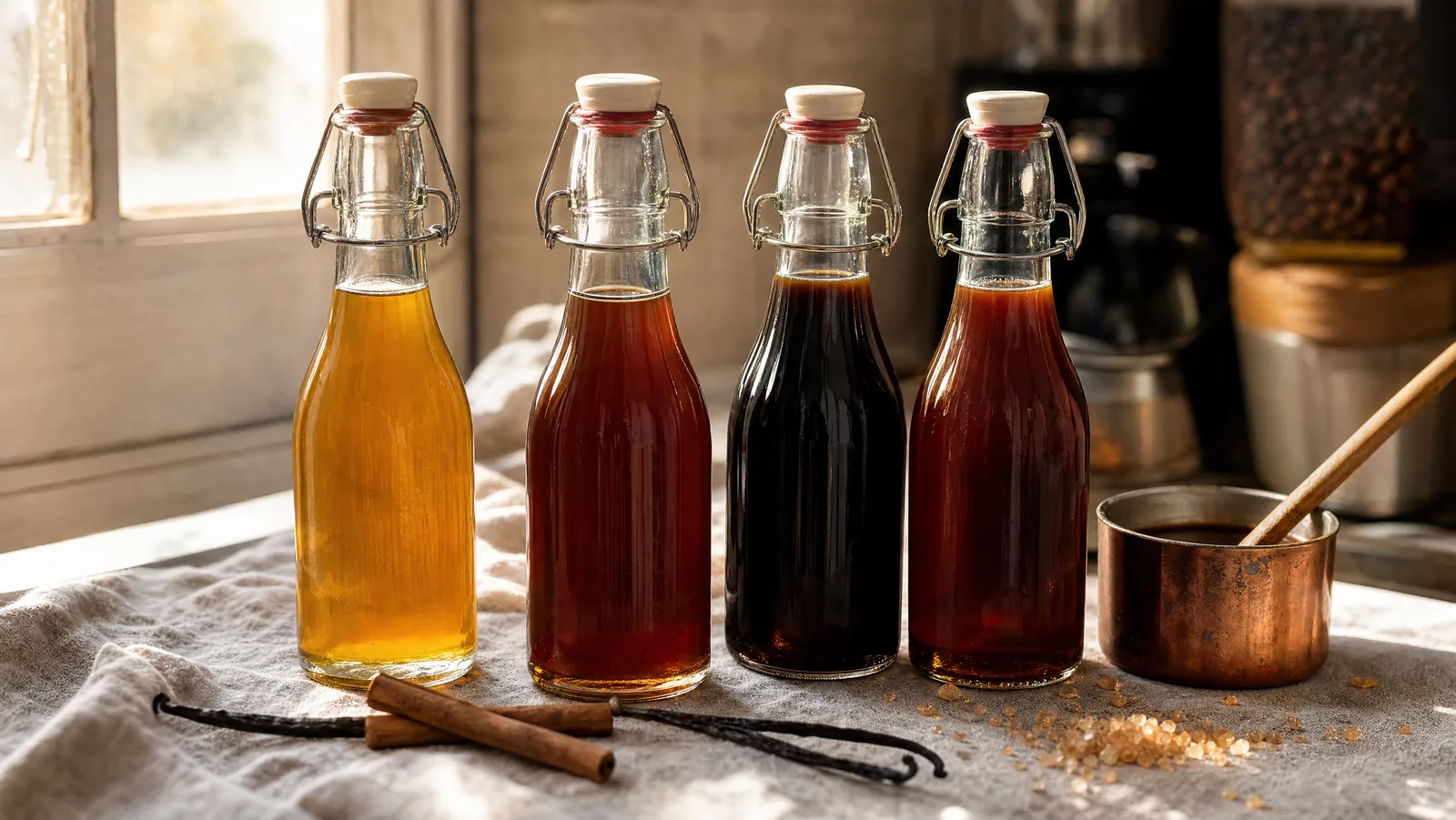
Flavored syrups work identically, since they are simple syrup with something steeped into it. If you want vanilla, brown sugar cinnamon, or something seasonal, our flavored syrup recipes use the same base. Store-bought bottles are fine too, and they are the easiest upgrade for anyone who is not going to stand at a stove.
The hot-splash trick, when you have no syrup
Put the sugar in the empty glass, add 1 to 2 tablespoons of hot water or hot coffee, and stir until the liquid is clear with no grit on the spoon. Then add the cold coffee, then the ice. The hot volume is small enough that it will not warm the drink meaningfully.
This rescues an iced coffee you have already poured, too. Decant an inch of it, heat that inch, dissolve the sugar in it, pour it back.
Sweetener by sweetener: what works in cold coffee
| Sweetener | Dissolves cold? | Start here per 12 oz | Tastes like |
|---|---|---|---|
| 1:1 simple syrup | Already dissolved | 1 to 2 Tbsp | Clean sweet, no flavor of its own |
| 2:1 rich syrup | Already dissolved | 2 to 3 tsp | Same, denser, less dilution |
| Store-bought flavored syrup | Already dissolved | 1 to 2 Tbsp | Vanilla, caramel, hazelnut |
| Granulated sugar | No, not in a usable time | Use the hot-splash trick | Fine dissolved, gritty if not |
| Superfine or caster sugar | Partly, with real stirring | 1 to 2 tsp | Identical to granulated |
| Brown sugar syrup | Already dissolved | 1 to 2 Tbsp | Molasses, toffee |
| Honey, thinned 1:1 | Only once thinned | 1 to 2 Tbsp | Floral, assertive, varies by honey |
| Maple syrup | Yes, already a syrup | 1 to 2 Tbsp | Woody and caramelized |
| Sweetened condensed milk | Yes, with stirring | 1 to 2 Tbsp | Rich dairy sweet, sweetens and creams |
| Agave nectar | Yes, thin and pourable | 2 to 3 tsp | Neutral-ish, faintly vegetal |
| Liquid stevia or monk fruit | Yes, it is a liquid | A few drops, then taste | Sweet with a lingering edge |
| Erythritol, dry | Poorly, and it recrystallizes | Make it into a syrup first | Sweet with a cooling finish |
| Allulose syrup | Yes | 1 to 2 Tbsp | Closest of the substitutes to sugar |
On superfine or caster sugar: smaller crystals have more surface area, so they do dissolve faster than granulated. They still do not dissolve fast in a cold drink. It is an improvement, not a solution.
Honey, maple, condensed milk, and brown sugar
Honey needs thinning before it goes near ice. The FAO notes that raising honey's temperature lowers its viscosity — a phenomenon it calls widely exploited in industrial honey processing, where thick honey otherwise slows flow during pumping, settling, filtration and bottling. One 2022 study of industrialized honey in Agroindustrial Science measured mean absolute viscosity falling from roughly 7,430 mPa·s at 20°C to about 267 mPa·s at 60°C. Cold honey is thick enough to sit in a rope at the bottom of the glass. Stir it 1:1 with hot water, cool it, treat it as a syrup, and go lighter than you think.
Maple syrup is the easy one. Already pourable at fridge temperature, it mixes in with ordinary stirring, and its woody caramelized note suits darker roasts and oat milk better than a bright washed Ethiopian.
Brown sugar should be cooked into a syrup rather than spooned in dry. Same 1:1 ratio, same method. The molasses depth is good in iced lattes and slightly odd in black iced coffee.
Sweetened condensed milk is the Vietnamese-style route, and it sweetens and creams at once. Saveur's recipe for ca phe sua da builds one serving from 10 g of medium-finely ground coffee and 1 tablespoon (18 g) of sweetened condensed milk, with boiling water dripped onto the milk through a phin. Scaled to a glass, 1 to 2 tablespoons stirred into warm coffee before icing gets you there.
Agave dissolves easily and we would still skip it. It costs more than sugar and adds a faint vegetal note to a drink with nowhere to hide it.
Stevia, monk fruit, erythritol, and allulose
Iced coffee is a brutal environment for a sugar substitute. No fat, no foam, nothing to cover an aftertaste.
Stevia has a documented bitterness problem. Researchers at the Technical University of Munich and the German Institute of Human Nutrition identified two bitter taste receptors, hTAS2R4 and hTAS2R14, that respond to steviol glycosides, and their announcement notes the licorice-like aroma appears at high concentrations. Structure drives the balance: rebaudioside D, with five glucose units, is roughly five times sweeter and about two thirds less bitter than dulcoside A, which has two. That is why a premium Reb D or Reb M product tastes cleaner than a cheap packet. Use the liquid and start with two or three drops.
Erythritol fails twice over here. Its solubility sits far below sugar's — reference and supplier data commonly quote around 37% by weight at 25°C, with some sources higher — and the same sheets describe it as easy to crystallize out of solution, so dry granules can reappear as grit. It also has a cooling finish, which Cargill attributes to erythritol's high negative heat of solution. Patent literature on erythritol beverages (Cerestar, US6066345) reports that a 20°C erythritol solution matched to the sweetness of 10% sucrose was judged about as cooling as a sucrose solution chilled to 14°C, though the patent is careful to say the effect cannot be heat of solution alone, since the erythritol was already dissolved. In an already-cold drink that reads as a menthol edge. Cook it into a syrup first.
Allulose is the one we would reach for. Cargill's own material puts allulose at 70% as sweet as sugar, the same range as erythritol, and credits it with faster sweetness onset for a more balanced profile. Formulators also pair allulose with erythritol partly to offset the cooling effect described above.
Monk fruit blends are commonly bulked mostly with erythritol, so read the label. A pure liquid monk fruit extract sidesteps the recrystallization issue entirely.
Sweetening cold brew: you are sweetening twice the liquid
This is where the math quietly falls apart. Cold brew concentrate is meant to be cut with water, and that cut doubles the volume you are sweetening.
Stumptown's bottled concentrate is sold as a double-strength product the company says to dilute with equal parts water, and America's Test Kitchen recommends the same 1:1 start for homemade concentrate. So 4 oz of concentrate becomes 8 oz of drink before ice. Sweeten the bottle to taste and the finished glass lands half as sweet as you intended.
Two fixes: sweeten the finished glass rather than the concentrate, or, if you must pre-sweeten a batch, double the syrup relative to what tasted right undiluted and dial back from there. If you brew your own, our guide to how to make cold brew coffee at home has both ratios, and the brew ratio calculator handles the dilution arithmetic.
Before or after the ice? And the case for sweetening the milk
Sweeten before the ice, into the warmest coffee you have. Stirring syrup into a glass already packed with cubes means fighting the cold with a spoon that cannot move freely.
Dilution is the part people forget. Ice in a glass you nurse for twenty minutes adds a meaningful amount of water, which flattens sweetness along with everything else. Taste the drink fresh and slightly too sweet, because that is where it lands once the ice has done its work. Brewing stronger, or chilling the coffee fully before it meets ice, solves more sweetness problems than extra syrup.
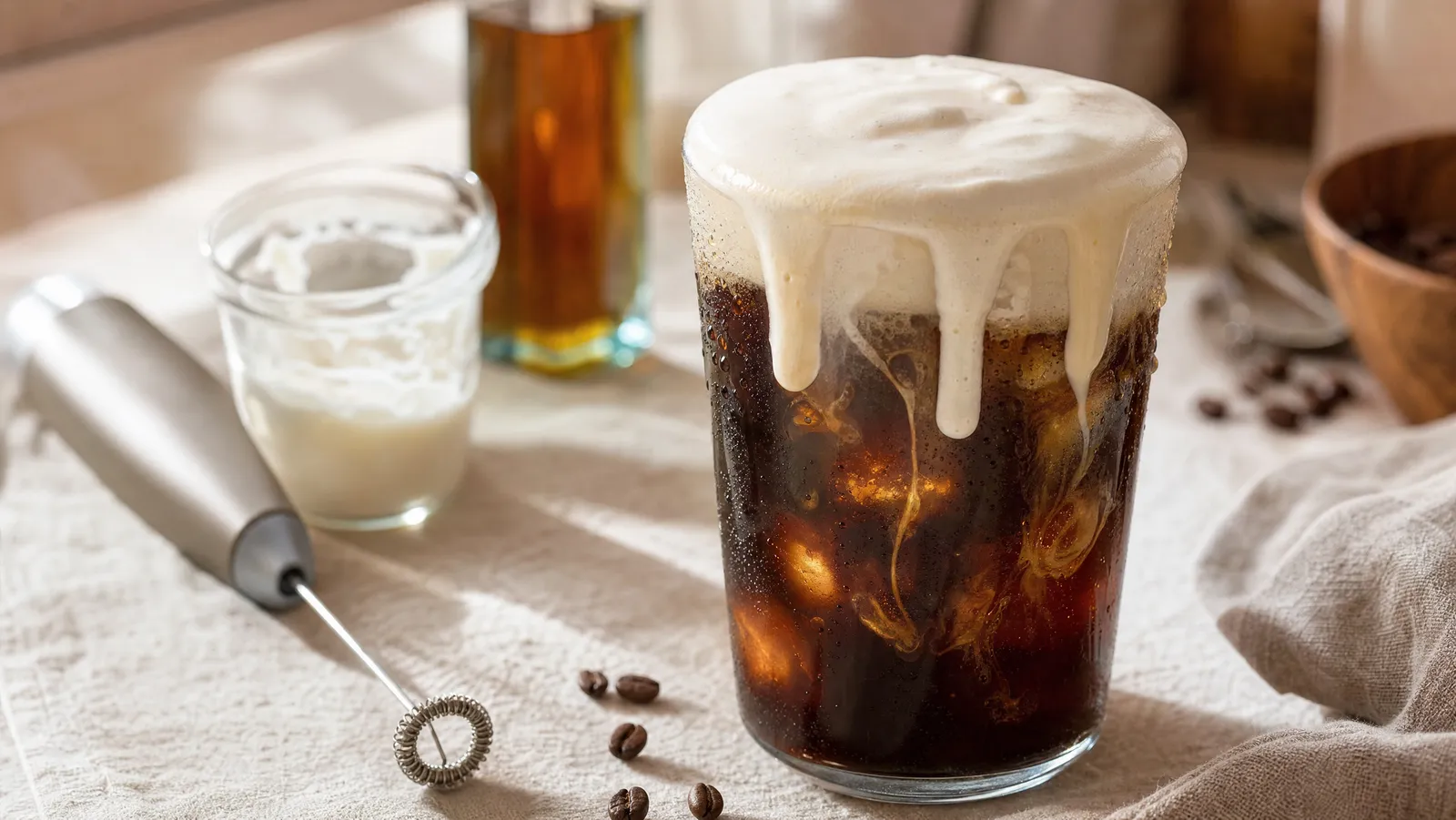
The other option is to put the sugar in the dairy. Sweetened milk, or a sweetened cold foam poured on top, keeps the coffee clean and front-loads the sweetness into the first few sips. Our walkthrough on cold foam at home covers the technique, and syrup is already part of that recipe.
Frequently Asked Questions
Why doesn't sugar dissolve in my iced coffee?
Because cold water dissolves sugar slowly, not because it cannot hold it. Standard chemistry solubility tables put cane sugar at about 179 grams per 100 grams of water at 0°C, far more than you are adding. The American Chemical Society's chemistry curriculum explains why: hotter water means faster-moving molecules and more water-to-sugar contacts pulling crystals apart. In a cold glass that is too slow to finish while you stir.
Can I just use more sugar and stir longer?
More sugar makes it worse, since you are adding crystals to a liquid already dissolving them slowly. Stirring longer helps, but you would be stirring for minutes rather than seconds while melting ice waters the drink down. Dissolve the sugar in a tablespoon of hot water first.
What is the best sweetener for iced coffee if I don't want to make syrup?
Maple syrup, sweetened condensed milk, or a store-bought flavored syrup. All three are already liquid, all three mix in with normal stirring, and none need a stove. Maple reads as maple, condensed milk reads as a dessert drink, and a bottled vanilla or caramel syrup reads closest to a cafe.
Does honey work in iced coffee?
Only if you thin it first. The FAO notes honey's viscosity falls as its temperature rises, which is the flip side of what you see in a cold glass: fridge-temperature honey is thick enough to sink in a clump instead of mixing. Stir it 1:1 with hot water, cool it, and use it like a syrup.
How do I sweeten cold brew without watering it down?
Use a 2:1 rich syrup, so you add half as much liquid for the same sweetness, and sweeten the diluted glass rather than the concentrate. Concentrate is normally cut 1:1, which Stumptown advises for its bottled product and America's Test Kitchen recommends for homemade, so anything sweetened at the concentrate stage ends up half as sweet in the glass.
Do zero-calorie sweeteners taste worse in iced coffee than in hot?
In our experience, yes, because cold black coffee has nothing to mask an aftertaste. Erythritol is the worst offender: reference data notes it crystallizes out of solution easily, and patent research found a 20°C erythritol solution matched to the sweetness of 10% sucrose tasted about as cool as sucrose chilled to 14°C. Allulose syrup or a high-purity liquid monk fruit extract are cleaner choices.
What we'd actually pour
Keep a bottle of 2:1 rich syrup in the fridge door and the problem disappears permanently. Two or three teaspoons into the coffee, stir, then ice. No syrup on hand? Dissolve the sugar in a tablespoon of hot coffee first and carry on.
The principle carries across every cold drink you make: deliver sugar as a liquid, and account for the ice before you taste. For the rest of the drinks that principle covers, start with our pillar on café-style coffee drinks at home.