Best Coffee Machine Cleaners and Descalers in 2026
 Tommie Chaney·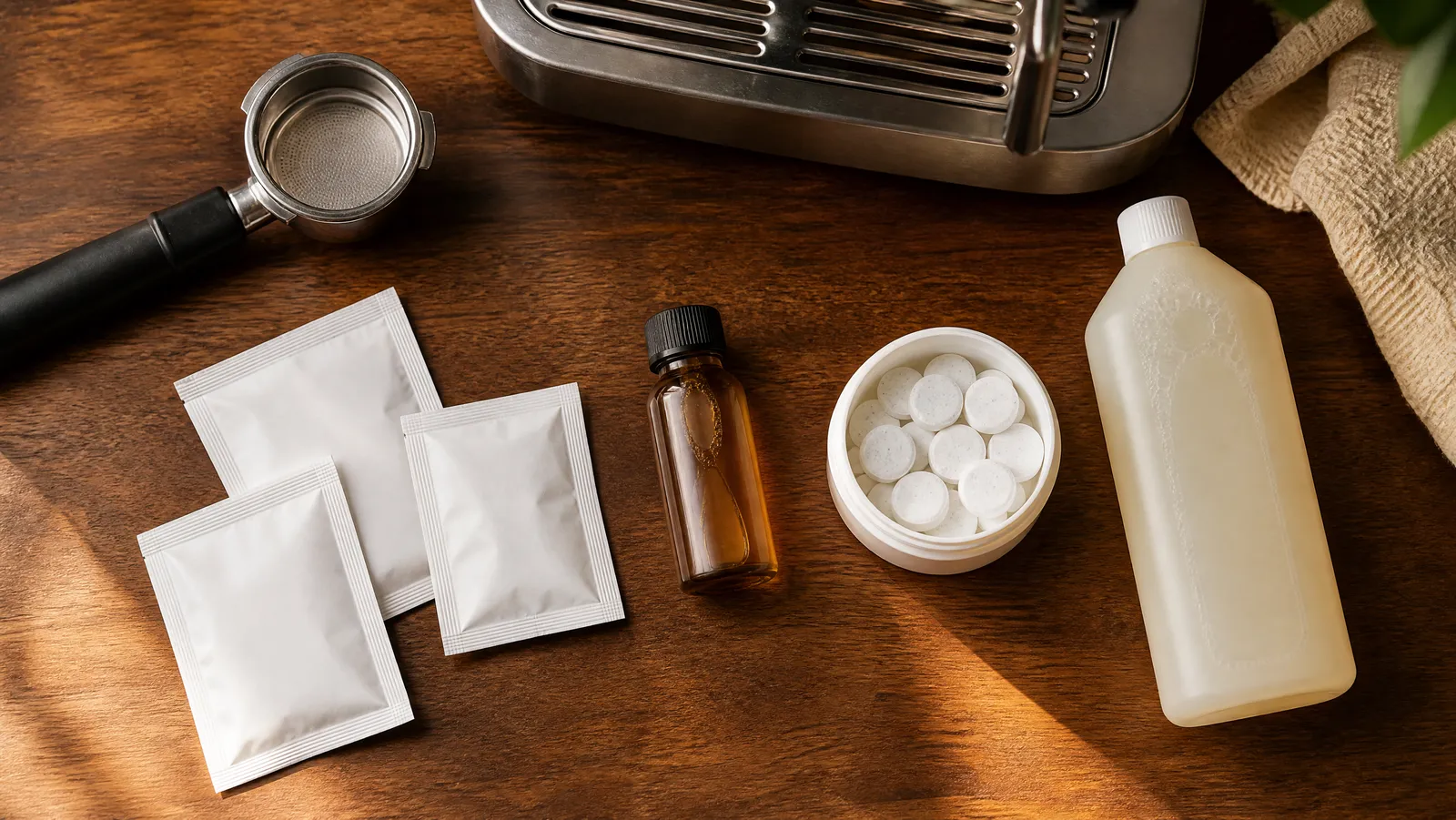
Affiliate disclosure: Sweeter Grind is a participant in the Amazon Services LLC Associates Program. We may earn commissions on qualifying purchases at no extra cost to you.
Nothing in this category is exciting, and the right answer is usually the cheapest thing that matches the job.
There is no single best coffee maker cleaner and descaler, because the two words describe two different chemistries. Scale is a mineral deposit in the water path and needs an acid. Coffee oil is an organic residue in the brew path and needs an alkaline detergent. Most people need two products, not six — and if you want the full procedure rather than the shopping list, start with how to clean and descale coffee equipment.
Descaler vs Detergent: Why You Need Both
A descaler is an acid. Limescale is calcium carbonate, and acids dissolve it in a reaction that yields a calcium salt plus carbon dioxide and water — which is why a descaling tank fizzes. Sulfamic acid produces calcium sulfamate; citric acid produces calcium citrate. One caveat worth carrying: Super-Clean, which sells a sulfamic-acid descaler, states that citric acid can combine with limescale when heated to form hard-to-dissolve calcium citrate deposits — an interested party's claim, but a reason to rinse thoroughly whichever acid you use.
A detergent is the opposite end of the pH scale, and it does nothing to scale at all. The clearest confirmation comes from the manufacturers themselves. Urnex's own product page for Cafiza describes it only as eliminating "coffee residue and oils from espresso machine groupheads, valves and lines" — no descaling claim anywhere. Retailer Whole Latte Love's listing carries Urnex's guidance more bluntly: "This product is not a decalcifier and should not be dissolved in a reservoir or put through a boiler."
That cuts both ways. Acid does not emulsify rancid coffee oil, and detergent does not dissolve rock. Descale a filthy brewer and the coffee still tastes stale; scrub the baskets on a scaled machine and it still runs slow and cool.
One safety rule first: never mix cleaning chemicals. Do not combine a descaler with a detergent, or either with bleach, hoping to do both jobs at once. Run them as separate cycles with a plain-water rinse between, and read your manual before choosing an acid — it is the only document that knows what your boiler is made of.
Our Picks at a Glance
Prices as of August 2026; they change.
| Job | Pick | Price |
|---|---|---|
| Descaling almost anything | Urnex Dezcal (8 packets) | $16.99 |
| Descaling with zero mixing | Durgol Swiss Espresso (4 bottles) | $36.69 |
| Coffee oils in an espresso machine | Urnex Cafiza powder (566 g) | $19.99 |
| Oils and stale grounds in a grinder | Urnex Grindz (430 g) | $19.99 |
| Milk protein in wands and frothers | Urnex Rinza Alkaline (33.6 oz) | $15.00 |
| One drip machine, minimum fuss | Urnex Cleancaf (3 packets) | $9.99 |
Best Overall Descaler: Urnex Dezcal
If you buy one acid, buy this one. Dezcal is a powdered descaler in single-use packets — the two-pack contains eight — and Urnex lists it as usable on Keurig, Nespresso, Breville, Jura and De'Longhi machines as well as generic drip brewers and kettles. That breadth is the point: one box covers the kettle, the drip machine and the espresso machine on the same shelf.
The value case is arithmetic. At $16.99 for eight packets as of August 2026, a descale costs about $2.12 — descale a drip brewer every couple of months and one box is more than a year of maintenance.
The claims on the box deserve a label. Urnex states the formula "is more effective at removing limescale than vinegar, works faster than vinegar, and is odorless." Those are the manufacturer's words, not a tested finding — we have not run these products side by side. The odorless part, at least, is a real quality-of-life improvement over acetic acid.
The honest limitation: it is a powder, so it has to be dissolved properly before it goes in the tank, and single-use sachets are the most expensive way to buy an acid by weight. The procedure — filter out, cycle, rinse twice — is the same whichever acid you use, and it lives in how to descale a coffee maker.
Best Liquid Descaler: Durgol Swiss Espresso
Durgol Swiss Espresso solves one problem: measuring. It arrives as four single-portion 125 ml bottles you pour straight into the tank. Durgol states one bottle dissolves up to 10 g of lime — enough to decalcify one espresso machine once — and that the liquid contains none of the additives found in tablets that could clog a machine.
Durgol also claims the product "works 5–10 times faster than other branded decalcifiers" and that a corrosion-protection formula means it "will not damage your espresso machine when used correctly." Both are manufacturer claims, and we would not repeat either as a finding.
Where Durgol earns its place is with super-automatics, with reservoirs too narrow to stir powder into, and with owners whose manual specifies a liquid. It is the most convenient product in this guide by a wide margin.
The honest limitation: cost. At $36.69 for four bottles as of August 2026, that is roughly $9.17 per descale — more than four times a Dezcal packet for the same job — and the single-portion format gives you no way to dose down for a one-litre tank. Our guide to how often you should descale your coffee maker will tell you how many bottles a year you are signing up for.
Best Espresso Machine Detergent: Urnex Cafiza
This is the alkaline half of the pair, and the product most home espresso owners are missing. Cafiza is a detergent powder for backflushing: a small dose goes in a blind basket, the pump runs, and solution is forced back through the group head and three-way valve, flushing oils that no amount of wiping reaches. Urnex lists it as removing "coffee residue and oils from espresso machine groupheads, valves and lines," recommends it for a daily backflush regimen, and lists NSF certification.
The powder format is the underrated feature: tablets are dosed for a specific group size, while powder lets you use less on a small home machine. Urnex's guidance that Cafiza is not a decalcifier and should not be dissolved in a reservoir or put through a boiler is worth taking seriously — it defines both what this product is for and where it must never go.
The honest limitation: it only makes sense if your machine can backflush, which requires a three-way solenoid valve. Many entry-level and lever machines do not, and for those Cafiza is useful only as a soak for portafilters, baskets and screens. And 566 grams is more powder than most kitchens get through quickly — retailer Whole Latte Love reckons a bag that size lasts a home user more than a year. How to backflush and maintain an espresso machine covers how to check.
Best Grinder Cleaner: Urnex Grindz
The grinder is the piece of gear people clean least and should probably clean most, because stale oil in the burr chamber taints every dose after it. Grindz is a granulate you run through the grinder like beans; Urnex describes it as a food-safe, gluten-free tablet that absorbs and loosens grounds and cleans burrs and casing without disassembly.
That is the whole value proposition. Pulling burrs on some grinders means shims and a recalibration afterwards, and plenty of owners simply never do it; running granulate through takes two minutes. Urnex also positions it as a way to prevent flavour transfer between regular, decaf and flavoured beans.
The honest limitation: Urnex states plainly that it is not for super-automatic espresso machines, so if your grinder is built into a bean-to-cup machine, this is not your product. It is also no substitute for brushing the chute, hopper walls and exit path, where retained grounds also sit — a brush and a vacuum do that for far less. Full method in cleaning a burr grinder; the brush itself is in coffee equipment cleaning supplies you actually need.
Best Milk System Cleaner: Urnex Rinza Alkaline
Milk residue is a third chemistry again — protein and fat, not mineral and not coffee oil. Rinza Alkaline is what most cafés use for it. According to Urnex UK, the alkaline formula "breaks down milk proteins and fats, keeping steam wands, automatic milk frothers, and internal milk lines hygienic and odour-free," is safe for daily use, and is dosed at 30 ml in 500 ml of warm water for a 15–30 minute soak of wands, frother parts and pitchers.
If your machine has an automatic milk circuit — a carafe, a suction hose, internal tubing — this is close to non-negotiable, because no version of "wipe it down" reaches inside a milk line. Urnex claims the dual-chamber bottle delivers over 30 uses, putting a clean under fifty cents at the $15.00 August 2026 price.
The honest limitation: if you use a plain wand and wipe-and-purge after every drink, a cloth and steam already do most of this — Rinza is a periodic deep clean, not a daily requirement. And being alkaline, it does not remove scale from a milk line; Urnex sells a separate acid formula for that. Our guide to cleaning a steam wand and milk system covers the routine either way.
Best Budget Pick: Urnex Cleancaf
Cleancaf is the combined product, and for one kind of buyer it is the correct answer. Urnex describes it as eliminating residual coffee oils and buildup that can turn rancid, and as gently removing lime scale and oil residue in automatic coffee makers — three single-use packets that it calls a three-month supply, listed as safe on Keurig, De'Longhi, Nespresso, Ninja, Hamilton Beach, Mr. Coffee and Braun machines.
If you own one drip brewer or one pod machine, do not want a shelf of chemistry, and would realistically otherwise do nothing, this is the buy. At $9.99 as of August 2026 the barrier to starting is low, and starting matters more than optimising.
The honest limitation: combined products compromise at both ends by design, and a formulation gentle enough to double as a detergent is not the acid you want on a badly scaled espresso boiler. On per-unit value Dezcal beats it — three packets for $9.99 against eight for $16.99. Buy Cleancaf for simplicity, not economy.
What About Vinegar?
Vinegar is a weak acid and it does dissolve scale. It is also hard to rinse out, and several manufacturers advise against it — Super-Clean's descaling guide goes further and says it attacks delicate seals. We cover the full comparison in vinegar vs descaling solution for coffee makers — short version: it works, it smells, and your manual probably says no.
Cheaper: Mix Your Own
Here is the part a buying guide is supposed to leave out. Commercial descaler is, chemically, mostly acid you can buy in a bag. Alliance Chemical's descaling guide gives a baseline of roughly 20 g of citric acid per litre of water for a stainless-steel home machine on medium-hard water, rising to about 25 g/L on hard water and capped near 15 g/L for aluminium boilers.
Do the arithmetic. Food-grade citric acid retails around $5.27 for a one-pound bag at BooKoo Foods as of August 2026 — 454 g, or about 22 doses at 20 g each. That is roughly $0.24 per descale, against $2.12 for a Dezcal packet and $9.17 for a Durgol bottle: about a ninth the cost of the cheapest commercial option here and a fortieth of the most expensive.
For an out-of-warranty machine with a stainless or brass water path, DIY is the rational choice and we will not pretend otherwise. What you give up is the corrosion inhibitors and buffering agents in commercial formulations, and any recourse if something goes wrong. Ratios and caveats are in DIY descaling solution: citric acid vs vinegar.
Match the Product to Your Machine
Check your manual before acting on it.
| Machine | Descaler | Detergent | Also |
|---|---|---|---|
| Drip coffee maker | Yes — Dezcal or Cleancaf | Cleancaf covers it | Wash carafe and basket by hand |
| Pod / capsule (Keurig, Nespresso) | Yes — Dezcal or Cleancaf | Rarely needed | Wipe the needle and drip tray |
| Pump espresso (backflushable) | Yes — Dezcal or Durgol | Yes — Cafiza | Group brush, blind basket |
| Super-automatic with milk system | Yes — Durgol or Dezcal | Machine-specific tablets | Rinza for the milk circuit |
| Electric kettle | Yes — Dezcal | No | Nothing else |
| Burr grinder | No | No | Grindz plus a brush |
Two rules fall out of it: no milk, no milk cleaner; no backflush, no Cafiza.
What You Don't Need to Buy
Machine-branded descaler at a premium — usually. Branded descalers are real formulations, not coloured water. Jura's product information sheet for its 2-phase descaling tablets lists the ingredients as maleic acid and sulfamic acid with sodium bicarbonate and benzotriazole, and calls the formulation "tailored to use in JURA fully automatic coffee machines." Considered, yes. Chemistry unavailable elsewhere, no.
When the branded product does matter: warranty. De'Longhi describes EcoDecalk as the descaler it recommends for all its coffee makers, and Breville sells its own descaler packets while advising owners to consult their model's manual to choose a cleaning solution. If your machine is under warranty and the manual names a product, use that product — the savings are not worth the argument.
"Coffee machine cleaning" sprays and all-purpose gadgets. If a product will not tell you whether it is an acid or a detergent, it is not solving a defined problem.
A milk cleaner if you never steam milk. Obvious, and still a common purchase.
Frequently Asked Questions
Can I use one product for everything?
Only partly. A combined cleaner-descaler like Cleancaf handles a home drip brewer adequately, because a drip machine's oil problem is mild. An espresso machine needs two — an acid for the boiler, an alkaline detergent for the group — because Urnex's own guidance is that Cafiza is not a decalcifier and must not go through a boiler.
What's the best descaling solution for a coffee machine that's under warranty?
Whatever your manual names. De'Longhi presents EcoDecalk as the descaler it recommends for all its coffee makers, and Jura publishes a formulation it describes as tailored to its own machines. If the manual is silent, a general-purpose descaler for coffee makers like Dezcal or Durgol is the conventional choice — but the manual outranks any buying guide, this one included.
Is a descaler safe for rubber seals?
Acid type matters, and the published claims conflict. Super-Clean, which sells a sulfamic-acid descaler, describes sulfamic acid as gentle on materials and states it "does not attack rubber seals or plastic parts". Other sources make the opposite argument for citric acid — that being the weaker acid, it is the safer one around seals. We would not pick a winner from marketing copy. What is less contested is concentration and contact time: Alliance Chemical's guide warns that aluminium boilers pit at citric acid concentrations over 15 g/L. The takeaway: check what your manual says your water path is made of, and do not leave any descaling solution standing in a machine longer than the instructions specify.
How long will one box or bottle actually last?
At August 2026 prices: Dezcal gives eight descales for $16.99, Durgol four for $36.69, Cleancaf three for $9.99, and Urnex claims over 30 uses per Rinza bottle. How fast you get through them depends on your water hardness — see how often you should descale your coffee maker.
Can I mix descaler and detergent together to save a cycle?
No. Never mix cleaning chemicals. Beyond the safety issue, an acid and an alkali neutralise each other — you would end up with a solution that does neither job. Run them as separate cycles with a plain-water rinse between.
Do I need anything besides chemicals?
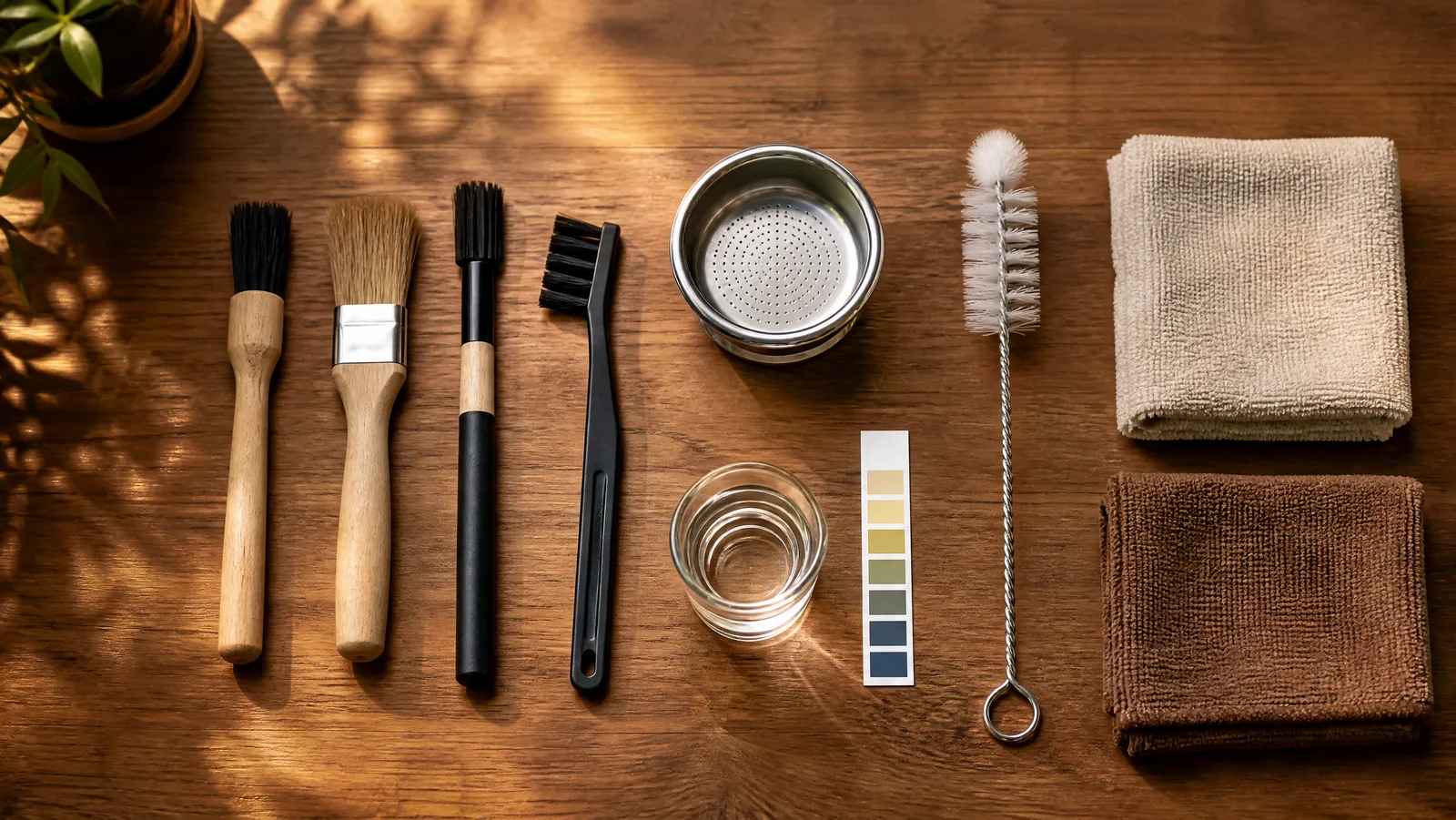
Usually yes: a group brush, a blind basket for backflushing, a bottle brush for reservoirs, and hardness test strips so you know your interval. Those are tools, not chemistry — see coffee equipment cleaning supplies you actually need.
The Two-Product Answer
If you buy two things, buy an acid for the water path and an alkaline cleaner for whatever your machine puts coffee or milk through. For most kitchens that means Dezcal plus Cafiza (espresso), or Cleancaf on its own (drip). Everything else here is a specialist tool for a specific machine, and the cheapest correct product beats the most expensive one every time. For the schedules and procedures, see Sweeter Grind's complete cleaning guide.
Related reading
- How to Descale a Coffee Maker — the procedure, step by step
- Vinegar vs Descaling Solution for Coffee Makers — is the pantry option good enough
- DIY Descaling Solution: Citric Acid vs Vinegar — ratios and costs
- Coffee Equipment Cleaning Supplies You Actually Need — brushes, baskets, test strips
- How Often Should You Descale Your Coffee Maker? — water hardness sets your interval

Urnex Dezcal Descaler (2-Pack, 8 Packets)
A powdered descaler sold in single-use packets, one packet per machine per descale. Urnex lists it as compatible with drip brewers, pod machines, espresso machines, super-automatics and kettles. This is the default buy if you want one acid that covers a mixed-equipment kitchen.

Durgol Swiss Espresso Descaler (4 x 4.2 fl oz)
A ready-to-use liquid descaler in single-portion 125 ml bottles, aimed at espresso machines and super-automatics. Durgol states that one bottle dissolves up to 10 g of lime, which it describes as enough to descale one espresso machine once. Worth it if your manual specifies a liquid descaler or your tank is awkward to mix powder in.

Urnex Cafiza Espresso Machine Cleaning Powder (566 g)
An alkaline detergent powder for backflushing pump espresso machines and soaking portafilters, baskets and shower screens. It dissolves coffee oils; it is explicitly not a descaler. Buy it if you own a machine with a three-way solenoid valve you can backflush.
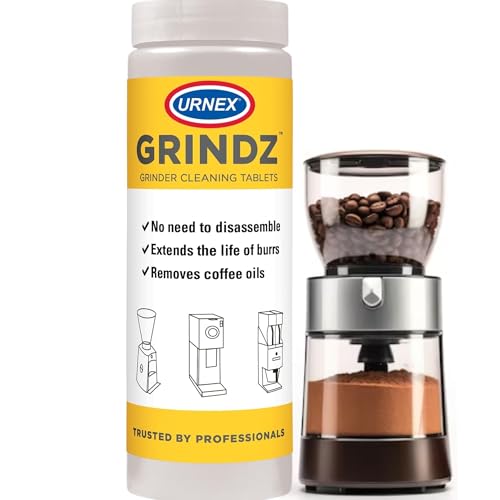
Urnex Grindz Coffee Grinder Cleaning Tablets (430 g)
Food-safe cleaning granules you run through a burr grinder as if they were beans, to absorb oils and dislodge stale grounds. Urnex states they clean burrs and casing without disassembly. Buy them if your grinder is a chore to strip down, or if you rotate between regular, decaf and flavored beans.
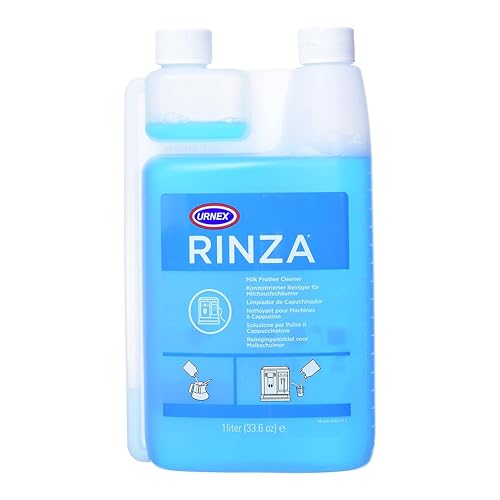
Urnex Rinza Alkaline Milk Frother Cleaner (33.6 oz)
A liquid alkaline cleaner for milk systems — steam wands, pitchers, and the internal lines of automatic frothers. Urnex states the alkaline formula breaks down milk proteins and fats. Only buy it if you actually steam milk, and treat it as close to essential if your machine has a sealed milk circuit you cannot reach with a cloth.

Urnex Cleancaf Coffee Maker Cleaner (3 Packets)
A combined cleaner-and-descaler powder in three single-use packets, aimed at home drip brewers and pod machines. Urnex describes it as removing both residual coffee oils and lime scale in one pass. The right buy for someone with one drip machine who wants to do this a few times a year and stop thinking about it.