Coffee Equipment Cleaning Supplies You Actually Need
 Tommie Chaney·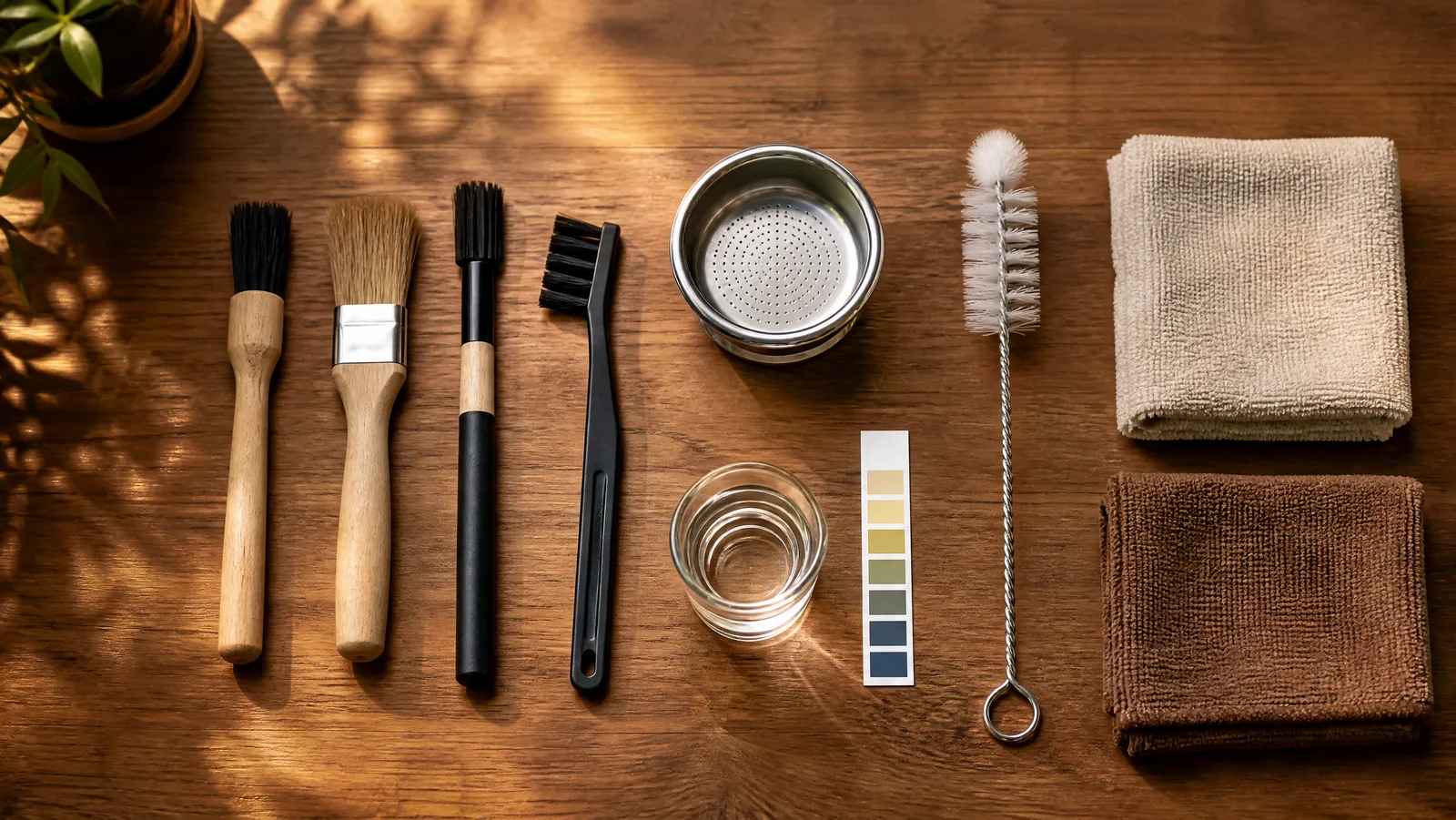
Affiliate disclosure: Sweeter Grind is a participant in the Amazon Services LLC Associates Program. We may earn commissions on qualifying purchases at no extra cost to you.
The complete list of coffee equipment cleaning supplies is four tools and two chemicals. Not a drawer of gadgets. The four tools — a brush set, a blind basket, water hardness strips and a bottle brush set — cost $41.34 as of August 2026, and unlike the chemicals, you buy them once.
Everything else being sold to you is merchandising.
The tools that do real work in this category are cheap, dull, and mostly not coffee-branded. The expensive-looking bundles are usually one useful brush wrapped around a tamper you will replace. This article is the hardware half of cleaning and descaling coffee equipment — what to buy, what each item does, and what will waste your money.
The Whole Kit, in One Table
| Tool | What it's for | Price (Aug 2026) |
|---|---|---|
| 5-piece espresso and grinder brush set | Grinder chamber, group head, spouts, steam wand | $10.99 |
| 58 mm blind basket (2-pack) | Backflushing a machine with a three-way valve | $12.38 |
| Water hardness test strips | Setting your descaling interval | $9.99 |
| 5-piece bottle and carafe brush set | Reservoirs, carafes, cold brew vessels, kettle spouts | $7.98 |
| Total | $41.34 |
Prices are as of August 2026 and move constantly — treat them as a scale, not a quote. Two of the four are optional depending on your setup, which we'll be specific about below.
The consumables are a separate purchase and a separate decision. For which descaler, backflush detergent, grinder tablets and milk-line cleaner to buy, see our guide to the best coffee machine cleaners and descalers.
Tools vs Chemicals: Two Different Shopping Lists
Tools are durable goods. A stainless blind basket has nothing to wear out, a nylon brush lasts years, and test strips get used a handful of times a year. You buy this list once and you're done.
Chemicals are the opposite: consumable, machine-specific, and frequently governed by warranty conditions. Descaler is an acid aimed at limescale. Backflush detergent is an alkaline powder aimed at coffee oils. Grinder tablets are a dry food-safe media. Milk-line cleaner is its own thing again. They are not interchangeable, and you should never mix cleaning chemicals — use one product at a time, at the concentration its label specifies, and rinse between them.
That division is why this article stops at hardware. Everything below is a delivery mechanism; the chemistry that does the dissolving is the cleaners and descalers guide's job.
The Brush Set: The Coffee Grinder Cleaning Brush Everyone Skips
Brushing is the highest-leverage cleaning you do, because it's the only step that happens often enough to matter. Every other job on the calendar is monthly or quarterly. Brushing is daily, takes forty seconds, and clears the oils before they oxidize into the stale, papery flavor no descaling will fix.
You need two bristle types for two jobs. A soft, dry brush works the grinder — burr chamber, carrier, and especially the chute, where damp grounds pack into a plug. Baratza's grinder cleaning guidance tells owners to clean inside the burr chamber and chute, and to "use the handle of your cleaning brush, or a small, stiff item like an unfolded paperclip to push packed coffee out of the chute." Note where the water appears in that same routine: only at the removable parts — "wash hopper and grounds bin with warm soapy water and dry thoroughly." Baratza's steps have you brush inside the burr chamber and chute rather than wash them. Keep the grinder brush permanently dry, stored away from the sink.
The machine side wants stiffer nylon. The CAFEMASY 5-piece set covers both, with a wooden-handled soft brush for the grinder plus angled nylon brushes for the group head, portafilter spouts and steam wand. The long handle exists for one reason worth understanding: the manufacturer describes it as keeping hands away from hot water while cleaning or backflushing, which is precisely when a stubby toothbrush gets you scalded.
Buy on shape, not bristle material — one genuinely narrow brush for spouts and wand tips, and a grinder brush with a handle you can grip with a dust-covered hand. The honest limitation: five brushes means five things to lose, and bristles don't solve a fully compacted chute. For the full grinder routine, see how to clean a burr grinder.
The Blind Basket: Measure Your Portafilter Before You Buy
A blind basket is a solid stainless disc with no holes. Dropped into your portafilter, it blocks the water's normal exit, forcing it backwards through the shower screen and out the machine's three-way valve, carrying coffee oils with it. It's the most effective piece of espresso maintenance there is — and the item here most likely to be bought in the wrong size, or for the wrong machine entirely.
Two checks before you order. First, the valve. According to Seattle Coffee Gear, backflushing only applies to machines with a three-way solenoid valve — the system that relieves brew pressure after the shot — and their guidance is blunt: "You don't backflush if your machine doesn't have this system — because you don't have the valves to clean!" They list Saeco, Breville, DeLonghi and Capresso models among the machines that instead need the brew head taken apart regularly. Blocking the water's exit on a machine with nowhere to vent it isn't a maintenance step; it's a pressure test you didn't intend to run. Our guide to backflushing and maintaining an espresso machine walks through the listen-for-the-hiss test, and your manual is the final authority.
Second, the diameter. 58 mm is the common prosumer size, but not the only one. Breville publishes a 54 mm stainless steel portafilter in the Barista Express specification, and that 54 mm platform runs across the Bambino and Barista line. De'Longhi's Dedica line sits on a smaller platform again: De'Longhi's own calibrated tamper accessory (DLSC058) has a 51 mm base and is listed as suitable for the Dedica and its other manual machines. If yours isn't one of those families, measure the basket seat before you spend anything.
If both checks pass, the HNF 58 mm blind basket 2-pack is food-grade 304 stainless and comes two to a pack, which is useful because these are small, round and easy to lose behind a counter. Seattle Coffee Gear suggests backflushing every one to two weeks depending on use, so it earns its place fast once it applies to you.
Water Hardness Strips: The Cheapest Tool, and the Only One That Changes Behavior
Everything else in this kit does a job. This one answers a question, and the answer rewrites your maintenance calendar.
"Descale every three months" is a guess dressed as advice. Scale accumulates in proportion to the calcium and magnesium in your water, so the right interval in a soft-water city and a hard-water suburb differ by months. According to the USGS, water measuring 0 to 60 mg/L is soft, 61 to 120 mg/L moderately hard, 121 to 180 mg/L hard, and above 180 mg/L very hard. American kits often report in grains per gallon instead; per Culligan, you convert ppm or mg/L to gpg by dividing by 17.1, which puts the USGS "hard" threshold at roughly 7 gpg.
The Varify water hardness test kit is a multi-pack of dip-and-read strips with a color chart the maker lists as covering 0–25 GPG and 0–425 PPM — both scales, which saves you the arithmetic. Dip, wait, compare. Then set your interval to your reading rather than to a generic number, using our breakdown of how often you should descale your coffee maker.
Be clear-eyed about what it is: a general household kit sold for pools, wells and softeners, whose own listing is inconsistent about how many strips are in the box. Neither affects the reading you need. Hardness is also only half the water story — minerals change how your coffee tastes, not just how your boiler ages, which is the subject of why water quality matters for coffee.
The Bottle Brush Set: Reservoirs, Carafes and Kettle Spouts
The forgotten reservoir is where most home coffee gear actually gets grim. It holds standing water at room temperature in the dark, and a sponge on a hand reaches roughly the top third of it. Same problem with a thermal carafe, a cold brew jug, and the inside of a gooseneck spout.
The HIWARE 5-piece bottle brush set solves it with reach rather than cleverness: a 16-inch long-handled brush, a 13.5-inch bottle brush, two 0.5-inch tube brushes and a 1-inch spout brush, all food-grade polypropylene. The long handle gets to the bottom of a carafe; the narrow tubes get into spouts and lid channels.
This is not a coffee product, and we should be straightforward about that. It is a generic kitchen brush set that happens to be the right geometry for coffee vessels, which is why it costs $7.98 as of August 2026 rather than triple that with a bean logo on the handle. Buy on dimensions, not branding — and keep these strictly on the wet side of your kit. For the technique that goes with them, see cleaning manual brewers: French press, AeroPress and pour over.
Two Things You Own Already
Two microfiber cloths, permanently separated. One for milk, one for everything else, and they never trade jobs. This is the highest-value habit in this article and it costs nothing. The milk cloth picks up protein and fat residue that goes sour within hours at room temperature; wiping a group head or a bean hopper with it moves that residue onto surfaces that then sit warm all day. Color-code them, wash the milk cloth hot and often, and hang it to dry. Breville's steam wand routine is to purge, then "wipe steam wand after each use" — which only works if the cloth is clean.
A pin or an unfolded paperclip. Breville's instruction book directs owners to "clean hole with pin" on the steam tip, and states plainly that "a pin can be used to clear the filter basket holes" when the fine holes block. Baratza names the same tool for a packed grinder chute, and pod machines have puncture needles that clog the same way. Keep one in the drawer with the brushes; it does a job no bristle can.
What You Don't Need to Buy
- All-in-one "espresso machine cleaning kit" bundles. The usual format is one decent brush, a blind basket, a cloth and a lightweight tamper — and the tamper is why the box exists. If you already own a tamper you like, you are paying for a spare you will never fit. Buy the brush set and the basket separately. Our take on which espresso tools earn their place is in espresso accessories you actually need.
- Branded cleaning cloths. A microfiber cloth is a microfiber cloth. Buy a multipack in two colors from the cleaning aisle.
- A blind basket for a machine with no three-way valve. Worth repeating, because it is the expensive mistake here — per Seattle Coffee Gear, machines without that valve are not backflushed at all.
- Milk-line cleaner if you never steam milk. Buy it the week you start making cappuccinos, not before.
- Anything bought on the assumption it's dishwasher safe. Breville's instruction book carries the flat note "Do not clean any of the parts or accessories in the dishwasher," then a page later specifies that the drip tray base and cover are dishwasher safe. The lesson isn't that Breville is careless; it's that "dishwasher safe" is a per-part claim, and the default for portafilters, baskets and gaskets is hand washing. Check your own manual.
- Single-use descaling sachets, usually. Sometimes the right call for a pod machine with a fixed dose. But compare cost per descale, not cost per box: divide the price by the number of descales each product actually delivers, and bulk concentrate often comes out cheaper per descale. Do that arithmetic at today's prices before subscribing to anything.
Storing the Kit
Keep it within arm's reach of the machine. Supplies stored under the sink in another room get used at a fraction of the rate of supplies sitting in a mug beside the grinder, and that gap is the entire reason maintenance schedules collapse.
Three rules make it work. Keep the grinder brush dry and separate from the wet brushes. Keep the milk cloth physically apart from the general cloth — different color, different hook. And hang bottle brushes bristle-down to drain rather than dropping them into a drawer damp; the HIWARE set includes a hanging hook on the handle for exactly that.
Frequently Asked Questions
What do I need to buy to clean a coffee maker?
For a drip brewer or pod machine: a bottle brush set for the reservoir and carafe, hardness strips to set your descaling interval, a clean cloth, and a descaler. That's around $18 in tools as of August 2026, plus the chemical. The brush set and blind basket here are espresso and grinder items; skip them if you own neither.
Do I need a blind basket for my espresso machine?
Only if your machine has a three-way solenoid valve. Seattle Coffee Gear's guidance is that machines without one aren't backflushed at all and instead need the brew head disassembled regularly. Listen after a shot: a brief hiss and a small squirt of water into the drip tray indicates the valve is there. Confirm in your manual before buying.
What size blind basket do I need?
Measure, don't assume. 58 mm is the most common prosumer size, but Breville specifies a 54 mm portafilter on the Barista Express and runs that platform across its Bambino and Barista machines, while De'Longhi lists a 51 mm base on the calibrated tamper it sells for the Dedica line. A 58 mm basket in a 54 mm portafilter simply won't seat.
Can I put coffee machine parts in the dishwasher?
Check the manual for that specific part. Breville's instruction book states "Do not clean any of the parts or accessories in the dishwasher," while separately noting the drip tray base and cover are dishwasher safe — so the answer varies part by part even within one machine. Hand washing in warm soapy water with a non-abrasive detergent is the safe default for portafilters, baskets and anything with a gasket.
Can I use a regular kitchen brush on my grinder?
Physically yes — what matters is that it's dry and dedicated. Baratza's cleaning guidance keeps water on the removable hopper and grounds bin, dried thoroughly, and has you brush the burr chamber and chute rather than wash them. Whatever brush you use should never have been wet, and should never be the brush you also use on a steam wand.
How do I know how hard my water is without test strips?
Your municipal supplier publishes an annual water quality report that usually includes hardness, free. Strips are still worth $9.99 as of August 2026 for two reasons: the report is a system-wide average rather than a reading at your tap, and it tells you nothing if you're on a well or running a filter or softener.
The Two-Item Version
If you buy nothing else, buy the brush set and the test strips — under $21 as of August 2026, covering the job you should do daily and the measurement that governs everything you do quarterly. The blind basket is conditional on your machine having a three-way valve and the right portafilter diameter. The bottle brushes are the cheapest way to fix the dirtiest part of a drip machine.
Then stop buying tools and start buying the right chemicals on a schedule your water dictates. For the full picture — intervals, chemistry, and machine-by-machine routines — read Sweeter Grind's complete coffee equipment cleaning guide.
Related reading
- How to Clean a Burr Grinder — the dry-clean routine, cleaning tablets, and why the burrs stay dry.
- Best Coffee Machine Cleaners and Descalers — the consumables half of the kit: descaler, detergent, grinder tablets, milk-line cleaner.
- How to Backflush and Maintain an Espresso Machine — the three-way valve test and the full backflush procedure.
- How Often Should You Descale Your Coffee Maker? — turning a hardness reading into a real interval.
- How to Clean Manual Brewers: French Press, AeroPress and Pour Over — where the bottle brushes earn their keep.

CAFEMASY 5-Piece Espresso and Grinder Cleaning Brush Set
A five-brush set covering the four surfaces that need brushing daily: the grinder chamber and chute, the group head and shower screen, the portafilter spouts, and the steam wand. The manufacturer lists a wooden-handled soft brush for the grinder and nylon-bristled brushes for the machine side. If you buy one thing on this page, buy this.

HNF 58 mm Blind Basket (2-Pack)
A solid, hole-free 58 mm basket in food-grade 304 stainless that drops into a 58 mm portafilter and blocks the water's normal exit, so a backflush pushes it back through the group and out the three-way valve. Buy it only if your machine has that valve and your portafilter is genuinely 58 mm.

Varify Water Hardness Test Kit (150 Strips)
A multi-pack of dip-and-read total hardness strips with a color chart the maker lists as covering 0–25 GPG and 0–425 PPM. It answers the one question that sets your entire descaling calendar: how much calcium and magnesium is actually in your tap water. Cheapest item here and the only one that changes what you do.
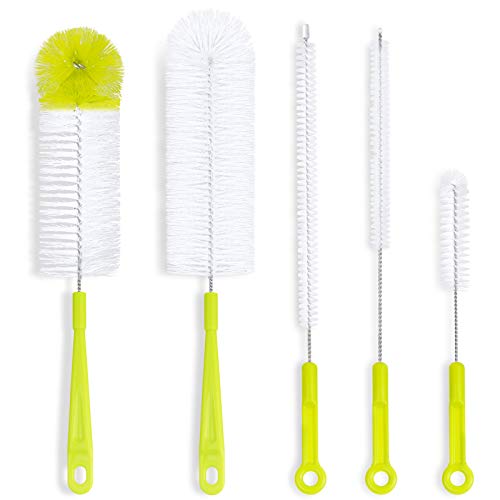
HIWARE Bottle and Carafe Cleaning Brush Set (5-Piece)
Five food-grade polypropylene brushes — a 16-inch long handle, a 13.5-inch bottle brush, two narrow 0.5-inch tube brushes and a 1-inch spout brush — sized for the tall, narrow vessels a sponge cannot reach. Water reservoirs, thermal carafes, cold brew jugs and kettle spouts.